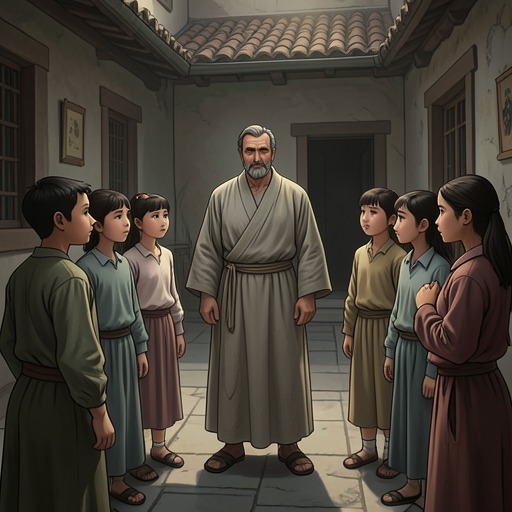
Confucius' disciples
AnalectsConfucius’ disciples form a varied community whose members learn not only through instruction but through questioning, service, disagreement, and mutual example. The text names them in differentiated roles—from companions who followed Confucius in Chen and Cai to students known for virtue, speech, government, and letters—and presents their education as a movement from personal cultivation toward responsible conduct in family and public life.
Identity and Range of Ability
The disciples are not treated as an undifferentiated body. Recalling those who had accompanied him in Chen and Cai, Confucius names Yan Hui, Min Ziqian, Ran Boniu, and Zhonggong for their conduct; Zai Yu and Zigong for speech; Ran You and Zilu for political affairs; and Ziyou and Zixia for literary learning. The classification makes room for distinct strengths rather than measuring every student against a single model. Their common membership in the school does not erase differences in aptitude or vocation.
The dialogue about the rites of passage into government makes that diversity visible in practice. Zilu proposes governing a large state pressed between stronger powers, threatened by military attack and famine; within three years, he says, he could give its people courage and a sense of direction. Confucius smiles at the answer. Ran You instead offers to administer a smaller territory and make its people prosperous, leaving ritual and music to a more qualified gentleman. Gongxi Hua says he wishes to learn, offering to serve as a junior assistant at ancestral rites or diplomatic gatherings. These answers are not interchangeable ambitions: they distinguish military and administrative responsibility from economic management and ritual service.
Learning Through Dialogue and Correction
Confucius’ teaching takes the form of exchange, and the students’ questions draw out practical instructions. Yan Hui asks what perfect virtue entails. Confucius answers with a discipline governing four kinds of action: seeing, listening, speaking, and moving must each be brought under propriety. Yan Hui responds that, despite his limited ability, he will make the teaching his practice. The scene defines learning not as agreement alone but as an undertaking to regulate one’s conduct.
The exchange about the rectification of names shows that a disciple can challenge the teacher’s priorities—and be corrected in turn. Zilu asks what Confucius would address first if the ruler of Wei invited him to administer government. Confucius answers that names must be rectified. Zilu calls this remote from immediate concerns; Confucius rebukes his presumption in speaking about what he does not understand. He then traces the political consequences: when names are incorrect, speech does not correspond to things; when speech fails, affairs cannot be completed; ritual and music consequently decline, punishments become improper, and the people are left unsure how to act. The lesson makes political responsibility depend on the fit between titles, words, and actual conduct.
The school’s instruction also reaches beyond the teacher’s immediate exchanges. Chen Kang asks Boyu whether he has heard anything unusual from his father. Boyu recounts two occasions when Confucius, standing alone, asked whether he had studied the Book of Poetry and the rites. He had not; Confucius told him that without the Poetry there was no way to speak, and without the rites no way to establish oneself. Chen Kang leaves pleased, having learned both about these teachings and that Confucius keeps his son at a distance rather than granting him special instruction. The episode presents the school’s central curriculum as learning with public and ethical consequences, not private privilege.
Family Ethics and Propriety
The disciples’ education is grounded in relationships at home as well as in formal study. The philosopher Yu argues that filial and fraternal conduct is a root of benevolence: those who honor family relations are seldom inclined to defy their superiors, while an aversion to such defiance is incompatible with a taste for rebellion. The argument makes the household a foundation for social order, though the text also gives family obligations a more intimate and difficult form.
Confucius advises that a child may remonstrate gently with parents, but if they will not accept the advice the child should increase reverence without abandoning the attempt; even punishment should not provoke resentment. He also says that parents’ presence should restrain distant travel, and that a child who travels must have a definite destination. These teachings give filial conduct specific circumstances and limits: respect does not mean silence, and persistence in counsel must coexist with reverence.
Propriety is not simply formal compliance. The philosopher Yu says that ease and harmony are prized in the practice of ritual, but harmony cannot be pursued without the discipline of ritual itself. In this account, good relations require both a humane quality of interaction and forms capable of regulating it. Confucius’ teaching to Yan Hui similarly turns propriety into a daily discipline of perception, speech, and movement.
Public Service and Accountability
The disciples’ different capacities lead toward public obligations, where learning is tested by its effects. In the account of Ji clan’s planned attack on Zhuanyu, Ran You and Zilu meet Confucius and report their chief’s intention, while Ran You maintains that neither of the two ministers wants the attack. Confucius challenges Ran You’s disclaimer: officials who hold a position must either carry out its responsibilities or withdraw, and those who fail to support what is in danger or steady what is falling have no justification for their office. He compares the ministers’ failure to restrain their chief to a keeper’s failure when a caged animal escapes or a stored treasure is damaged.
Ran You then argues that Zhuanyu is fortified and near Bi, making it a future danger if not taken now. Confucius rejects this as an excuse for aggression. A ruler, he says, should be troubled by unequal distribution and insecurity rather than merely by small numbers or poverty; with fairness there is no impoverishment, with harmony no lack of people, and with security no danger of overthrow. If distant people remain unpersuaded, the proper response is to cultivate civil and moral influence and then make those who come feel secure. Since Ran You and Zilu cannot attract the distant or preserve unity at home, planning armed action within the state compounds their failure. Confucius warns that the Ji clan’s real danger lies within its own walls, not at Zhuanyu. The episode makes public service a test of whether a disciple will accept responsibility for policy rather than hide behind a superior’s wishes.
A further maxim states the same principle at the level of government: when a ruler’s own conduct is correct, affairs proceed without orders; when it is not, commands go unheeded. Elsewhere Confucius describes the superior man’s progress as upward and the mean man’s as downward, and distinguishes learning undertaken for one’s own improvement from learning pursued for others’ approval. Together these teachings place a disciple’s advancement not in office or reputation alone but in the integrity and direction of personal practice.
A Community Without a Single Measure
The disciples’ shared formation is presented through differentiated instruction and repeated moral standards. Confucius’ nine reflections encompass clear sight and hearing, a warm countenance, respectful bearing, sincere speech, careful work, questioning when in doubt, anticipating the difficulties anger may cause, and considering righteousness when gain appears. The list connects inner judgment with outward behavior and practical decision-making; it offers no exemption for the gifted student or the aspiring official.
The school’s ideals also appear in the contrast between wealth and remembered virtue. The Duke Jing of Qi possessed a thousand teams of four horses, yet the people praised no virtue of his after his death; Boyi and Shuqi, who died of hunger at the foot of Mount Shouyang, were still praised. The contrast measures reputation by moral example rather than possession. In the disciples’ world, then, education is more than the acquisition of useful accomplishments: it is the making of people whose conduct can sustain relationships, give public responsibility moral substance, and outlast material power.