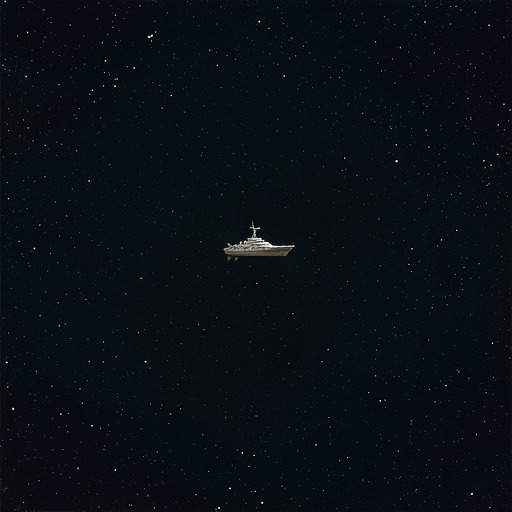
Ghazilnut
AniaraGhazilnut is a four-galactave lobule of the galaxy and a recurring region in which Aniara drifts. Its measured dimensions offer a local scale for the voyage, but that scale cannot explain the ship’s disappearance into the abyss or shield its passengers from the immensity surrounding them.
Definition and Scale
The account identifies Ghazilnut as a smaller lobule, consisting of four galactaves. Each galactave is fifteen light-years wide, so the stated dimensions give the lobule a width of sixty light-years. The passage also invokes an astronomical measure of eight hundred thousand galactaves, but immediately questions what measurements can explain. The contrast is not simply between a small and a large number: even an immense figure fails to make Aniara’s situation intelligible.
Ghazilnut is described as a region that may be bridgeable or may recede into a frame no larger than life needs. The alternatives make its apparent scale contingent on perspective. For the voyagers, it can be a bounded unit of travel; against the surrounding abyss, boundaries and distances lose their power to orient them.
Ghazilnut in Aniara’s Voyage
The ship’s passage through Ghazilnut is presented as a recurrence rather than a dramatic arrival. The narrator describes the drift as workaday and says the ship lies in Ghazilnut as it had before. That matter-of-fact return gives the region a place in the voyage’s routine, while the larger context steadily undercuts any reassurance that routine might provide.
The spatial account culminates in Aniara being swallowed by the abyss. At that point, measurements have been named but cannot serve as an explanation for what is happening to the ship. Ghazilnut remains a comprehensible local designation; Aniara’s engulfment in the void exceeds what that designation can make comprehensible.
Cosmic and Human Significance
Much later, the passengers’ dreams acknowledge their lowly rank in Lobule Ghazilnut. This recognition comes amid the perpetual enigmas of star-strewn galaxies without end: the lobule is not the ultimate horizon, but only one small region within a boundless cosmic field. The earlier contrast between navigable measurement and the abyss thus returns as a change in human scale. Even the passengers’ familiar galactic setting becomes a minor frame beneath the endless stars.
The change is accompanied by a darkening among many souls. They roam the halls with reality blown apart, after thought has broken down and fantasy has died out. Ghazilnut does not cause this collapse in the evidence; rather, its place within the endless galaxies gives the passengers a measure of their smallness as their capacity to imagine or interpret reality fails.
A glossary note connects the name’s second element, Nut, with the Egyptian sky-goddess, while stating that Ghazil has not been identified. The note offers no definitive origin for the whole name. That uncertainty suits the location’s role in the narrative: it can be charted in galactaves, yet its name and its place in a limitless cosmos do not resolve the larger mystery of the voyagers’ condition.