Mars
AniaraMars, known in the poem as the tundra globe, is presented as a destination for refugees from a radiation-damaged Earth and as a place where the promise of refuge gives way to labor, cold, and confinement. Its role shifts from a checkbox on an evacuation form to a distant world of barracks-hospitals, mines, and surveilled enclosures; the movement toward it exposes how bureaucratic rescue can become another machinery of dispossession.
The Planned Refuge
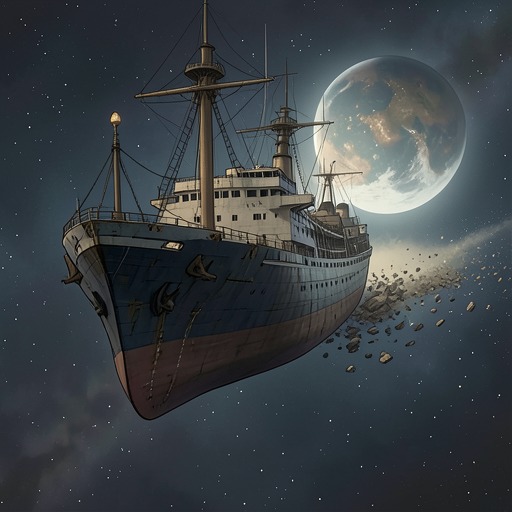
The initial plan sends refugees to labor camps on Mars or Venus until Earth can be detoxified. This is described as an established arrangement, not a new experiment, and its administrative normality sits uneasily beside the scale of the catastrophe that produced it. The refugees are not promised a new home so much as temporary placement and work while their planet is made habitable again. Yet the planned journey is already shadowed by failure: the Aniara is knocked off course, its steering mechanism irreparably damaged, and its passengers will never reach the camps. Mars remains a destination in the evacuation scheme, but for those aboard the ship it becomes an unreachable one.
The registration scene makes that scheme concrete. A woman fills in cards in the dim concourse, her five small nails glinting like lamps, and directs people to sign their names and state what they have in mind. The form asks which part of Mars they would prefer, specifying the tundra to the east or west. The detail of a preferred region gives the appearance of personal choice within a system that has already determined the refugees’ broad fate: departure from Earth and placement elsewhere. An accompanying provision for a jar of uncontaminated soil makes the transfer feel at once practical and intimate. People are asked to choose a destination and carry a small remnant of clean ground, while the larger question of whether they will ever return remains outside their control.
Routes, Sorting, and Duration
Mars is not a single undifferentiated endpoint. The poem distinguishes Tundra Two and Tundra Three, and a later account gives the transfer to Tundra Three a duration of nine years. The evacuation of Gond takes ten. These long spans turn relocation into an extended process rather than a brief passage between planets: movement itself consumes years, while the named destinations register how thoroughly migration has been organized and divided.
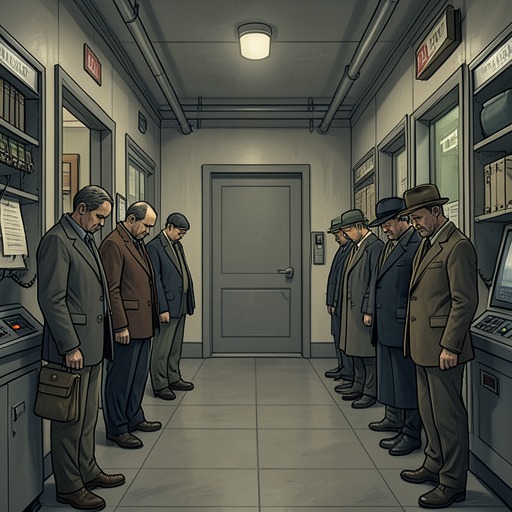
The account of processing shows how that division works. Fast talk is used to settle disquiet while punch-cards are matched with souls identified by prior testing. The matches are entered into microrolls that record each loss and win. Those selected for the tundra kingdom are lifted into the cosmic field and sent there to be steeled; others are routed to Venus’s marshy shore. The formal language of testing and recording converts people into sortable cases. The brief reassurance offered during processing does not alter the fact that their destinations have been assigned through a system whose records track outcomes as if human lives were entries in an account.
Cold, Labor, and Confinement
The landscape awaiting Mars’s arrivals is defined by cold as well as by work. The poem notes that Marsfolk need respite from the tundra cold, while Venusfolk need safety from their swampy climate. These needs distinguish the two environments, but neither destination is simply a refuge from environmental harm: the planned Mars camps are labor camps, and the tundra’s harshness remains part of the lived experience of those sent there. In one account, a woman spends a year or more in dreary barracks-hospitals on Tundra Two before taking a bargain-fare Goldonder home. The passage gives a limited but concrete measure of life there: institutional wards, a prolonged stay, and a return journey made at reduced fare. It does not make that journey representative of every migrant, but it shows that arrival on Mars could mean an extended period of hospital and barracks life before departure again.
Other images make the violence of the system harder to mistake for ordinary settlement. Nations are shut up in murky mines and used and misused as if they were soulless things, until those deemed rejects are expelled. In the same sequence, glass-equipped surveillance ducts look into chambers, while the narrative urges a soul toward Tundra Two, where a plexiglass housing stands and the speaker and Nobby had hoped to go browsing. The contrast between the hope of browsing and the enclosing, monitored spaces surrounding it turns a destination into an architecture of control. Mars is not only the place people are sent; it is a place where their movement, labor, and presence are regulated.
The carceral geography extends to Antalex, in Penal Territory, where a cesium quarry lies within a towering transparent keep built for rational surveillance. Elsewhere, people shatter into cellules in a State that continues to make claims on them even after it has melted down. These images place extraction, observation, and state control in the same landscape of displacement. The transparent enclosure is especially pointed: visibility is presented as a rational principle, yet the people within the system remain subject to coercion rather than protected by being seen.
Narrative Significance
Mars gathers the poem’s competing meanings of refuge. It is named in advance as a destination selected on a card; it is measured in years of transfer; it is encountered through cold, hospital wards, mines, and monitored chambers. The difference between the administrative promise and the reported conditions is not a simple contradiction: both belong to the same migration system. A route advertised as rescue can deliver people into labor and confinement, while the breakdown of the Aniara leaves its passengers unable even to reach the place assigned to them.
Calling Mars the tundra globe compresses that double image into a geographical name. The planet is a possible shelter from a poisoned Earth, but the account offers no uncomplicated escape into safety. Its mapped regions and carefully recorded transfers suggest an orderly response; the mines, surveillance ducts, and prolonged stays show what that order costs the people subjected to it. Mars therefore gives the wider catastrophe a material destination: exile is not only distance from Earth, but also life under institutions that decide where displaced people go and what is done to them there.