Xinombra
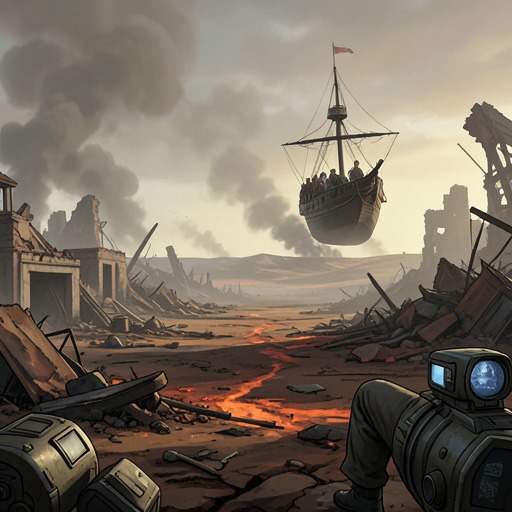
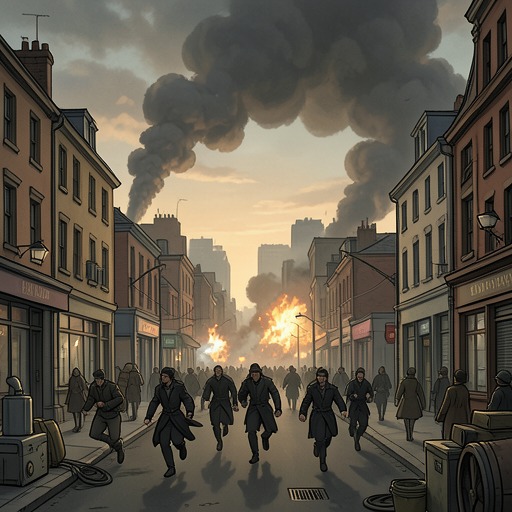
AniaraXinombra is an invented Central American city marked by repeated destruction. The poem places it in a landscape of fire and spreading catastrophe, then returns to it through the image of a precious stone driven into its heart. Its statement that the city died a third time makes recurrence part of Xinombra’s definition: this is not a place with one isolated account of ruin, but one whose destruction has already accumulated a history.
Identity and Setting
A note identifies Xinombra as a city invented by Martinson and specifies that it had been destroyed by an earlier holocaust. The evidence gives no detailed map, civic history, or account of its inhabitants; its identity is established instead through catastrophe and through the recurrence of its name. The Central American setting locates the invention, while the city’s fictional status distinguishes it from the poem’s more immediate references to Earth and its destroyed places.
Xinombra belongs to a broader imaginative landscape in which devastation travels across regions. In one passage, Gond is caught in the fire of the phototurb and twisted into a spiral of torrid gases. The force plunges among mountains and fills the land of Rind before the poem turns to Xinombra, where primordial flame chastises the city. The sequence gives the city a place in a widening field of disaster, but does not establish that the destruction of Gond or Rind directly causes Xinombra’s fate. Its connection to them is made by the poem’s movement from one ravaged landscape to another.
Fire and the First Destruction
The account of Xinombra’s fiery destruction follows images of a sunroar and branching lightning, with a speaker recalling cries from people already blinded and afraid. The poem then describes matter as combusted and befouled and presents primordial flame as the force that chastises Xinombra. This is not a detailed report of the event’s mechanics: no agent, date, or sequence of decisions is supplied. Instead, the city appears at the culmination of a vision in which destructive force grows beyond ordinary human measure.
The language also makes the catastrophe difficult to separate from a larger, elemental scale. Fire is not merely a local blaze; it is associated with matter itself, while the force outside human control continues to grow. The city’s destruction is thus rendered as a human calamity inside a cosmic-seeming process. That framing does not explain why Xinombra was destroyed, but it emphasizes how little power its inhabitants appear to have against the forces described.
The Third Death
A later passage returns to Xinombra through the image of the stone of wisdom, wrapped in what the poem calls the slaughter-mask of genius, being shot to the heart of the city. The result is stated with stark finality: Xinombra died a third time. The stone is also called a jewel, so the passage holds together preciousness and destruction. Wisdom and genius are not presented as uncomplicated sources of protection; joined to the image of the city’s repeated death, they acquire an ominous, destructive aspect.
The wording establishes a renewed attack or blow at the city’s heart, but leaves the responsible actor and the precise nature of the stone unexplained. It also does not narrate the earlier deaths individually. The reader learns the count—three—without receiving a complete chronology. That gap matters: Xinombra’s past is visible as accumulated loss, while the intervening events remain outside the account. The repeated death registers the scale of its history more clearly than any civic or personal detail could.
Narrative Significance
Xinombra’s return transforms the city from a single setting into a record of catastrophe’s repetition. Its earlier holocaust, its appearance amid fire, and the later declaration of a third death are distinct pieces of evidence, not one fully explained chain of events. Together they make destruction feel cumulative: a city can be named again after its ruin, only for the poem to imagine its heart struck once more.
That recurrence resonates with the larger work’s preoccupation with nuclear devastation, though the evidence does not identify Xinombra’s particular holocaust as a nuclear attack. The poems of Aniara emerged in a moment of acute public anxiety about the hydrogen bomb: the Soviet Union announced its possession of one in August 1953 and detonated it four days later. Elsewhere in the work, the nuclear destruction of Dorisburg is recounted as a catastrophe reaching the space ship Aniara through the Detonee, the last voice from Earth. Against that wider frame, Xinombra offers a separate, invented history of repeated destruction. Its force lies in the distinction as much as the resemblance: the city’s ruin is ancient within the poem’s imagined history, yet it speaks to a work shaped by contemporary fears of devastation on an immense scale.