Rind
AniaraRind is the homeland of the Blind Poetess and one of the few places in the poem where cultural memory, environmental damage, and the lives of the dead meet in a specific landscape. It is remembered not as an untouched refuge but as a country whose myths preserve a life, whose soil requires rescue, and whose buried generations still seem to speak. For the exiles, Rind holds both the weight of material loss and the possibility of making that loss intelligible through song.
Homeland and Cultural Memory
Rind is identified as the native land of the Blind Poetess. The poem links the country to the stories that surround her: Rindi myths envelop her life and, taken together, become a sacred wine. In the nearby image of words changing from smoke to splendor, poetic transformation appears as something drawn from this accumulated inheritance. Rind thus signifies more than a birthplace. Its traditions nourish a way of speaking in which a life can be remembered through many stories rather than reduced to a single account.
The explanatory note on Rind adds a distinct biographical association. Martinson said he chose the German word for tree bark as the name of the Blind Poetess’s country because he remembered a young woman in South America who had been blinded by trachoma, a disease that covers the eye as bark covers a surface. This note links the place-name, the poetess’s blindness, and a remembered bodily experience, while leaving Rind itself a fictional country. The association gives the name a tactile force, but the poem’s treatment of Rind also exceeds that symbolism: the land has damaged plants, threatened soil, human history, and a future its inhabitants are trying to shape.
Return to a Damaged Land
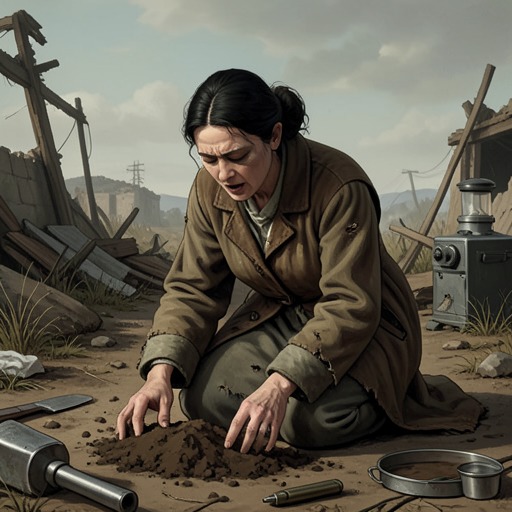
The speaker’s years on the Martian tundra form part of a destiny that leads back toward Rind. In that period, the speaker learns how to move the guard like an envoy sent from the country. Later, as a songstress for the effort called Reclaim the Tundra, the speaker returns home. The return is not to a recovered landscape. Rind is cold, and all its plant life is injured.
Against this visible damage, determined people persist with a plan to save the soil by means of a new substance. The poem does not specify the substance or report whether the plan succeeds; its emphasis falls on the persistence of the effort. Rind’s environment is neither a pastoral backdrop nor merely a symbol of the speaker’s feelings. Injured plant life and endangered soil are conditions to which people must respond. The return therefore joins personal homecoming to a collective, practical attempt at repair, while withholding any easy promise that determination will undo the damage.
The Buried Generations
Rind’s fields also hold generations sunk into the earth. They lie beneath the springtime wind, yet the poem imagines them raising their voices together as a choir. The contrast is central to the place’s remembered character: the dead are physically concealed in stark fields, but their collective voice remains audible in the poem. Spring does not erase the burial; it provides the season and wind through which the image of communal song emerges.
This buried choir makes Rind’s history more than an individual inheritance. The Blind Poetess’s life is surrounded by myths, while the generations beneath the fields form another kind of shared memory, voiced as a collective rather than organized around one remembered figure. The image gives the land a temporal depth: its present damage and its inhabitants’ plans occupy ground already filled with the past. Rind’s promise of renewal is consequently inseparable from what cannot be restored or brought back above ground.
Rind in the Exile’s Recollections
Rind persists in a narrative shaped by fragments rather than by a continuous return. The speaker describes recollection arriving in flashes, with beams from different ages converging and fragments gathered from long migrations. Elsewhere in this movement of memory, the speaker sorts Mima shards in shock and solitude. These broken objects make the work of recollection concrete: the past is approached through remnants, not recovered as an intact scene. Rind belongs to this larger pattern of preserving what can be assembled while acknowledging what remains dispersed.
The poem also places remembering beside forgetting. A curtain is rigged up for dreams, and a grand forgetting comes between the survivors and their memory of Xinombra. The passage concerns that other memory, not a stated act of forgetting Rind; its relevance is the contrast it establishes within the exiles’ experience. Memory can be gathered in fragments, but it can also be screened off. Against that instability, Rind’s myths and the imagined choir of its dead represent forms through which the past may continue to speak.
The country’s final significance is sharpened by the poem’s vast scale of loss. After fifteen thousand years, the spacecraft still drives toward Lyra, carrying things and bones and desiccated plants from Dorisgrove like a museum. That image does not identify the plants as Rind’s, but it makes the preserved remains of lost places part of the voyagers’ eventual condition. Rind’s injured vegetation and buried generations thus belong to a wider meditation on what survives displacement: not a living homeland restored, but names, stories, fragments, and the material traces of worlds left behind.