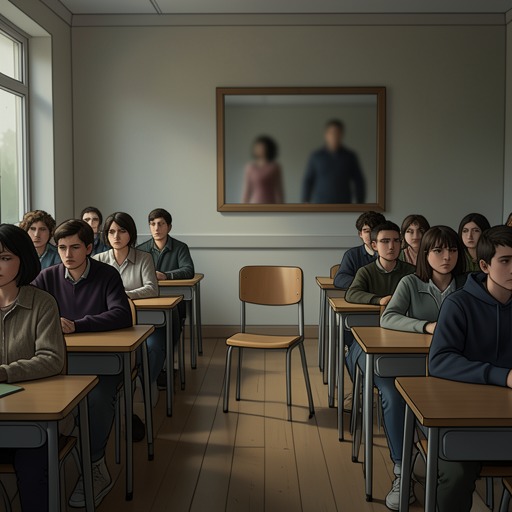
1972 school year
AnotherThe 1972 school year is the decisive origin point of the Yomiyama phenomenon as it is reconstructed by Tatsuji Chibiki. Twenty-six years later, Chibiki identifies that year’s third-year Class 3 as the moment when the death of the popular Misaki Yomiyama was followed by a collective refusal to acknowledge it, a choice that he believes opened the way for the disasters that began the following year.
The Year of Misaki Yomiyama’s Death
Chibiki recalls the 1972 school year as the year of “the death of Misaki, who was popular with everyone.” The available account does not describe the circumstances of the death itself, but it makes the social response central: the students and adults involved did not act from deliberate malice. Chibiki says that he was young, attached to certain ideals as an educator, and acted as he believed was right; the students likewise behaved according to their own understanding of what was proper.
That apparently well-intentioned response became the critical error. Instead of allowing the class to accept Misaki’s death, the people of third-year Class 3 treated the dead student as though death could be denied. The year therefore marks not merely a student’s death but the beginning of a collective distortion of reality, in which recognition, memory, and social conduct were made to serve the wish that the loss had not occurred.
Chibiki’s Responsibility and Withdrawal
Chibiki regards the 1972 school year as the source of a responsibility he has carried for decades. He says that the decision made then became the trigger through which “the doors to death” swung open at the school, and he accepts responsibility both for that original mistake and for being unable to stop the disasters that began the following year.
His continued presence at the school is consequently tied to the year’s aftermath. He quit teaching and became the librarian, describing that change partly as an act of “running away.” Remaining at the school allowed him to preserve access to its records and to explain what had happened, but it also kept him physically and morally attached to the event he believed he had helped cause. In the 1998 school year, he is still described as perhaps the last person at the school who directly experienced the 1972 event.
The Graduation Photograph and the Return of the Dead
The 1972 school year is linked to the old classroom in the former school building and to the photograph that later became disturbing evidence. Chibiki says he was present when the photograph was taken. A few days afterward, students brought it to him, insisting that it visibly included the dead Misaki Yomiyama. Chibiki agrees that the boy appeared in the image and remembers that Ritsuko Sakakibara may have been among the students who showed it to him.
The photograph turns the class’s refusal into something more than a private act of mourning. Misaki’s continued presence is made visible in a school record, allowing the dead student to occupy the same symbolic space as the living. In retrospect, the image becomes the first concrete sign that the class’s attempt to preserve Misaki’s presence has altered the boundary between the dead and the living.
Rules Carried into Later Class 3s
The consequences associated with the 1972 school year extend beyond that single class. Chibiki keeps copies of the third-year Class 3 class lists for twenty-seven years, from 1972 through the 1998 school year, arranged with the newest records on top. The records therefore create a material chronology in which the founding year remains physically connected to every later occurrence.
The later explanation of the “extra person” also gives the original event a continuing operational pattern. While the casualty is hidden within a class, records and memories are said to be tampered with, so that details that should be impossible appear coherent and no one recognizes the casualty’s true identity. The 1972 school year thus establishes the conditions under which social memory itself becomes unreliable: the class does not merely forget, but receives a world in which contradictory evidence has been made to fit.
Legacy in the 1998 School Year
The practices developed in response to the 1972 school year reappear in the 1998 third-year Class 3. The class attempts to increase the number of students treated as “not there” to two, but the measure has no effect. After Mr. Kubodera’s death, the class gradually stops ignoring Mei Misaki and Koichi Sakakibara, and classmates begin behaving as though Mei genuinely exists. This change shows both the persistence and the fragility of the inherited strategy: the old rules can be enacted, but their continuation depends on collective belief.
Chibiki’s knowledge also makes him a destabilizing presence whenever the class’s history is discussed. During a later meeting concerning the peculiar circumstances imposed on the current third-year Class 3, he openly acknowledges awareness of the class’s situation, causing the room’s atmosphere to freeze. The original event therefore remains active not only as backstory but as a pressure on every attempt to manage the present.
The 1972 school year is significant because it supplies the Yomiyama phenomenon with its founding pattern: a popular student dies, a community refuses to accept the death, and the refusal becomes an enduring breach in the ordinary relation between records, memory, and mortality. Every later “disaster” is understood against that first decision, while Chibiki’s lifelong return to the school preserves the year as both historical evidence and unresolved guilt.