August 8–10, 1998
AnotherAugust 8–10, 1998 is the decisive three-day interval in which Third-Year Class 3 leaves ordinary school life for a supposedly restorative camping trip and enters a sealed landscape of ritual, fear, and murder. The trip begins as an attempt to confront the Yomiyama phenomenon by visiting Yomiyama Shrine, but the promised return to safety never occurs. At Sakitani Memorial Hall, the students’ temporary community becomes the setting for a chain of attacks, concealments, and deaths whose full meaning emerges only afterward.
Planning and Purpose
The trip is announced as a two-night, three-day class camping trip from August 8 to August 10. Earlier discussion places the destination at Yomiyama Shrine, a site associated with the mountain and with the old story of Misaki, the boy whose death twenty-six years earlier helped shape the class’s fear of the supernatural. The shrine is described as a possible “linchpin” separating the living world from the land of the dead, and the head teacher’s proposal therefore gives the outing a ritual purpose as well as a recreational one.
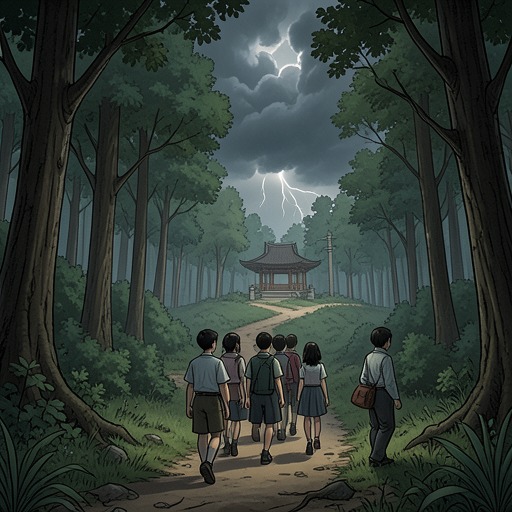
The plan is later confirmed as a journey to Sakitani Memorial Hall, a lodge owned by the school at the foot of Yomiyama Mountain. The class is expected to ascend the mountain and visit the shrine under the supervision of the teachers. Tatsuji Chibiki intends to accompany the students and help ensure that the undertaking proceeds safely, while Ms. Mikami is placed in the position of managing the class during a period already destabilized by Mr. Kubodera’s death and the resulting absences. The proposed excursion thus takes place under institutional strain: the class is not simply going away together, but attempting to restore an order that has already begun to fail.
Departure and Temporary Peace
On the evening of August 8, the students travel by public bus to the northern edge of the city, get off at the end of the line, and walk for another twenty minutes up the hillside to the lodge. More than half of those who have come maintain only a surface appearance of calm. The narrator nevertheless experiences the evening as a rare interval in which the usual pressure loosens. A photograph is proposed by Yuya Mochizuki as a record of the students’ last summer of middle school, and Ms. Mikami insists that she should remain in the picture rather than merely take it.
The resulting photograph is framed by an uneasy normality. The students pose, call for “Cheese,” and briefly participate in a familiar school ritual, while the narrator notices that indifference itself has become almost comforting. The scene offers a narrow form of peace, but its fragility is emphasized by the setting and by the knowledge that the class has come to perform an act meant to ward off disaster. The photograph preserves the appearance of togetherness at the very moment when the trip is preparing to expose how little security that appearance contains.
Shrine Ritual and Its Failure
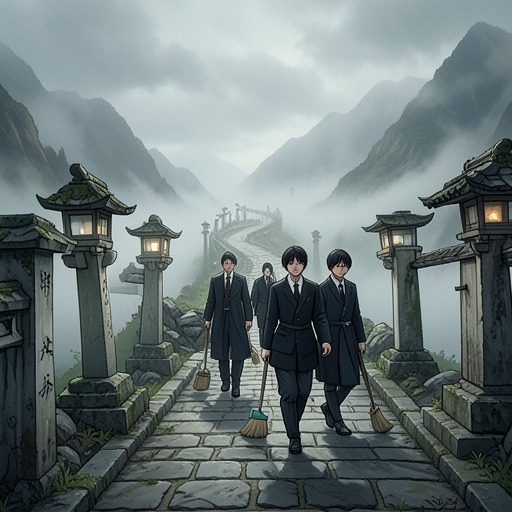
The shrine visit gives the camping trip its clearest ceremonial structure. Yomiyama Shrine is found to be severely neglected, bearing the same name as the town while appearing almost abandoned and cut off from the rest of the world. Instead of merely observing the site, the students collectively clean it. Their labor produces a moment of shared conviction: they begin to believe that repairing the shrine might also repair the damaged boundary between the class and the disasters afflicting it.
Mr. Koga reinforces that belief by assuring the students that everything will be all right now. The confidence attached to the cleaning ritual is immediately overturned. It does not break the curse, and the students’ attempt to purify or restore the shrine proves inadequate against the force they fear. The failed ritual is important because it transforms the trip from a planned intervention into a demonstration of helplessness. A communal act that briefly creates solidarity cannot restore safety; after it fails, the class remains together physically while its confidence in ordinary remedies collapses.
Violence at Sakitani Memorial Hall
The temporal frame darkens as the lodge becomes the site of successive threats. During the gathering, Tatsuji Chibiki attempts to calm the students and describes a dangerous incident as an attack connected with an existing medical condition rather than an extraordinary event. His reassurance is presented as a lie, however, and the students’ fear is not dispelled by the authority of the adults. The gap between what the students are told and what is actually happening becomes one of the defining conditions of the night.
The violence is preceded by signs that the group cannot interpret. Mr. Kubodera withdraws his right hand from a bag on his desk and reveals an object with a sharp silver blade, something wholly out of place in a middle-school classroom. At Sakitani Memorial Hall, blood, darkness, strange sounds, and a locked or burning room turn the lodge’s domestic spaces into zones of uncertainty. When the narrator forces open a hot door, the source of the sound and smell is revealed to be a fire consuming the room. The heat and smoke drive him back, while the building’s apparent refuge becomes an active danger.
The danger also fractures personal trust. Naoya Teshigawara reports that Tomohiko Kazami has been murdered and explains that Kazami had recently failed to remember shared childhood experiences, including a secret riverside base and an abandoned bicycle trip toward the ocean. Those missing memories make Kazami appear strange to his friend and connect private recollection to the class’s wider crisis. The trip therefore turns memory itself into a threatening sign: what should confirm friendship instead becomes evidence used to suspect that someone has changed.
Ending and Aftermath
Near midnight, as August 9 approaches, a conversation breaks off when the speaker’s voice fades away. The moment marks the collapse of a tenuous connection between people who had been trying to understand the disasters together. The narrator immediately runs, and the trip’s apparent chronology of shared meals, travel, cleaning, and group photography gives way to isolated flight and survival.
The later investigation establishes that the deaths at Sakitani Memorial Hall were not caused by the fire. Kensaku Numata, the caretaker, was stabbed in the neck with numerous metal cooking skewers and was then burned. Four students—Manabu Maejima, Yonemura, Sugiura, and Nakao—died from blood loss after being stabbed and cut repeatedly with a sharp blade. Izumi Akazawa appears to have died when she fell from a second-floor balcony and broke her spine. The fire was subsequently set with kerosene scattered around the kitchen.
Witness testimony and the surrounding circumstances establish Mieko Numata’s responsibility for the six deaths. Tatsuji Chibiki restrained her, but before she could be handed over to the police, she died after biting through her tongue in an apparent suicide. Her motive remains unclear even after the official findings. The trip consequently ends not with an explanation of the Yomiyama phenomenon, but with a confirmed human crime layered over the class’s supernatural fears.
Narrative Significance
August 8–10, 1998 compresses the book’s movement from ritual hope to institutional failure and then to physical catastrophe. The journey separates the students from school, ordinary schedules, and reliable adult protection, creating a threshold space in which the class can attempt to cleanse its relation to death but cannot control what follows. The shrine supplies the language of purification; the photograph supplies an image of continuity; the lodge supplies the enclosed setting in which those efforts are violently disproved.
The period also joins collective memory to recurring disaster. The camping trip is prompted by stories of an earlier class and by the belief that a visit to the shrine might interrupt repetition, yet the students reproduce the very pattern they hoped to escape. Their shared rituals create brief cohesion, but the failed cleansing, concealed truths, attacks, fire, and suicidally motivated violence reveal how quickly communal order can be replaced by suspicion and self-preservation. The dates therefore function not merely as a calendar entry but as the book’s concentrated passage from an attempted ceremony of restoration to the massacre at Sakitani Memorial Hall.