1983 school year
AnotherThe 1983 school year is the decisive historical precedent for the recurring disaster surrounding Yomiyama North Middle School Third-Year Class 3. It is identified as an on year, the year in which Reiko Mikami was a member of the class, and the year when the disasters began but stopped partway through. Its pattern of deaths—eight victims by the end of August, followed by no further deaths from September onward—turns an apparently chaotic history into a crucial clue about the operation of the Yomiyama phenomenon.
Discovery and Historical Position
The year first enters the investigation through Koichi Sakakibara’s question to Tatsuji Chibiki at the Secondary Library. Koichi asks whether 1983, fifteen years earlier, had been an on year or an off year, checking the Third-Year Class 3 class-list binder for confirmation. Chibiki immediately recognizes the implication: 1983 was Reiko Mikami’s year. She had then been in her third year of middle school and a member of Yomiyama North Middle School Third-Year Class 3, making the old school year directly relevant to the present disaster rather than merely an archival curiosity.
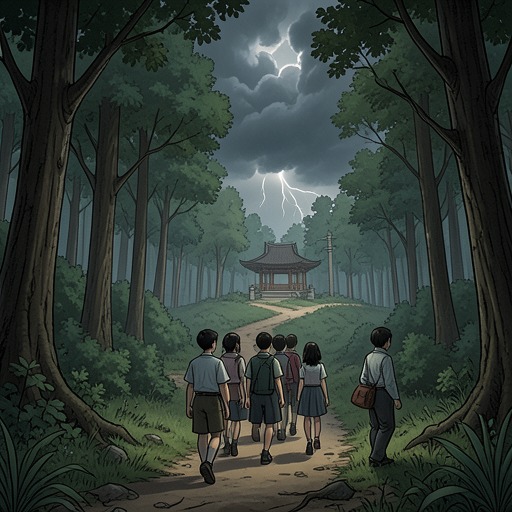
Koichi and Mei Misaki had already learned that 1983 was remembered as the year when the disasters began and then stopped partway through. The interruption reportedly occurred after something happened during the class camping trip over summer break. This partial cessation distinguishes 1983 from a simple sequence of undifferentiated calamities: the year contains a historical break whose cause becomes a central question for the investigation.
Victims and the August Stoppage
Chibiki’s examination of the 1983 class records supplies the year’s concrete toll. Several names in the binder are marked with red Xs, with dates and causes of death recorded beside them. The records also include cases in which a student survived while a family member died, showing that the disaster’s reach was not confined neatly to the classroom’s enrolled students. Yet the file contains no mention of the death of Ritsuko Sakakibara, even though her death is known to have occurred in July.
Chibiki counts seven victims in the records, excluding Ritsuko because he had never learned about her. The deaths were distributed across the school year: two in April, one in May, one in June, one in July, and two in August. Adding Ritsuko produces a total of eight deaths. The chronology is as important as the number. There were no further deaths beginning in September, and Chibiki states the conclusion plainly: it stopped in August.
The concentration of deaths before the end of summer gives the 1983 school year its characteristic shape. The disasters escalate through spring and summer, include Ritsuko’s July death, reach two further deaths in August, and then cease. That sequence provides the model against which the events of the current year are measured and explains why the camping trip is treated as a possible turning point rather than as incidental background.
Reiko Mikami and Concealed Knowledge
The year’s significance is inseparable from Reiko Mikami. In the present, she is twenty-nine and occupies the position of teacher and household member connected to Koichi, but in 1983 she was a student in the affected class. Her former membership makes her both a witness to the earlier disaster and a person whose relationship to the current class cannot be treated as ordinary.
The class’s knowledge of the rules also reaches back through this connection. Members understand that records and memories can be tampered with while the extra person, or casualty, is hidden in the class. Details that would normally be impossible are made to appear consistent, preventing people from recognizing the casualty’s true identity. Chibiki confirms that this distortion really occurs, without hesitation. The 1983 school year therefore functions not only as a list of past deaths but also as evidence for the mechanism by which the class’s social and documentary reality is altered.
Reiko’s position is especially difficult because the Fourth of the North Yomi fundamentals requires Koichi and Reiko to behave as though they are unrelated at school. Koichi calls her Ms. Mikami at school and Reiko at home, while she addresses him as Sakakibara, the transfer student, rather than Koichi. Most of the class knows the truth, including Mr. Kubodera, so the instruction to ignore both Koichi and Mei as if they were not there is understood against the awkward fact that Reiko is being asked to ignore her own nephew in school while living with him afterward.
Pattern, Strategy, and Consequence
The past year also clarifies the logic of the class’s defensive strategies in the present. Because ordinary records and memories cannot be trusted while the casualty is hidden, the students attempt to manipulate recognition itself. They first try to increase the number of people treated as not there by ignoring both Mei and Koichi. When that tactic has no effect, there is no reason to continue excluding them, and the class gradually changes its behavior after Mr. Kubodera’s death. Mei is again treated as someone who exists, and classmates such as Naoya Teshigawara begin addressing her directly.
This change shows how the 1983 school year operates as a precedent rather than a closed historical episode. Its deaths establish the danger; its abrupt ending establishes the possibility that the disaster can be interrupted; and its altered records and memories establish why the class must act collectively even when its own perceptions are unreliable. The past is thus both an archive and an operating manual, though one whose decisive instructions remain incomplete.
Narrative Significance
The 1983 school year converts the Yomiyama phenomenon from rumor into a recurring historical structure. It links Reiko’s adolescence to the present crisis, places the deaths within a precise April-to-August progression, and supplies the first clear example of disasters stopping before the school year ends. The records preserve dates and names while omitting Ritsuko’s death, making the archive itself an example of the concealment that the characters are trying to overcome.
Its greatest narrative force lies in the unresolved gap between pattern and explanation. Everyone can identify that the deaths stopped in August, and Koichi learns that the camping trip may have marked the interruption, but the available evidence does not yet explain exactly why the sequence ended. That gap makes 1983 a charged piece of time: a completed precedent whose consequences remain active, a year that ended while its method of ending was still hidden.