Koichi’s Killing of Reiko
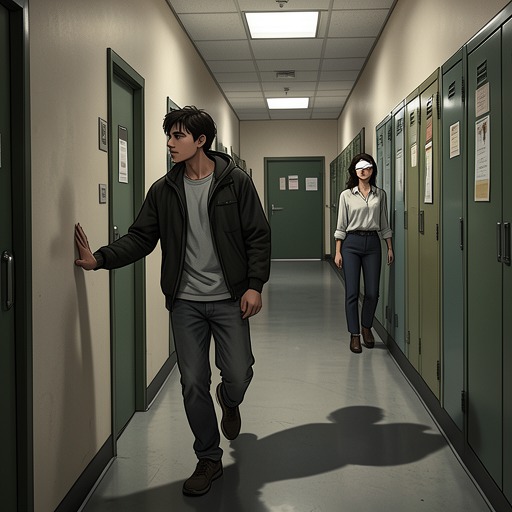
AnotherKoichi’s Killing of Reiko is the climactic act of “returning the casualty to death” in the 1998 Class 3 disasters. In the burned grounds of the Sakitani Memorial Hall, Koichi Sakakibara accepts Mei Misaki’s judgment that the trapped person bears “the color of death,” then drives a pickax into Reiko Mikami’s back. The act appears to be a necessary sacrifice demanded by the catastrophe, but it is also an intimate killing: Reiko is Koichi’s aunt, his mother’s younger sister, and the woman who has occupied the role of his homeroom teacher, guardian, and surrogate mother. Its final significance lies in that collision between supernatural necessity and personal recognition, which makes the rescue of the class inseparable from an unbearable act of betrayal and grief.
Causes and Background
The killing grows out of a chain of fear, incomplete knowledge, and increasingly desperate attempts to identify the “extra person.” The class has already experienced several disasters, including the death of Mr. Kubodera, and Izumi Akazawa publicly assigns responsibility to both Mei and Koichi. She demands an apology from Mei, arguing that Mei resumed behaving normally as soon as she stopped being “not there,” while the class continues to suffer. This atmosphere turns uncertainty into accusation and makes individual classmates into possible causes of the collective crisis.
Naoya Teshigawara illustrates the danger of that reasoning. He confides that he has been wondering whether the “extra person” came with the group and whether some visible sign might reveal the identity. He later admits that he attacked Tomohiko Kazami because he had become convinced Kazami was not himself. Teshigawara had covertly questioned Kazami about childhood memories: a secret riverside base and a failed bicycle trip toward the ocean. Kazami remembered neither episode, and Teshigawara interpreted those gaps as proof that the real Kazami had died long ago and that an impostor had entered the class. His confession shows how the search for an invisible enemy converts ordinary uncertainty into violence.
The immediate setting further strips away ordinary safeguards. Koichi follows the others into a dark dining hall after noticing blood and being grabbed by the ankle. When he opens a heated door, he discovers that the strange sound and smell come from a fire consuming the room. Flames, smoke, and intense heat make the scene an emergency in which hesitation becomes physically dangerous, while the absence of clear identities makes moral judgment equally unstable.
The Encounter at the Memorial Hall
After the explosion, Mei is covered in ash and looking toward a second person lying four or five meters away. The victim is facedown, heavily coated in ash, with the lower body pinned beneath large pieces of lumber. From Koichi’s position, the person’s identity, height, and gender cannot be determined. Mei explains that the blast knocked over the lumber and left the victim unable to move, transforming a possible rescue into a question of whether the trapped person is the source of the disasters.
Mei is holding a pickax, apparently recovered from nearby or taken from a shed. Without turning her eyes from the victim, she declares that they cannot save the person because the victim is the “extra person.” She says that she can see “the color of death.” Her certainty is not based on an ordinary identifying feature that Koichi can independently verify; it is a supernatural perception associated with her artificial eye. The scene therefore places Koichi between Mei’s vision and the victim’s vulnerable body, with the decision resting on knowledge that cannot be shared equally among those present.
Mei orders Koichi to move. He sees the conviction in her face and the confused terror in Reiko’s eyes behind him. The victim is revealed to be Reiko Mikami, who protests that they cannot proceed and accuses them of acting irrationally. Koichi responds by taking the pickax from Mei rather than allowing Mei to strike. This transfer of the weapon changes the action from an instruction he witnesses into a deed for which he personally assumes responsibility.
The Pickax Attack
The pickax is medium-sized, with a handle roughly sixty or seventy centimeters long. Its iron head has two pointed ends, sharper and more dangerous than Koichi initially expects, and its weight makes the capacity for lethal injury immediately concrete. The object does not remain an abstract symbol of emergency rescue: in Koichi’s hands, it becomes the instrument by which the class’s survival is measured against Reiko’s life.
Koichi tells Mei that she cannot do this, but when she answers that failure to act will allow the disasters to continue, he acknowledges that he understands. He says that he will do it. Reiko screams at him, and he turns back toward her, holding the pickax and facing the fact that the supposed casualty is a terrified, living person who can still plead for mercy.
He plants his feet, lifts the pickax over his head, and repeats to himself that it is the only way. In the instant before the blow, he aims at the place on Reiko’s back where her heart should be. The narrative prolongs this hesitation rather than treating the killing as a swift mechanical solution: Koichi must pass through doubt, recognition, and the demand to trust Mei. He ultimately decides that he will believe her, or at least that he wants to believe her, and accepts that desire as sufficient grounds for action.
Koichi then swings with all his strength. Reiko’s scream does not stop him, and the point of the pickax enters her back and reaches her heart. The impact produces a pain in Koichi’s own body, recalling the X-ray of his shriveled, distorted lung after its third collapse. The physical echo binds the murder to his own damaged body, making the act not merely something he does to another person but an experience that rebounds through him as injury, shock, and irreversible knowledge.
Identity, Recognition, and Consequences
The killing’s horror depends on the collapse of the distinction between stranger and family. Koichi had been asked to kill an obscured figure whose body was hidden beneath ash and timber; instead, the “extra person” is Reiko, a woman whose face carries a shadow of his mother and whose place in his life has made her emotionally indispensable. The supernatural category supplied by Mei cannot erase the human identity that emerges at the moment of violence. It intensifies the ethical contradiction: the person designated as the cause of the disasters is also someone Koichi has trusted and loved.
The wider disaster at the Sakitani Memorial Hall confirms that violence there has multiple human causes and forms. The caretaker, Kensaku Numata, dies after being stabbed repeatedly in the neck with metal cooking skewers. Four students—Maejima, Yonemura, Sugiura, and Nakao—die from blood loss caused by multiple stab wounds and cuts, while Akazawa dies after her spine snaps in a fall from the second-floor balcony. None dies from the fire itself. The evidence establishes that Mieko Numata, Kensaku’s wife and co-manager of the hall, caused the deaths of all six people, then scattered kerosene in the kitchen and set the fire. Tatsuji Chibiki restrained her, but before she could be surrendered to the police, she bit through her tongue in an apparently successful suicide attempt.
This aftermath places Koichi’s act beside other forms of violence without reducing them to one cause. Teshigawara attacks Kazami because of a mistaken theory about memory; Mieko kills six people before setting the hall ablaze; Koichi kills Reiko because Mei identifies her as the supernatural casualty whose continued existence sustains the disasters. The circumstances differ, but each act emerges from a crisis in which ordinary interpretation and ordinary protection have failed. The resulting deaths are therefore both personal crimes and symptoms of a larger environment where fear makes violent certainty appear preferable to helpless uncertainty.
Narrative and Thematic Significance
Koichi’s Killing of Reiko is the story’s most severe test of the “Not There” Strategy and of the principle that the casualty must be returned to death. Earlier, the class treats social absence as a protective measure: Mei is excluded from attendance records and classroom recognition in the hope that the supernatural balance will be restored. At the memorial hall, that strategy reaches its violent endpoint. The problem is no longer whether a person should be socially treated as absent, but whether a living body can be physically removed in order to end the disasters.
The scene also exposes the danger of making an unseen threat into a public enemy. Akazawa’s accusations, Teshigawara’s investigation, and Mei’s perception all seek a single person who can explain the class’s suffering. Yet the act of identification does not create moral clarity. Koichi has no ordinary proof, Reiko cannot defend herself in terms the others can accept, and the visible facts of the scene—ash, timber, fire, blood, and a weapon—provide no secure bridge between supernatural diagnosis and ethical permission. The killing succeeds only when Koichi chooses trust over independent certainty, and that choice leaves him responsible even if the diagnosis is true.
The event’s narrative power comes from its deliberate delay. The weapon is noticed, taken, weighed, raised, aimed, and finally swung through a sequence that makes the familiar shape of a pickax newly strange and terrifying. Each stage forces attention onto bodily action: feet planted, arms lifted, the victim’s scream, the weapon’s weight, and the pain that returns to Koichi’s chest. Violence is not reduced to a plot mechanism. It becomes a perceptual and moral ordeal in which the supposed solution to the catastrophe is itself experienced as another disaster.
Reiko Mikami’s death consequently functions as both resolution and wound. It fulfills the supernatural logic that Mei has recognized, but it also destroys Koichi’s remaining confidence that knowledge can protect him from harm. He does not discover a clean distinction between the living and the dead, the innocent and the guilty, or rescue and murder. He acts because the catastrophe demands an answer, and the answer is permanently marked by the fact that he had to deliver it himself.