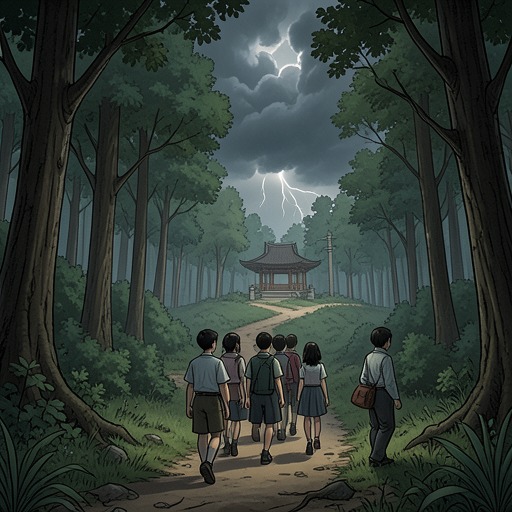
The Yomiyama Shrine Camping Ritual
AnotherThe Yomiyama Shrine Camping Ritual is the 1998 Class 3 attempt to stop the year’s disasters by reenacting the earlier class’s camping trip and visiting Yomiyama Shrine. Its decisive significance lies in the collision between ritual hope and material violence: a journey intended to restore safety instead concentrates frightened students, uncertain authority, and lethal opportunity at the Sakitani Memorial Hall.
Causes and Background
The idea arose from the mystery of why the disasters had stopped fifteen years earlier. Tatsuji Chibiki discussed the question with Reiko Mikami, who had endured bitter experiences two years before and had since been appointed substitute head teacher after Mr. Kubodera’s death. Chibiki inferred that she might be desperate for a solution and predicted that a similar camping trip could take place that August.
The proposed repetition was exact in its ominous logic. The 1998 class would travel to the same location and on the same days as the third-year Class 3 trip fifteen years earlier, then visit Yomiyama Shrine in the hope that the disasters would stop. The plan transformed a historical coincidence into a deliberate rite, while Ms. Mikami’s tense, strangely vacant expression suggested that the announcement carried a burden beyond ordinary school administration.
On July 21, Ms. Mikami announced a two-night, three-day class camping trip from August 8 to 10. She presented it as an important ritual, made participation voluntary, and asked students who were able to attend to join. The indirectness of the announcement concealed its central purpose: the class was not merely going away together but attempting to reproduce an earlier collective action against the Yomiyama phenomenon.
The Ritual Setting and Participants
The trip took place at the school-owned Sakitani Memorial Hall, a lodge at the foot of Yomiyama. The mountain and shrine carried a supernatural reputation. Yomiyama had long been associated with Mount Yomi, the land of the dead, while oral traditions described the shrine as a linchpin separating this world from the next. The earlier head teacher’s suggestion that the class visit it therefore appeared, to some, to be an appeal to divine intervention rather than a practical safety measure.
Participation changed after another death. When the shut-in Atsushi Ogura died despite rarely leaving home, students who had assumed that staying indoors might protect them reconsidered. A rumor began circulating that everyone who joined the camping trip would be saved. Late decisions drove the total to fourteen students—nine boys and five girls—exactly half the class. With Ms. Mikami as chaperone, fifteen people were to spend two nights and three days at the lodge.
The ritual also depended on adult supervision that was visibly uncertain. Ms. Mikami told the group at the school gate that they would climb Yomiyama the next day and pray for the class’s safety, but her voice did not convey firm conviction. Later, Tatsuji Chibiki said that he would accompany the ascent and help ensure that everything went well, while warning everyone to be careful on the return. When he raised the possibility that rain would cancel the outing, Ms. Mikami answered uneasily that they would decide according to the weather. The ritual’s authority was therefore both official and hesitant.
Visit to Yomiyama Shrine
The remembered precedent came from an earlier third-year Class 3 camping trip. That trip had also lasted two nights and three days, beginning on August 8, and had been organized after the head teacher, Mr. Koga, consulted a medium about how to end the disasters. The proposed answer was to visit Yomiyama Shrine and pray for salvation.
The shrine did not resemble a secure sacred refuge. It was severely run-down, shared the town’s name, and appeared to have been abandoned by the wider world. During the earlier visit, the students cleaned the shrine together. Their shared labor briefly convinced them that the curse might truly be broken, and Mr. Koga assured them that everything would now be all right. The confidence was immediately disproved: the disasters continued, showing that the ritual could create solidarity without controlling the force it claimed to oppose.
In the 1998 repetition, the shrine visit was meant to repair that earlier failure by reenacting the same route and intention. Yet the plan placed the students inside a dangerous threshold rather than carrying them safely across one. School rules, ordinary supervision, and the separation between classroom life and the mountain were suspended, while the shrine’s association with death intensified every movement toward it.
Failure and Escalation at the Lodge
The ritual did not prevent catastrophe. Before or during the trip, the class remained subject to fear, suspicion, and the expectation that any accident might be part of the disasters. Chibiki attempted to contain that fear when a student suffered a serious attack. He insisted that the student would be fine if taken to the hospital, called the episode a familiar attack associated with the student’s condition, and denied that it was an extraordinary event or freak accident. His calm reassurance was intended to preserve order, but the narration immediately identifies it as a lie, exposing the gap between institutional control and the students’ actual danger.
The lodge became the site of a much more direct breakdown. During the crisis, Mr. Kubodera withdrew his right hand from a bag on his desk and revealed a sharp silver-bladed object, apparently a hunting knife or kitchen knife. This image connects the camping setting to the earlier Kubodera event and shows how the ritual’s promise of protection coexists with the sudden availability of weapons and the collapse of ordinary classroom boundaries.
Suspicion also turned inward. Naoya Teshigawara reported that he had been secretly investigating Tomohiko Kazami, asking him about shared childhood experiences. Kazami failed to remember their secret riverside base or the attempted bicycle trip toward the ocean, and Teshigawara treated those gaps as evidence that something was wrong with him. His reasoning converted damaged memory into a threat diagnosis, helping turn the lodge into a place where friends could become targets.
The danger was not confined to interpersonal violence. Koichi Sakakibara entered a dark dining hall after noticing blood and, despite having the option to follow those who had fled, pushed farther inside. Something seized his ankle. Later, when he opened another door, he discovered that the strange sound and smell came from a fire: flames filled the room, while intense heat and smoke forced him to retreat. The ritual site thus shifts from a supposed sanctuary to a trap of darkness, bodily threat, and spreading fire.
Massacre and Aftermath
The final investigation established that the deaths at the Sakitani Memorial Hall were not caused by the fire. Kensaku Numata, the caretaker, had been stabbed in the neck repeatedly with large metal cooking skewers and was burned afterward. Four students—Manabu Maejima, Yonemura, Sugiura, and Nakao—died from blood loss after being stabbed and cut in multiple places with a sharp blade. Izumi Akazawa died when her spine snapped in a fall from a second-floor balcony.
The evidence and witness testimony identified Mieko Numata, Kensaku Numata’s wife and co-manager of the lodge, as responsible for all six deaths. After murdering Kensaku, she was thought to have spread kerosene through the kitchen and started the fire. Tatsuji Chibiki restrained her, but before she could be handed over to the police, she died by biting through her tongue in an apparent suicide.
The aftermath destroys the ritual’s promise on every level. Cleaning the shrine had not ended the earlier disasters, and repeating the earlier trip did not save the 1998 participants. Instead, the camping journey assembled a temporary community whose members were exposed to institutional denial, misread memories, knives, accidents, arson, and suicide. The unanswered question of Mieko Numata’s motive leaves the catastrophe resistant to a single explanation, even after responsibility for the killings is established. The shrine ritual therefore remains a failed attempt to impose sacred order on a history that continues to produce death through both the supernatural pattern of the class and the human violence gathered around it.