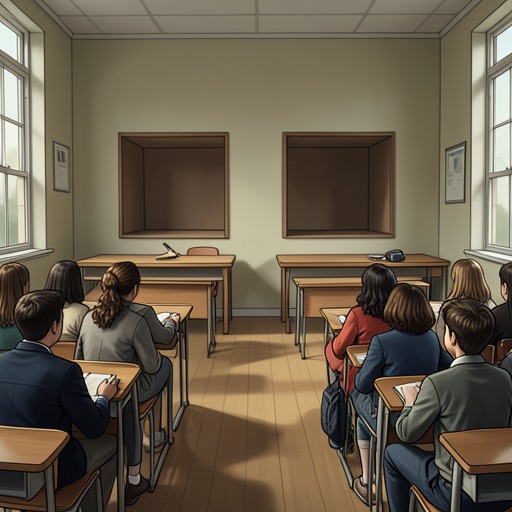
Kubodera’s Classroom Suicide
AnotherKubodera’s Classroom Suicide is the decisive rupture in the 1998 third-year Class 3 disasters. During a normal lesson, Mr. Kubodera, the class’s head teacher, abruptly produces a knife and drives it into his own neck in front of his students. The immediate horror is followed by an even more disturbing revelation: his elderly, bedridden mother had been found suffocated at home, and the circumstances strongly indicated that he had killed her before going to school. The event therefore joins public suicide, suspected familial murder, and the class’s supernatural crisis in a single act whose meaning remains morally and psychologically unstable.
The Classroom Attack
The suicide begins shortly after the bell at the start of class, when Mr. Kubodera enters in his familiar white dress shirt and initially appears as ineffectual as usual. The ordinary continuity of his appearance makes the change more alarming. His voice becomes difficult to understand, then breaks apart into sounds that no longer resemble healthy human speech. The students watch without being able to interpret what is happening as he withdraws his right hand from a bag resting on his desk.
The object is a knife with a sharp silver blade, entirely alien to the setting of a middle-school classroom. For several seconds, the class remains unable to connect the strange noises with the weapon in his hand. Then Mr. Kubodera turns the blade toward himself, curls his fingers around the handle, bends his elbow inward, and thrusts the knife into his neck. The action takes place before everyone in the room. His broken vocalization becomes a bellow, and the students’ confusion gives way to screams and commotion.
The Hidden Crime
The later account supplied by Mr. Chibiki changes the apparent sequence and stakes of the event. Mr. Kubodera had been single and had lived with his mother, an elderly woman who had suffered a stroke and had been largely bedridden for years. Because he rarely discussed his private life, most colleagues knew little about the circumstances of his home. When the police searched the house, they found that his mother had died in the bed where she spent her days, with a pillow pressed over her face. The death was treated as an obvious murder.
She had died late on Sunday the 12th or before dawn on Monday the 13th, placing her death immediately before Mr. Kubodera’s appearance at school. The available circumstances made him the probable killer. Mr. Chibiki presents caretaker’s exhaustion as a possible explanation: after being driven into a mental state beyond his capacity to escape, Mr. Kubodera may have murdered his mother. Yet the account refuses to reduce the matter to a simple diagnosis. He could have confessed, concealed the crime, fled, or otherwise attempted to continue living; instead, he waited for morning and deliberately killed himself before the class.
A Catastrophe Made Legible
The discovery of the mother’s death gives the classroom suicide a grim internal logic without making it morally comprehensible. Mr. Kubodera’s public act can be read as an attempt to end his life after the killing, but it also forces the students to become witnesses to consequences they had not known existed. His death is not merely an isolated act of madness in a classroom: it is the visible end of an unseen domestic crisis, and the students’ later knowledge arrives only after the violence has already made understanding unavoidable.
The event also belongs to the information disorder surrounding third-year Class 3. Mr. Chibiki confirms that when the extra person, or the casualty, is hidden within the class, records and memories can be tampered with so that contradictory details appear coherent and no one recognizes the casualty’s true identity. The certainty of his answer gives the phenomenon an institutional and epistemic dimension: the class is not simply endangered by deaths, but by a reality in which evidence and memory cooperate in concealing the cause.
Consequences for the Class
Before Mr. Kubodera’s death, the class had attempted to increase the number of students treated as “not there” from one to two. Because that strategy produced no effect, the students no longer had a reason to continue ignoring Mei and Koichi. The change did not arise from a formal decision or an announced reversal. It spread gradually and almost invisibly, but Mr. Kubodera’s death marked the boundary between the old arrangement and the new one.
Afterward, classmates began behaving as though Mei actually existed. During lunch on Thursday, for example, Teshigawara treated her as present while she stood beside Koichi and addressed comments to her directly. The suicide thus has a social consequence beyond grief and shock: it exposes the failure of the class’s protective performance and weakens the collective discipline that had made Mei socially absent. A death that seems to confirm the necessity of the countermeasures instead helps reveal their limits.
Narrative Significance
Kubodera’s Classroom Suicide is the first major eruption in which the hidden violence of the disaster becomes impossible for the students to keep at a distance. The classroom, ordinarily a regulated space of lessons, attendance, and adult authority, becomes the scene of an act that destroys the distinction between school life and private catastrophe. That collapse is echoed later in other dangerous spaces: the abandoned old classroom, the dark dining hall at the Sakitani Memorial Hall, and the fire that consumes the building. Across these settings, familiar structures cease to guarantee safety.
The event’s moral force lies in the unresolved relation between explanation and responsibility. Caretaking exhaustion may illuminate how Mr. Kubodera reached the point of killing his mother, but it does not erase the fact of the murder; his suicide may follow from unbearable guilt, yet it also leaves the students with the trauma of witnessing it. The incident therefore resists both easy condemnation and easy absolution. It shows how the Yomiyama phenomenon turns incomplete knowledge into danger, while insisting that the human suffering beneath the supernatural pattern cannot be dismissed as mere mechanism.