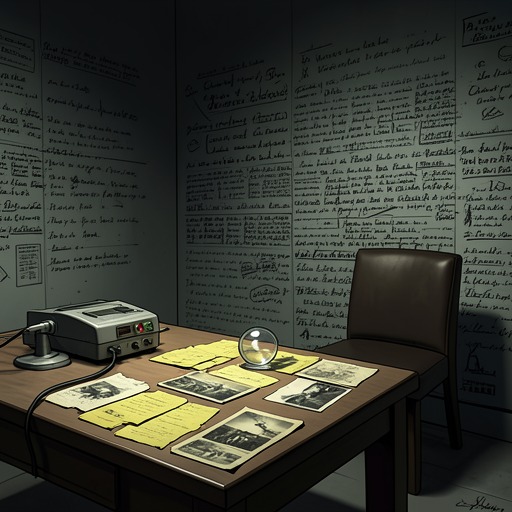
The Search of the Old Class 3 Classroom
AnotherThe Search of the Old Class 3 Classroom is the investigation that carries the 1998 Class 3 disasters from rumor into physical evidence. After forming a plan to enter the abandoned room in Building Zero, Koichi Sakakibara, Naoya Teshigawara, and Yuya Mochizuki recover an old audiocassette identified as Katsumi Matsunaga's recording. The action matters not merely because it finds a clue: it crosses a prohibited boundary, restores a suppressed voice, and demonstrates that the past has been materially preserved even when memories and records have been altered.
Causes and Background
The search begins with the need to understand the “extra person” and the disasters afflicting Yomiyama North Middle School Third-Year Class 3. The students have learned that the class’s attempt to increase the number of people treated as “not there” has failed, and that ordinary explanations are being distorted by the phenomenon. Mr. Chibiki confirms that records and memories can be tampered with while the casualty remains hidden, making details that should be impossible appear normal and preventing the class from recognizing the casualty’s identity. Investigation therefore becomes more than curiosity: it is an attempt to find evidence outside the unstable network of present-day recollection.
The old classroom is selected because Katsumi Matsunaga’s testimony may be connected with the disasters. Naoya Teshigawara has also been questioning Tomohiko Kazami about their childhood memories, and Kazami’s inability to remember their secret base by the river or a failed bicycle trip toward the ocean makes the reliability of remembered history increasingly suspect. The search consequently joins two lines of inquiry: the recovery of a physical record from the past and the testing of living memory against it.
Entry into Building Zero
The three students deliberately debate when to enter. Koichi recognizes that waiting until night would be dangerous because they must not still be inside when the sun goes down, while Teshigawara rejects both midday and early morning as unsuitable. They finally go according to plan after three o’clock, wearing their school uniforms so they will not attract attention and preparing to claim that the art club is holding a meeting if a teacher challenges them.
The second floor of Building Zero is explicitly closed. Ropes stretch across the eastern and western stairwell entrances, and a cardboard sign bears the words “Do Not Enter.” After checking that nobody is nearby, the three slip under the rope and climb the unused stairs. The procedure gives the search the character of an illicit expedition, but the prohibition is also practical: the building has been left untouched for years, and entering it means moving outside the ordinary institutional supervision of the school.
The Abandoned Classroom and the Tape
The hallway is brighter than Koichi expects because daylight enters through the northern windows, yet the grime, damage, accumulated dust, and stagnant odor make the years of abandonment unmistakable. The former classroom of Yomiyama North Middle School Third-Year Class 3 is the third room from the western end. Tomohiko Kazami had verified its position, having gone there with Izumi Akazawa and others at the beginning of May to retrieve the desk and chair intended for the student who was “not there.” The room is therefore not an abstract historical site; it has already been used to support the class’s present-day strategy.
Inside, the students search for a place where something could have been concealed. Koichi notices a tall, narrow wooden cleaning closet in the corner, roughly two meters high. It contains only old, ordinary supplies—brooms, a dustpan, a bucket, and a mop—until the search reveals an object fixed above them. Red writing on brown tape addresses students who may come after the original writers and may be afflicted by disasters that defy explanation. The message transforms the closet from a mundane fixture into a deliberate archive prepared for future victims.
Teshigawara recognizes the handwriting as Matsunaga’s. Removing the packing tape takes several minutes of difficult, straightforward labor, but the effort finally exposes a totally nondescript TDK sixty-minute audiocassette at the start of its reel. The object’s plainness is significant. Unlike a dramatic relic, it is an ordinary recording medium, yet its physical survival gives the students something that the phenomenon’s manipulation of memories and records cannot easily dissolve. They take Katsumi Matsunaga's cassette tape with them and flee the restricted area, returning to the art club room after five in the afternoon, later than Koichi had realized.
Evidence, Danger, and Consequences
The search’s discovery does not remain isolated from the violence surrounding Class 3. The recovered tape becomes part of the effort to reconstruct what happened before the current disasters, but the investigation unfolds alongside acts that show how quickly uncertainty can become physical danger. Mr. Kubodera withdraws a sharp-bladed knife from a bag on his desk before his speech collapses into unintelligible sounds, an event that reveals how investigation and explanation are occurring under the shadow of sudden death.
The danger later reaches the students directly. After Naoya Teshigawara attacks Tomohiko Kazami, he explains that Kazami had behaved strangely and could no longer remember shared childhood experiences. Koichi then enters a dark dining hall after noticing blood and is seized by the ankle. When he opens a heated door, he discovers that the strange sound and smell come from a fire, with flames filling the room and hot air and smoke forcing him back. These episodes do not constitute the classroom search itself, but they establish the stakes of the evidence it produces: attempts to recover the past take place within a chain of violence, altered memory, and lethal misrecognition.
The later investigation of the Sakitani Memorial Hall massacre provides a grim contrast to the tape’s role as testimony. The coroner’s findings show that none of the six victims died from the fire. Kensaku Numata was stabbed in the neck with numerous metal cooking skewers before being burned; four students—Manabu Maejima, Yonemura, Sugiura, and Nakao—died from blood loss caused by repeated stabbing and cutting; and Izumi Akazawa apparently died after breaking her spine in a fall from the second-floor balcony. Mieko Numata was conclusively held responsible for the deaths and was believed to have started the fire with kerosene after killing her husband, before dying by suicide while in custody. Against this background, the search’s cassette represents an alternative to destruction: where the memorial hall’s evidence is burned, cut, and physically erased, Matsunaga’s account survives in a small, recoverable object.
Significance in the Class 3 Mystery
The search dramatizes the conflict between institutional prohibition and the need for historical knowledge. Building Zero, the old classroom, the cleaning closet, and the tape form a sequence in which space stores what official routines and collective memory have failed to preserve. The students do not discover the past through a clear public record. They find it behind ordinary cleaning supplies, sealed under tape, accompanied by a warning written for unknown successors.
The action also clarifies the class’s exceptional social order. Mr. Chibiki is considered safe because he has no direct link to third-year Class 3, allowing him to interact with Koichi and Mei Misaki without effect. By contrast, most of the class participates in the decision to treat Mei and Koichi as “not there,” while Mr. Kubodera knows from the beginning that Reiko Mikami is Koichi’s aunt and that the supposed separation between school and home conceals a blood relationship. The search works against this enforced suspension of ordinary recognition: it seeks a record capable of naming what the class has been organized to ignore.
As a result, The Search of the Old Class 3 Classroom is both a physical raid and a struggle over who controls the past. The students cross the rope marked “Do Not Enter,” locate the former classroom, uncover the warning, and retrieve Katsumi Matsunaga's cassette tape. Its decisive consequence is epistemic before it is explanatory: the disaster is shown to have a history that can still speak, even when people, classrooms, and records have been made to forget.