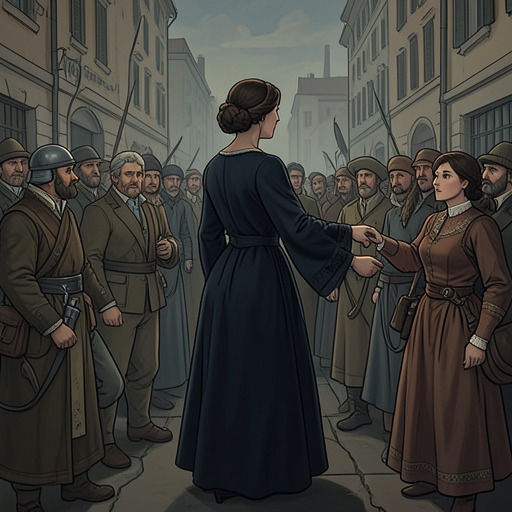
Understanding and refusing to understand
AntigoneUnderstanding and refusing to understand is the conflict between adapting to limits and holding fast to a choice that cannot be negotiated. In Antigone’s exchanges with Ismene and Creon, the word “understand” belongs to two opposed demands: that people learn to live within ordinary and political constraints, and that they refuse those constraints when compliance would require abandoning what they consider essential. Antigone does not deny the consequences. She rejects the idea that understanding them obliges her to consent.
A lesson learned in childhood
Antigone describes understanding as a command she has heard from others since childhood. Its everyday lessons are specific: she was told not to touch water lest it wet the tiles, or the earth lest it stain her dress. She was also expected to control her appetite, keep what she had in her pockets rather than give it away, and restrain the impulse to run in the wind, drink when hot, or swim at an inconvenient time. The repeated instruction makes moderation seem like a rule imposed on desire, not a neutral kind of wisdom.
Her answer is not that these restrictions are incomprehensible. She understands what others want her to do and why; what she rejects is the expectation that she must always adapt. She says she does not want to understand and will understand when she is old, then qualifies that promise: “If I ever get old. Not now.” The qualification gives her defiance a limit and a cost. The future in which she might accept compromise is uncertain, while the present is the time in which she refuses it.
Roles, duty, and what can be done
When Antigone tells Ismene that “Everyone has their part to play,” she describes their predicament in terms of assigned roles. Creon must have them put to death; they must bury their brother. The formulation recognizes the force of the situation without suggesting that Antigone welcomes it. To her, the roles have already been cast, and the question of what to do cannot be answered by pretending that the conflict will disappear.
Her sense of action is also bounded. Antigone tells Creon that there is nothing more she knows, but at least she can do this much, and must do what she can. That statement connects her refusal to a concrete obligation rather than to an abstract wish to oppose authority. She cannot claim the power to resolve everything; she can carry out the act she believes is hers to perform.
Creon’s argument for understanding
Creon presents understanding as necessary to governing and keeping a failing political community together. In his account, someone must say yes and steer the ship: it is taking on water, beset by crime, poverty, and misery, while the crew refuses its work, officers look after themselves, and the storm threatens everyone. Under those conditions, he argues, a ruler cannot pause to make fine distinctions about whether to say yes or no, or what a decision may cost him. He must seize the wheel, issue orders, and act against the first person who advances.
The ship image explains why Creon sees Antigone’s refusal as incompatible with his responsibility. The individual loses a name in the storm; only the ship and the storm remain. His claim is that political survival can demand choices that a person would not make in isolation. Yet the image also exposes the price of his position: order is preserved through action that treats people as an undifferentiated threat. Understanding, for Creon, means accepting that necessity can override personal distinctions and scruples.
Refusal as a chosen position
Antigone answers that she is there for something other than understanding. She says she is there to say no to Creon and then to die. Her refusal therefore does not rest on the belief that she can escape the outcome: she identifies death as part of the course she has chosen. When Creon insists that he has tried to understand her and asks her to be sure what she is dying for, Antigone’s position remains that he cannot hear her. She says she knows what she is saying, but speaks from a kingdom he can no longer enter, setting her own certainty against his accumulated wisdom and authority.
The disagreement is sharpened by Antigone’s rejection of Creon’s political obligations and account of necessity. She says that she did not say yes, that she can still say no to what she dislikes, and that the choice is hers alone. Creon, by contrast, can have her put to death because he has said yes. The opposition makes consent and power unequal: Antigone’s no cannot prevent the punishment, but neither can Creon’s authority turn it into her agreement.
Happiness, compromise, and the limits of reconciliation
The conflict over understanding widens into a conflict over happiness. Antigone condemns a life organized around protecting happiness at any cost and mocks the search for a small chance of contentment so long as one does not ask for too much. She insists on wanting everything, whole and immediate, or nothing. The demand is not a practical plan for securing every desire; it defines the compromise she refuses to call sufficient.
Together, these exchanges distinguish knowledge from assent. Antigone understands that her actions place her in conflict with Creon and that he intends to kill her; she does not accept that this knowledge should make her yield. Creon understands the dangers he believes threaten the state and treats political command as an obligation to act. Neither account persuades the other, because they set different limits on what may be sacrificed: Creon invokes the community’s survival, while Antigone insists on the integrity of her no and on doing what she can. Their impasse makes understanding not a bridge to agreement but the very term over which the tragedy’s opposing demands become clear.