Saying “yes” and saying “no”
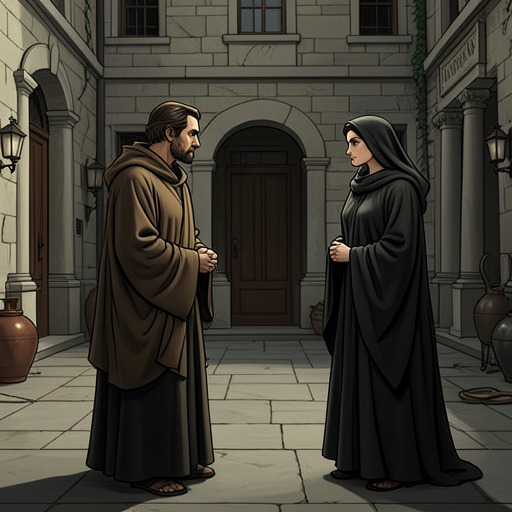
Antigone“Saying ‘yes’ and saying ‘no’” is the play’s central conflict of choice: Antigone treats refusal as a freedom she will not surrender, while Creon argues that someone must accept the burden of governing and act to keep the state afloat. Their disagreement is not merely over a decision. It is over what a person owes to family, to political order, and to the self—and whether compromise can count as a livable answer.
The roles of refusal and responsibility
Antigone initially describes their predicament as a casting of roles: Creon must have them put to death, and she and Ismene must bury their brother. The formulation makes the conflict seem already assigned, but it does not make Antigone’s choice feel passive. She sees burial as what she must do, and later insists that she has to do what she can. Her limited power is not an excuse for inaction; it is the measure within which she acts.
That emphasis distinguishes what each character understands as obligation. Antigone’s responsibility is immediate and familial: burying her brother. Creon’s is public and political: keeping a damaged community from collapsing. Their duties point in opposite directions, and neither speaks as though a satisfactory compromise were available. The tragedy grows from the fact that each frames a choice as necessary while refusing the other’s account of necessity.
Antigone claims the right to say no
In the confrontation, Antigone rejects Creon’s assumption that his political concerns, obligations, and explanations should persuade her. She insists that she has not said yes, that she can refuse what she dislikes, and that the choice belongs to her alone. Creon’s crown, guards, and royal authority give him the power to put her to death; they do not, in her view, turn his agreement with political rule into hers. His ability to impose the consequence exposes the difference between coercive power and consent.
She also interprets Creon’s continued attention as evidence that he wants to hear her through to the end. Although she says she has nothing more to learn from him, she recognizes that he is listening rather than simply summoning his guards. The exchange therefore holds two acts of speech against each other: Creon’s governing yes, which commits him to action, and Antigone’s no, which denies that his decision can define her assent.
Her refusal is not presented as a plan for political power or a route to survival. Antigone says she is there to refuse Creon and then die. The stark pairing makes the consequence part of the choice she declares, rather than a danger she has overlooked. Her insistence is absolute precisely where her practical control is not: Creon can order her death, but she maintains that he cannot make her say yes.
Creon’s ship and the demands of rule
Creon answers with an image of a ship taking on water from every side. He describes a state beset by crime, poverty, and misery, with a spinning wheel, a crew that will not work, officers looking after themselves, a damaged mast, and sails beginning to tear. In that emergency, he argues, there is no time for fine distinctions about whether a ruler ought to say yes or no. Someone must seize the wheel, issue an order, and act against whoever advances.
The ship image makes Creon’s argument consequentialist in its emphasis: the threatened community must be kept from disaster, and the ruler’s immediate duty is to steer. Yet the cost of this kind of action is also present in his account. In the disorder, the person struck down loses his name; Creon, clinging to the wheel, loses his name as well. Only the ship and the storm retain names. Political responsibility may demand action, but in his own metaphor it can erase the distinctions and identities that make individual moral choices meaningful.
Creon’s defense is not simply that power permits him to decide. He presents rule as exhausting work: to say yes is to sweat, roll up one’s sleeves, seize life with both hands, and plunge into it. By contrast, he calls saying no easy, even when it ends in death, because it can mean sitting and waiting. His criticism turns on what he sees as unequal burdens: the ruler must enter the disorder and take responsibility, while the resister can refuse participation. Antigone does not accept that description of her own action as mere passivity.
Refusing understanding and compromise
Antigone answers the shipwreck argument by saying she does not want to understand. She distinguishes her purpose from Creon’s: understanding may help him govern, but it is not what she has come to do. Her refusal to be persuaded is thus also a refusal to adopt his terms of judgment. She will not weigh the political emergency as he weighs it, because doing so would make his measure of necessity the measure of her decision.
That separation sharpens when she condemns the happiness and ordinary life that others feel required to love at any cost. She compares those who accept small chances at happiness to dogs content to take what is available, and declares that she wants everything, wholly and now, or nothing. The demand rejects incremental satisfaction and the compromises that make a tolerable life possible for Creon’s world. It gives her no workable middle ground between complete fulfillment and refusal.
Her attack on hope follows the same logic. Invoking her father, Antigone says that questions continue to the end, until no hope remains—not even the smallest possibility left to strangle—and describes stamping out hope wherever it appears. Hope, which might ordinarily open a path toward compromise or survival, becomes something she distrusts because it can prolong negotiation with an outcome she rejects. The language makes her no more than a single answer: she will not let possibility soften the refusal she has chosen.
An irreconcilable standard of choice
The conflict cannot be resolved by showing that one character has no duties or the other no agency. Antigone acts from the duty to bury her brother and claims ownership of her refusal, though she cannot control the sentence imposed on her. Creon acts from the responsibility he assigns to political leadership, while his ship metaphor acknowledges that rule can strip both opponents and rulers of their names. Each sees a cost in the other’s choice, but they do not agree on which costs can be accepted.
The repeated opposition between yes and no therefore gives the confrontation both its political and ethical form. Creon’s yes means taking hold of a compromised world and acting within it; Antigone’s no means refusing to make that compromise her own. Her choice leads toward death, while his argument stresses the need to preserve the state and the lives aboard it. The play leaves those standards in collision: responsibility may demand participation, but survival and order do not persuade Antigone to assent.