Political responsibility and order
AntigonePolitical responsibility and order in Anouilh’s Antigone are not a settled civic ideal but a bitter argument over what governing requires and what a person may refuse. Creon regards rule as work that someone must undertake, even when its tasks are repellent and its choices morally compromising; Antigone insists that the obligation to bury her brother cannot be absorbed into political necessity. Their opposition gives the play’s conflict its shape: one accepts responsibility by saying yes to an imperfect world, while the other preserves her integrity by saying no, whatever the consequence.
Rule as an Unchosen Duty
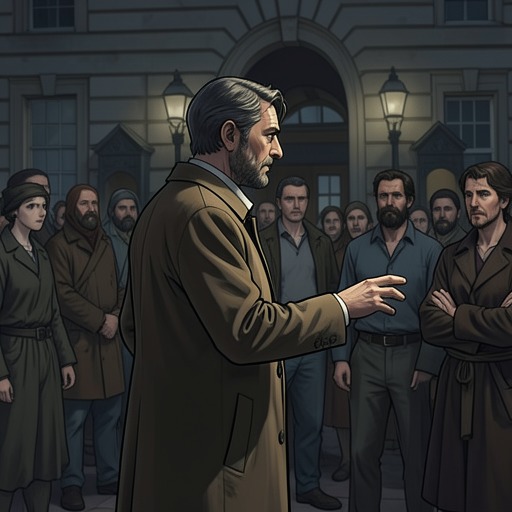
Creon describes his accession as something that happened rather than as the fulfillment of an ambition. He recalls waking one morning as king of Thebes and says that he loved other things in life more than power. Yet, when he considered refusing the role, he felt like a workman declining the work in front of him. He therefore said yes, treating acceptance as the honest response to a task that could not simply be left undone. His account makes authority less a privilege than an obligation, though it also reveals how readily duty can become an argument for accepting the burdens and compromises of power.
That logic is explicit when Creon tells Haemon that everyone eventually has to accept that they are men. He marks the present as Haemon’s painful day of recognition and imagines the moment when his son crosses the threshold and leaves him: adulthood, in this account, means entering a world where responsibility cannot be avoided. Creon’s language makes political maturity continuous with personal loss. To govern and to grow up alike require accepting conditions that cannot be made wholly just or painless.
Antigone’s Refusal and Familial Obligation
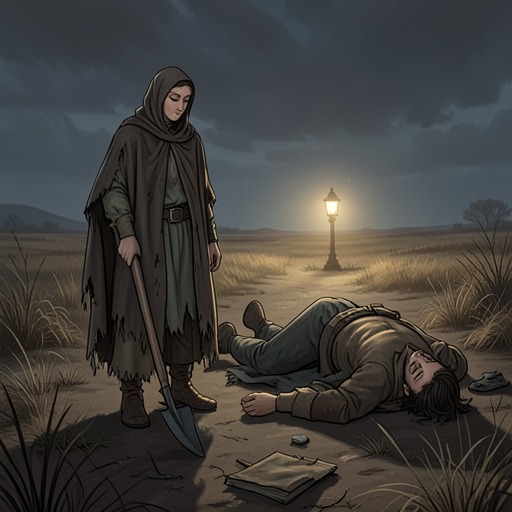
Against Creon’s account of necessary acceptance, Antigone gives her action a narrow but absolute scope. She knows she can do little, but says that at least she can do this, and that she must do what she can. Earlier, she frames the conflict as a division of roles: Creon must have the sisters put to death, and they must bury their brother. The stark symmetry does not make the roles equally powerful. Creon possesses the authority to impose death; Antigone claims only the ability to carry out the familial duty that his rule forbids.
Antigone rejects Creon’s attempt to persuade her through politics, obligations, and his account of how the crown came to him. She says that she did not say yes, and that she alone retains the choice to refuse what she dislikes. Creon can have her put to death, she argues, because he said yes; his political power can determine her fate, but cannot make her consent to the principles behind it. Their disagreement is therefore not simply between obedience and disobedience. It concerns whether a ruler’s responsibility can require a subject to accept a compromise that the subject regards as intolerable.
That refusal extends beyond the burial dispute into Antigone’s standard for happiness. She rejects the contentment of those who love life at any cost, comparing them to dogs that lick whatever they encounter and search for a small chance of happiness so long as they do not ask too much. She demands everything, here and now, whole and complete, or else nothing. The demand clarifies why Creon’s offers cannot reconcile them: a workable, limited life is for him the condition of continued existence, while for her it falls short of what life must be.
The Decree as Public Policy
Creon’s account of Polynices’ exposed body shows how he translates a private act of burial into a political problem. He says he would have buried his nephew for sanitation, but has kept the body unburied because the city must understand what has happened. The day after a failed revolution, he argues, the city needs to smell Polynices’ corpse for a month. The image makes the cost of his policy concrete: an administrative decision is not confined to law or palace debate but becomes an odor that reaches the palace and, in Creon’s telling, must be experienced by the whole city.
The exposure is at once repellent and deliberate. Creon says that the stench turns his stomach and that he will not close his window; although he considers the policy stupid, he believes the city must endure it for a while. He likens the people he governs to sheep who need to understand the consequences of revolt. His stated aim is public instruction, not personal vengeance, but the means of instruction impose a physical burden on the city and make the body of Polynices a political instrument. The tension between sanitation and spectacle reveals the cost embedded in Creon’s notion of order: a ruler may recognize a policy’s cruelty or absurdity and still defend its usefulness to government.
The Ship and the Necessity of Command
Creon’s most expansive defense of rule is an image of a ship taking on water in a storm. Crime, poverty, and misery fill it; the wheel turns with the wind; the crew refuses to work and pillages the hold, while the officers build a raft and reserve its fresh water for themselves. The mast cracks, the wind howls, and the sails tear. In this emergency, Creon argues, someone must take the wheel and steer. Careful distinctions about whether to say yes or no seem like luxuries when the vessel and everyone aboard it may be lost.
The metaphor also exposes what this kind of command demands. Creon describes shouting orders and shooting at the first person who advances into the crowd. Under the pressure of collective danger, he says, the person struck loses a name, as does the ruler who clings to the wheel. Only the ship and the storm retain names. Political responsibility thus appears not as clean, impartial authority but as action that may erase the identities of both victim and decision-maker. Creon’s insistence that the ruler must act carries a grim consequence: the order that keeps the ship moving may depend on treating individuals as indistinguishable parts of a threatening crowd.
The Work That Remains
Near the end, Creon returns to the language of labor. When a job is waiting to be done, he argues, a person cannot fold their arms and refuse simply because the work is dirty; if one person does not do it, someone else must. The formulation echoes his recollection of the workman who cannot honestly decline the task of kingship. It also leaves the ethical question unresolved: accepting responsibility may prevent the abandonment of public duties, but it does not make the task or its consequences clean.
That unresolved tension defines the play’s treatment of political order. Creon’s yes keeps authority functioning, yet its logic leads him to defend a policy he admits is revolting and to demand action that can strip people of their names. Antigone’s no protects the force of a duty that cannot be negotiated into ordinary political terms, but it cannot protect her from the ruler’s power to impose death. Neither position converts the other: for Creon, refusing the work is itself a failure of responsibility; for Antigone, accepting a compromised life means surrendering what she cannot surrender. Political responsibility remains necessary and costly, while order remains vulnerable to the very coercion used to maintain it.