Burying the dead and funeral rites
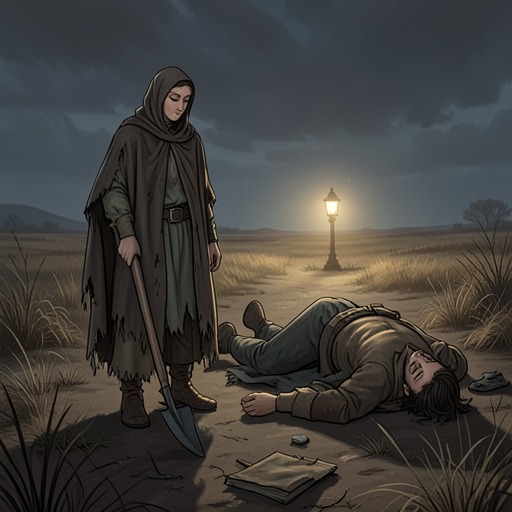
AntigoneBurying the dead and funeral rites are the play’s central point of collision between kinship, sacred obligation, and political authority. Creon orders a grand funeral for Eteocles while forbidding Polynices’ burial, making the dead brother’s exposed body a warning to the living. Antigone answers not with a claim to power but with the insistence that the dead must be laid to rest; Creon, who would bury Polynices for reasons of sanitation, nevertheless keeps the body exposed because the city must learn from its stench. The rite is therefore both a gesture of care for one dead person and a public contest over what the living are required to accept.
A Funeral Decree as Public Order
After Eteocles and Polynices kill each other outside Thebes, Creon distinguishes them in death as sharply as his decree can. Eteocles, named the good brother, receives a grand funeral; Polynices, branded a villain and traitor, is to remain unmourned and unburied, exposed as food for jackals and vultures. The decree does not merely withhold honors. It makes the refusal of burial a visible punishment and declares that anyone who performs the sacred rites for Polynices will be put to death. The city’s new order is thus established through both a sanctioned funeral and the threatened denial of one.
That distinction rests on a political judgment about the brothers, but Antigone refuses to let it settle the dead brother’s claim to rest. She describes the roles as already cast: Creon must have her put to death, and she and her sister must bury their brother. Her formulation makes the clash seem larger than a dispute over procedure. The decree assigns the living their parts, but Antigone treats burial as an obligation that cannot be canceled by the state’s verdict on Polynices.
The Dead as Kin, Not an Abstraction
Antigone explains her action through the ordinary intimacies of family care. If a living brother returned exhausted from a long hunt, she says, she would take off his shoes, bring him food, and make his bed. Polynices, she insists, has finished his hunt. He is returning to the house where their father and mother, and Eteocles too, are waiting for him; he has a right to rest. The domestic image transforms the apparently simple act of putting earth on a body into the last service a sister can offer her brother.
This sense of duty also reaches beyond the household. Antigone says that the unburied wander for all eternity without finding rest. Her words make burial more than a customary honor: withholding it leaves the dead in a state of endless unrest. She does not claim she can do everything, but says this is something she can do and therefore something she must do. Her commitment is expressed through limited agency—she cannot reverse the deaths or the political settlement, but she can refuse to leave her brother without burial.
Ritual, Belief, and Practical Resistance
Creon challenges the religious rationale for the rite by asking whether Antigone truly believes that a soul will wander forever unless someone throws a little dirt on the body with the right words. He points to the priests of Thebes, whose tired attendants shorten gestures and swallow words so they can finish the ritual and have another drink before lunch. In his account, the formal ceremony is already compromised by haste and habit. He calls it a ridiculous passport and a litany of gibberish, arguing that Antigone would herself have been ashamed to see it performed.
Antigone’s answer does not depend on defending every element of the ceremony. She says she knows that burial may amount to nothing more than this, but that at least she can do it, and has to do what she can. The exchange leaves the rite suspended between two understandings: Creon sees its prescribed words and gestures as hollow, while Antigone insists on the act’s moral force even when its outcome cannot be proven. The disagreement is therefore not resolved by establishing whether the ritual works in the afterlife. It turns on whether uncertainty gives the living permission to abandon the dead.
The Body as Political Message
Creon’s opposition to the burial is not presented as simple reverence for custom or personal hatred of the corpse. He tells Antigone that the decomposing body, surrounded by guards, and the drama around it are all politics. He claims that he would have buried Polynices for sanitation alone, and that the smell turns his stomach; nevertheless, he will not close his window. The city, he says, needs to smell the body for a while. He intends the whole of Thebes to endure that smell for a month so that the people he governs will understand the cost of disorder.
The body consequently carries two meanings that cannot be separated. For Antigone it is her brother, whose right to rest survives his political identity. For Creon it is a public lesson, an instrument through which the ruler makes the city experience the consequences of rebellion. He can regard the corpse as revolting and still preserve its exposure as policy. That contradiction reveals the decree’s harsh logic: the practical case for burial does not prevail because the spectacle of non-burial is meant to do political work.
An Irreconcilable Measure of Duty
The argument over funeral rites condenses the difference between Antigone’s refusal and Creon’s governance. Creon insists that someone must say yes and steer the ship through crime, poverty, and misery; authority must act amid dangers that do not permit perfect distinctions. Antigone rejects the premise that political obligation can require her assent. She says she did not say yes, and that her choice is hers alone. Against Creon’s demand for a decision that sustains the city, she sets a duty to her brother that she will not trade for survival or compromise.
Their measures of what can be sacrificed do not meet. Creon treats the burial ban as a terrible but necessary political message; Antigone treats burial as the one remaining act she can perform for a dead relative. Her insistence that she wants everything, whole and complete, rather than a modest share of happiness belongs to the same refusal of partial settlement. Funeral rites are where that refusal becomes concrete: a little earth, a brother’s rest, and the question of whether the city’s order can claim authority over the dead as well as the living.