Article 129a of the Criminal Code: Propaganda for terrorist organizations
AuerhausThe terrorism-related provision is invoked against the Auerhaus residents after a search turns their kitchen’s homemade “terrorists” poster into part of a criminal investigation. Its appearance marks the distance between the household’s comic, improvised games and the authorities’ literal legal reading of them: the prosecutor names the terrorism charge, but it does not become a conviction at trial.
The Charge During the Search
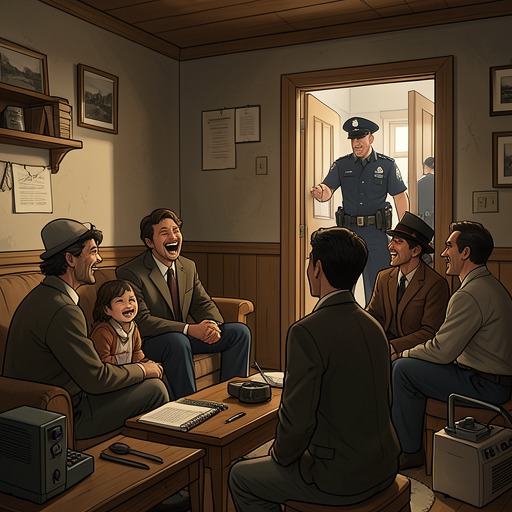
During the search, people in plain clothes replace the masked officers, and the group is kept in the kitchen while a prosecutor displays an official warrant. The investigation includes the drug law; as the officers inspect Frieder’s conscription file, they also list suspected theft, suppression of documents, denigration of the state and its symbols, forgery, and property damage. The prosecutor then points to the “terrorists” poster hanging above the sink and adds the charge of promoting a terrorist organization.
The poster had grown out of household jokes and routines. Residents who failed to wash up had their portraits added to it, and the group also pasted on photographs of recently deceased celebrities they disliked, crossing those out with a large X. The poster thus made the residents’ shared domestic satire physically visible to the investigators. When the prosecutor names the terrorism-related offense, Frieder’s grin disappears; the shift in his expression registers that this accusation has a different weight from the other charges read aloud.
From Investigation to Trial
The search does not establish that the household was a terrorist organization. At the later trial, the narrator recalls Pauline telling the kitchen workers, quietly, that the authorities had even tried to charge them with supporting a terrorist organization, before adding that they would have to get up earlier to make that case stick. Her remark presents the accusation as one of the prosecution’s expansive attempts, not as the court’s eventual finding.
The trial ends with separate outcomes for the residents. Cäcilia is acquitted after her parents’ lawyer argues that she was not pictured on the poster, a defense the narrator wryly calls an acquittal by dishwashing. Vera, Pauline, and the narrator receive forty hours of community service each for theft and defaming the memory of the dead. Frieder receives fifty hours, with the wooden pistol also contributing to his sentence. Harry receives a suspended prison sentence for drug dealing and possession, as well as a two-year driving ban connected to the pursuit. The terrorism-related accusation is not among the offenses for which the residents are convicted.
Legal Labels and Social Consequences
The charge shows how an everyday object can acquire a radically different meaning inside a legal investigation. To the household, the poster is a joke shaped by chores, teasing, and irreverence; to the prosecutor, its wording is evidence worth naming under a serious criminal provision. The scene does not report a prosecution or conviction under that provision, but it does show the threat of that legal label entering the residents’ lives alongside the charges that do reach judgment.
That gap between accusation and outcome matters. The court ultimately distinguishes among the residents and the conduct attributed to them rather than treating the group as a single terrorist enterprise. Pauline’s quiet recollection of the charge during community service keeps the investigation’s reach present even after the trial: the accusation remains part of how the residents remember their case, while the verdict records other offenses and penalties.