Birth–School–Work–Death-Lebensschema
AuerhausThe Birth–School–Work–Death-Lebensschema is the novel’s shorthand for a life arranged in advance: birth followed by education, work, and death, as if a person could be filed away under a label and moved through its stages. The six friends’ shared house is an attempt to interrupt that sequence, but Frieder’s suicidal crisis makes the challenge more urgent than youthful rebellion. The formula promises order; the Auerhaus exposes how little order can tell its residents about what makes a life bearable, or whether someone will remain alive.
The sequence and its apparent inevitability
The schema first appears as a system of sorting. The friends imagine that their lives should not be filed into folders marked “Birth-School-Work-Death.” Their response is to move together into the Auerhaus, a students’ shared house in a village, with the immediate purpose of helping keep their best friend Frieder alive. Their alternative is practical as well as symbolic: instead of accepting a prescribed route as a private, inevitable destiny, they make a household whose days depend on shared attention and care.
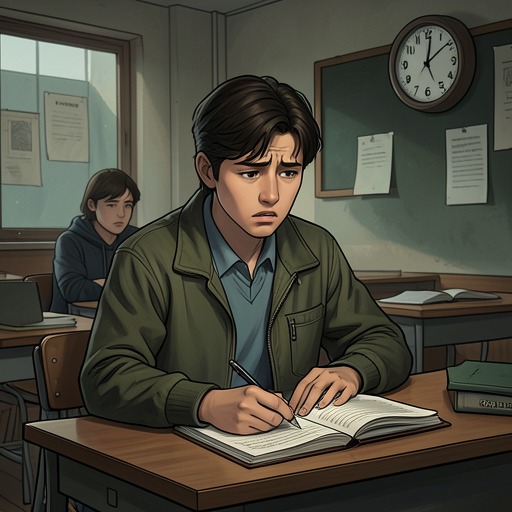
At school, the old sequence seems to continue unchanged. There are classes, breaks, and exams; the machinery appears to be the same. Yet the narrator and Frieder read what they choose at their desks, and their teachers leave them alone. The narrator reads comics while Frieder reads philosophers, psychologists, and instructions for suicide, including Alfred Adler’s question, “Wozu leben wir?” The question sits inside the school day without fitting its timetable. The institution still organizes time, but its ordinary progression cannot supply an answer to why living matters.
The other students make the schema’s social force visible. Asked why they live, the narrator imagines, they would say that the question is not on the exam and does not need to be known. They are at home in the school system, pass through the Abitur, and go on to study; when their cocoons open, they resemble their parents and inherit a practice, law office, or engineering firm along with their educational credentials and lives. Their version of the sequence is not simply a slogan. It is a path secured by family continuity, and its smoothness contrasts with the uncertainty that has drawn the Auerhaus residents together.
A household built against the script
For the narrator, moving in with Frieder also means getting away from his mother’s hostile boyfriend, F2M2. At home he is expected to help pave the driveway, paint the facade, and cover the ceilings with ugly boards, while enduring F2M2’s complaining. When the narrator’s mother speaks with him for more than five minutes, F2M2 responds with silence as punishment, drinks six or eight beers, and then explodes. The shared house therefore offers an escape from a family setting in which the narrator is assigned labor and exposed to hostility, not just a different place to sleep.
The decision to share the responsibility for Frieder develops from the fear that looking after him alone would be too much. The narrator wonders what would happen if someone else moved in too, so that two people could watch over Frieder. Vera agrees to join. The Auerhaus takes shape not as an abstract rejection of conventional life but as a chosen arrangement of people who accept responsibility for one another.
Its first evening gives that alternative an ordinary, domestic form. The residents sit around the kitchen table with the only cassette then available, while the rest remain somewhere in the moving boxes. The music is so loud that they cannot talk over dinner. They twirl spaghetti onto their forks and bob their knees; there is not much to discuss yet, because it is only the beginning. Against the schematic sequence of school and future work, the scene offers no manifesto. Its meaning lies in the newly shared table, the boxes still waiting to be unpacked, and a life beginning before its inhabitants know what to say about it.
Caring for a life without a formula
The shared routine soon becomes a form of watchfulness. Breakfast, lunch, and dinner bring repeated conversation, and all that talking amounts to keeping an eye on one of their own, who has tried to kill himself. The narrator admits that even after weeks he cannot understand why someone would want to die. He can partly understand the idea, but cannot understand that anyone would actually try. The distinction between conceptual knowledge and lived crisis unsettles the confidence that a conventional life sequence can make its stages intelligible.
Frieder gives the narrator a more exact distinction. After spending the day thinking, he explains that he did not want to kill himself; he simply did not want to live anymore, and believes those are different things. The sentence refuses to turn a suicide attempt into a simple, settled wish for death. His account gives the household a way to talk about an experience its members cannot resolve, but it does not make them able to predict what he will do.
That uncertainty becomes especially stark around ordinary departures. When Frieder says he will still ride his bicycle, the narrator and the others hurry to catch the bus into town. In the third period, the seat beside the narrator remains empty, and he imagines Frieder hanging from a rope in the hayloft. He cannot stop the image. The feared outcome is not a distant abstraction in the life sequence: it is present in a vacant place beside him, even as the day’s transport and lessons continue.
The narrator also learns that outward mood cannot serve as a reliable guide. When Frieder pauses before speaking, the narrator does not know whether he is about to announce that he has decided never to try again or that he plans to die that day and wants everyone out of the house. Sadness might mean tiredness; happiness might mean that he is already about to jump. Frieder has told him that someone who has thought about suicide continually may become suddenly cheerful, without reason, after deciding. In this household, an apparent return to normality can intensify rather than end the fear. The sequence’s tidy stages offer no dependable sign by which the others can know what comes next.
Home, institutions, and competing futures
The word “home” itself changes according to who is speaking. On December 24, the narrator is at his family’s house, but he says that his real home is the Auerhaus. With people outside the shared household, “home” means family; among those who are at home in the Auerhaus, it means the shared house. The distinction makes belonging something established through shared life rather than automatically guaranteed by kinship. It also shows that leaving home does not erase the family: the narrator returns to a changed room and discovers that his sisters have stopped sharing, with each now having her own room. The sister old enough to think F2M2 is foolish has inherited the narrator’s portable television.
The school’s routine is set beside another institutional track: military conscription. The narrator is uncertain whether he will get through the Abitur and still does not know what to do about the Bundeswehr. Frieder, officially classified as insane, does not have to undergo the medical examination; the psychiatric hospital sends a certificate and the matter is settled. The narrator bitterly recasts the extra time as fifteen months given free because Frieder once tried to shorten his life. Then the formula mutates into “Birth, school, bummbumm, work, death.” The inserted sound of gunfire makes the passage from schooling toward adult obligation feel newly charged, rather than a neutral progression.
Frieder’s own place in this expected future remains uncertain even to his parents. He says they are proud that he attends the Gymnasium and would be proud if he went to the moon, but would not understand him. Their pride follows visible achievement; it does not bridge the gap between the expected milestones and his inward struggle. The narrator’s classmates, by contrast, seem able to accept the sequence as a family inheritance. Between these responses, the schema describes not one universal experience but a social arrangement that feels natural to those who can move through it and inadequate to those whose lives have become difficult to continue.
What the formula cannot settle
The novel does not replace the sequence with a confident theory of recovery. When the narrator asks whether he should save Frieder if he is suddenly in danger, Frieder takes a long time before saying that he thinks he may be rescued and wants to make the choice himself. He then argues that someone who asks whether his absence would matter does not go through with suicide, because he believes he matters. The exchange preserves both agency and connection: Frieder does not ask others to take the decision away from him, yet imagines a future in which his absence would count.
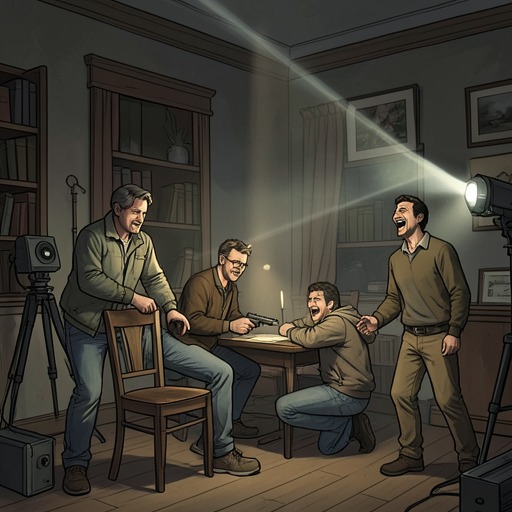
Later, after Frieder admits that he had deliberately tried to provoke the policeman into shooting him, the narrator hits him repeatedly and tells him to kill himself if that is what he wants, but to leave the others out of it. Frieder turns aside and tries to throw him off, but does not fight back. The violence does not yield a clean answer or resolve the difference between wanting rescue and courting death. Instead, the scene shows how the burden of watching over someone can become anger when friendship cannot control the danger it confronts.
After Frieder’s eventual successful suicide, the narrator can no longer find an answer to why Frieder wanted to die in the first place. The more he had talked with him about the first attempt, the paler the question became, until it had almost disappeared; whether the reasons were the same in the final suicide remains unresolved. The narrator’s reasoning favors a choice that leaves more possibilities open: if he does not kill himself today, he can still do it tomorrow, whereas death removes tomorrow’s choice. The Birth–School–Work–Death-Lebensschema is thus neither accepted as destiny nor replaced by an explanation that masters loss. Against its closed sequence, the novel sets the contingent work of staying together and the possibility that, for now, another day remains open.