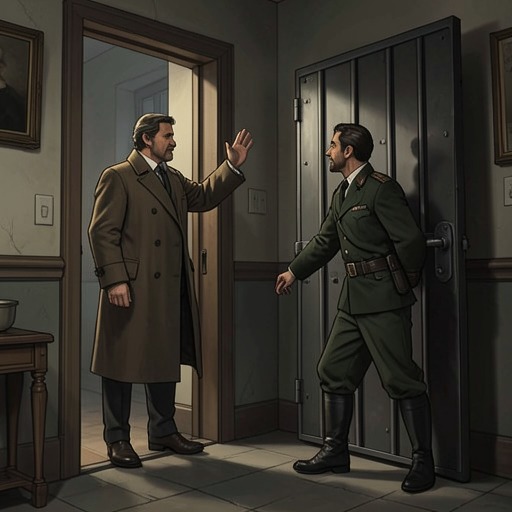
Frieder Steals the Narrator’s Conscription Medical File
AuerhausFrieder Steals the Narrator’s Conscription Medical File turns a compulsory medical examination into a comic, carefully staged act of evasion. When the narrator is summoned to the examination office in Stuttgart, Frieder enters under the pretext of searching for a lost bicycle key, draws the officials into looking beneath a table, and takes the narrator’s file while they watch him. The act briefly interrupts the military’s power to assign the narrator a future; its later discovery, however, makes the file evidence in a criminal case.
The summons and the examination
The episode begins with police officer Bogatzki arriving at the Auerhaus with an official document. He says it directs the police to collect the narrator and take him to the conscription examination; the narrator has already received two summonses, and Bogatzki insists that he must attend. When the narrator asks whether he can come in handcuffs, Bogatzki accepts the choice, though he plainly knows the narrator will not resist. His clumsy restraints hurt the narrator’s wrists, and Bogatzki discovers that he cannot find the key. Vera is allowed to accompany the narrator, while Frieder sets off by bicycle toward Stuttgart.
At the district examination office, Bogatzki waits outside so the narrator will not run away. Inside, the setting is almost entirely brown-gray: the facade, corridors, floor, benches, and employees’ uniforms blend into a single institutional color. A physician reads the narrator’s file, then orders him to undress and warns that refusing to cooperate would violate the conscription law. The examination thus treats the file as an administrative account of the person even before the commission has finished deciding what that person is fit to do.
After a long wait, the commission declares the narrator fully fit for service, rating him T1. Officials suggest assignments with the guard battalion or paratroopers. The narrator has been measured, classified, and given a place in the military system. That finding is the immediate stake in Frieder’s intervention: the paper he steals records an official judgment with consequences for the narrator’s future.
Frieder’s distraction
As the officials tell the narrator to wait outside, Frieder appears in the room, sweaty from cycling, and urgently asks whether anyone has found his bicycle key. He gets down on the floor and presses his cheek against it to peer across the carpet. Vera joins him, feeling around behind the chair legs. Frieder explains that he must hurry home because his grandfather is waiting for lunch, and invokes his grandfather’s captivity in Siberia as a reason the meal must be on time. His story is so improbable that it might have ended the performance; instead, it persuades the military men to join the search.
The suit-wearing official slides from his chair to look beneath it. The other officials crawl around the floor, following his lead, while the physician and the narrator remain seated. From beneath the table, Frieder elaborates on the cold, distance, and frozen toes of his grandfather’s journey on foot. Vera eventually calls out that she has found something. Frieder confirms that it is the key, thanks everyone, and leaves abruptly, slamming the door behind him. The performance has occupied the officials’ attention long enough to remove the file from their control.
The theft and its explanation
Frieder waits in the stairwell. Later, he and Vera present the narrator with a plastic bag containing a cardboard folder bearing the narrator’s name and the federal eagle. The top page is marked T1, fully fit for service: this is the examination file. The joke and suspense of the search now resolve into a concrete act. Frieder has taken an official record out of the room while its custodians were crawling across the floor.
Vera says she tried to watch the proceedings but could not see what happened while she was searching too. Frieder explains that the suited official had the folder in front of him. Once the man crawled under the table, the others watched him, and the folder was left exposed on the desk. Frieder says he had taken it while continuing to search on the floor. His comparison is to winning the lottery: a person must not celebrate, or the vultures will immediately gather. The line captures the balance on which the theft depended—success required Frieder to remain inside the distracting performance even after he had secured the document.
The act is collaborative, though the roles are unequal. Frieder devises and executes the misdirection; Vera joins the search and helps maintain the scene, then identifies the object they have been seeking. The narrator is the beneficiary rather than the thief, and his file is the material prize. Their evasion is not an abstract rejection of military service: it works through a particular vulnerability in the examination room, where officials’ attention can be diverted from a folder to a man on the floor.
The file’s return to view
The escape is temporary. When the authorities later search the Auerhaus, the file is found in the freezer. A prosecutor identifies charges of theft and suppression of documents, then points to additional alterations: Frieder has drawn lines through the federal eagles on the papers and added images of skewered chickens and small campfires. The document that once classified the narrator as fit for service has become both a concealed object and a surface for Frieder’s irreverent marks. Its recovery turns a successful diversion into part of the state’s case against the household.
The episode’s humor does not erase the pressure surrounding it. Bogatzki’s summons, the handcuffs, the examination, and the commission’s T1 decision show official power operating through orders, physical restraint, tests, and paperwork. Frieder answers not by confronting the commission directly but by making its officials participate in an absurd search. The file theft temporarily interrupts the institution’s authority to classify and deploy the narrator, while the later discovery demonstrates the limits and cost of that interruption. The folder survives both as the record of a medical judgment and as evidence of the household’s defiance.