Frieder’s Funeral and Burial
AuerhausFrieder’s Funeral and Burial is the communal farewell to Frieder, in which his friends and family must handle the physical fact of his death themselves. The ceremony moves from a crowd’s stunned silence to the awkward work of carrying and lowering the coffin, and ends with personal offerings at the grave. Its small, practical gestures make grief visible without making it orderly or complete.
Setting and the first sight of the coffin
The funeral takes place in spring, on the Thursday before Easter, or Maundy Thursday. The sun has regained its strength; the sky is intensely blue and empty, while fruit trees bloom white behind a hedge. The narrator connects the season to Easter and the story of Jesus, reflecting as a child had on the brief interval between Christmas and Easter. That association places Frieder’s burial beside a religious account of death and resurrection, but the narrator’s attention remains on the world immediately at hand.
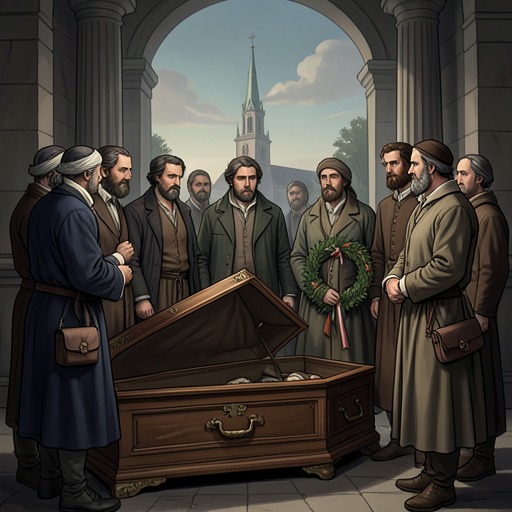
The mourners are silent as they stare at the hall doors. A loud clatter comes from within; the doors are unlocked and swing open. A wheeled stand emerges, pushed by the pastor and Frieder’s father. The crowd gives a sigh as the coffin comes into view: a huge brown wooden box with an oversized lid and bronze handles like heavy door knockers. The coffin’s imposing size makes the death difficult to keep at a distance, even as the narrator’s simple recognition that everything is true and finally decided registers the moment’s irreversibility.
The narrator briefly asks what comes next. Frieder’s voice answers that the lid should be opened because he cannot bear to see the mourners’ foolish faces. The request, spoken as Frieder’s, cuts across the solemnity: the dead friend is still present in the group’s remembered language, while the coffin confirms that he cannot take part in the ceremony. Vera goes to embrace Frieder’s father and speaks with him. She returns with the practical news that the pallbearers have not arrived, leaving the friends and family to carry the coffin themselves.
Carrying the coffin
Harry takes one of the coffin’s handles. Vera corrects the group when they try to carry it by the handles, insisting that it must go on their shoulders. The change turns the burial into a collective physical task rather than a procession conducted by hired bearers. But the mourners are of different heights, and their first attempt to lift the coffin onto their shoulders does not work. They exchange positions and rotate around one another, like riders in a Belgian circle, until they find an arrangement that holds.
The smaller people take the front near the feet: Vera and Frieder’s father are among them. The taller mourners take the back by the head, including Harry and the narrator, while the pastor and Police Chief Bogatzki stand between. The arrangement is practical, but it also places Frieder’s friends, family, and religious representative together beneath the same burden. When the narrator suggests switching sides, Harry calls for a stop. He crawls under the coffin as the narrator moves across to his side; the coffin tips backward, and the narrator has to lift it again as it wobbles. The care required to keep it balanced supplies no smooth ceremonial distance from the body they are carrying.
Lowering Frieder into the grave
At the grave, boards lie across the opening, and the group sets the coffin on them. Thick ropes are used to lower it while the pastor pulls away the boards. The mourners then let Frieder down into the grave. The sequence is deliberate and physical: the coffin is supported, the boards removed, and the ropes take its weight as the people above release it.
The pastor’s address is brief. He speaks of Maundy Thursday, the crucifixion, resurrection, and sin taken away. Vera and Harry have faces marked by long crying; exhausted and sad, they look to the narrator like real adults. The ceremony’s religious language offers a framework for death, while the friends’ strained faces and the descent of the coffin keep the scene grounded in a loss that no ritual can make abstract.
After Frieder’s parents, Vera goes to the grave and throws down a handful of sand. Harry follows, then the narrator looks into the pit. It seems enormously deep, and the coffin suddenly appears tiny. That shift in scale concentrates the separation into a concrete image: the enormous box that had dominated the hall is now far below, reduced by the grave and the distance from those standing above it.
Objects left behind and the unfinished farewell
A shuttlecock lies on the coffin, thrown down by Vera. Beside it is a large, tightly rolled joint, described as a heavy club reaching to Judgment Day. The objects preserve the difference between public funeral ritual and the private world the group shared with Frieder: one is a small piece of play, the other an outsized, irreverent offering. Their placement beside the coffin makes the farewell specific to this circle of mourners rather than solely to the pastor’s account of death.
The narrator does not want to throw sand onto Frieder. Instead, he lies down on the earth and stretches as far as he can, then lets his T-shirt fall onto the coffin. He sees something white among the yellow fabric and is startled, briefly thinking he has failed to remove the price tag. It is only the washing label. The moment combines an effort to reach Frieder with the mundane detail of a garment’s label: the narrator can offer the shirt, but cannot climb down to the coffin or make the separation disappear.
The burial thus ends not with a resolution but with objects left at a depth the living cannot cross. Vera’s handful of sand, the shuttlecock, the joint, and the narrator’s shirt record different ways of approaching the grave. The narrator’s attempt to reach as far as possible becomes the ceremony’s most intimate gesture, while the label on the shirt returns the scene, even at its most final, to the stubbornly ordinary world of the living.