Klauen als Haushaltsökonomie
AuerhausKlauen als Haushaltsökonomie is the Auerhaus residents’ attempt to make shoplifting serve the shared household rather than individual gain. Frieder gives the practice a rule, a vocabulary, and even a training setup: stolen goods are credited to the communal fund at half their shop price. The arrangement turns an illegal act into a miniature system of collective accounting, one shaped as much by scarcity and mutual dependence as by the residents’ irreverent pleasure in making their own rules.
Scarcity and the household’s resources
The scheme emerges from a household budget assembled out of unlike contributions. The narrator’s mother brings food from the supermarket: half-filled crates of discarded apples or peppers, and cups of yogurt just past their expiration date. Frieder collects a huge loaf from the baker every Friday, paid for by his parents with grain. Coffee, wine, and other expensive goods come from Frieder’s shoplifting at Penny, an idea Vera had suggested. The narrator’s chicken-farm wages and half-orphan’s pension add cash, but the kitchen fund still runs out quickly.
Cäcilia refuses to accept money from her parents. That preserves her pride, but, as the narrator recognizes, it makes the shared finances worse. When the money runs out again, he sells his coin collection, accumulated from birthday, Christmas, communion, and confirmation gifts since he was five or six. The household’s economy therefore depends on a shifting mixture of parental assistance, salvaged food, wages, benefits, personal possessions, and theft; no single contribution makes the arrangement secure.
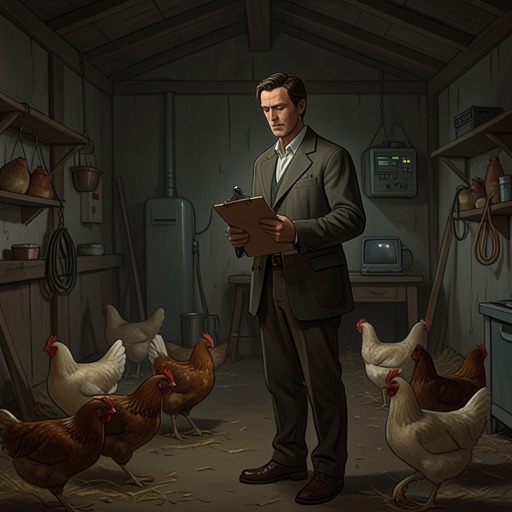
The narrator’s work at the chicken farm gives this scarcity a physical counterpart. Two evenings a week, he works in enormous sheds between villages, where chicken manure is spread on surrounding fields and its smell blows from one village to another. In Hall 9 he pulls on boots, catches the birds by their legs, and packs them into plastic boxes until the hall is empty by midnight. The work is paid labor, but it is also a scene of bodies handled under pressure: a chicken’s foot is severed when a box is stacked, and the shift leader treats the injury as ordinary. This job contributes to the household fund, placing the residents’ improvised theft-based income alongside another difficult form of work in the food economy.
Frieder’s accounting rule
Frieder announces that from then on he will credit everything he gets for free to the household fund. In his vocabulary, getting something for free means stealing it. He proposes that he and Vera teach the others how to steal, after which the value of what they take will be divided in the accounts: a ten-mark packet of coffee, for example, counts as five marks toward the communal fund. The rule does not claim that the goods cost nothing; it assigns half their retail value to the household while leaving the other half as a saving for the person who took them.
Vera makes the proposal’s collective logic explicit. Each person will have more private money left over, she argues, while the shared household still has everything it needs. The more they steal, the greater their prosperity, both individual and collective. The narrator hears an echo of economics class and Ludwig Erhard’s promise of prosperity for all. That classroom association gives the joke its pointed shape: the residents recast household theft as a theory of shared wealth, with a simple formula where formal economics would offer doctrine and policy.
The system also includes a deliberate exception. Frieder says that once a week he goes to Kaufhof’s delicatessen department; what he takes there is not entered into the household account but treated as a gift. The distinction exposes a limit in the collective principle: not every stolen item is pooled, and Frieder reserves a category for personal pleasure. The household rule is therefore not an abstract commitment to total sharing but a negotiated practice, with its own boundary between shared provision and an individual treat.
Training and performance
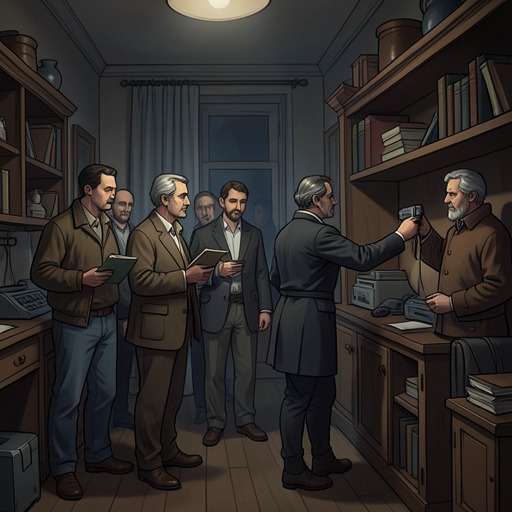
The residents do not leave the arrangement at the level of discussion. Frieder writes “Trainingszentrum” on cardboard and pins the sign outside the kitchen door. He points to coffee and wine placed on the windowsill as the goods to be taken, while Vera sits beside the door as cashier. She calls the target goods “Furandum,” meaning the things to be stolen. The ordinary kitchen becomes a rehearsal space, and the language of instruction and bookkeeping makes the operation look almost like a small institution.
Frieder’s teaching treats shoplifting as a learned performance. After the narrator has put his hand inside his jacket, Frieder points out the bulge under his armpit and tells him that he must look as though he is thinking about something else, without actually doing so. Frieder has, in the narrator’s description, turned theft into a science and risen from ordinary shoplifter to professor of shoplifting. They rehearse several more times, then hold their premiere. The narrator turns away from the refrigerated display with his hand still inside his jacket pocket and meets the seller’s eyes at the end of the aisle: the practice’s first real test replaces the safety of the mock setup with the possibility of being caught.
For the narrator, that possibility remains more than a technical problem. He admits that he cannot do it because he is terrified of being caught, and Cäcilia nods. Frieder counters by describing the feeling of leaving a shop as omnipotence; Vera says that practice makes it easy. Their encouragement presents theft as a source of power and a skill that fear can be trained out of, but the narrator’s hesitation marks a difference among the residents. Participation is not automatic simply because the goods will benefit the household.
Shared benefit, private risk, and consequences
The accounting rule tries to connect private action to collective provision: the person who steals retains a personal saving, while half the value goes to the kitchen fund. That structure makes the household’s benefit tangible without erasing individual incentives. It also spreads the activity beyond Frieder and Vera, who first develop the idea and offer to teach it. The scheme is at once practical and theatrical, held together by half-price calculations, a mock training center, a cashier, and a vocabulary that redescribes stealing as obtaining goods for free.
The residents’ dependence on these arrangements gives the rule its context, but it does not remove the risks. The narrator’s fear persists, and the later notice from Penny shows that the practice has consequences beyond the household’s own ledger. In a note addressed to Frieder Wittlinger, Gerhard Bogatzki informs him that he is banned from Penny and that the store manager will not file a criminal complaint. Frieder replies that he had not dared go there anymore anyway. The notice records both a penalty and a reprieve: access to the store is withdrawn, but prosecution is avoided.
The household economy’s comedy—its professor, training center, half-price valuations, and promise of collective prosperity—rests on actual need and actual exposure. Its members combine gifts, low-paid labor, benefits, personal sacrifice, and theft because their kitchen fund cannot reliably meet expenses otherwise. Their invented rules make the resources countable and negotiable, but the ban from Penny reveals the limit of that self-made system: the residents can decide how stolen goods are shared among themselves, not how a shop or the law will respond.