Suizidalität und ambivalenter Lebenswille
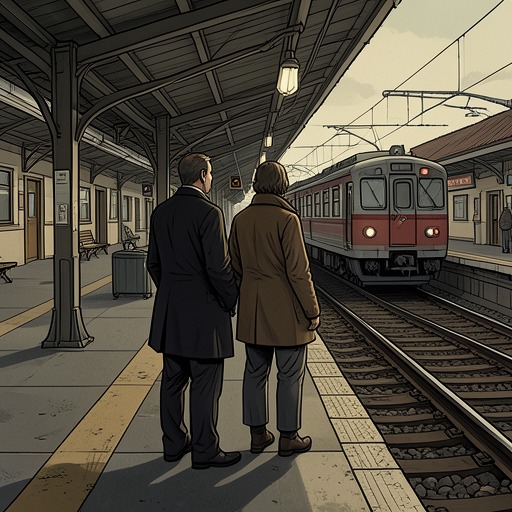
AuerhausSuizidalität und ambivalenter Lebenswille names the novel’s central tension between wanting life to stop and retaining some attachment to the possibility of continuing. Through Frieder’s changing words and actions, and the narrator’s effort to interpret them, suicidal thought appears as unstable and difficult to read from outside: rescue can be accepted, apparent good spirits can alarm rather than reassure, and even after death the reasons remain unknown.
Distinguishing the Wish to Die from the Wish to Stop Living
Frieder offers the clearest distinction when he says, "Ich wollte mich nicht umbringen. Ich wollte bloß nicht mehr leben. Ich glaube, das ist ein Unterschied." The statement does not resolve the danger; it makes visible a difference between an intention to cause one’s death and an exhaustion with continuing to live. The novel returns to that gap rather than treating suicidal thinking as a simple, unchanging decision.
That distinction also shapes the narrator’s understanding of Frieder’s earlier, failed attempt and his eventual death. The narrator recalls that the more he spoke with Frieder about why he had first wanted to die, the less distinct the question became, until it had almost disappeared. The absence of a clear answer is itself part of the account: intimacy and conversation do not guarantee access to another person’s reasons.
Rescue, Choice, and Unreadable Signals
The narrator asks whether Frieder would want to be rescued if he were suddenly in mortal danger, such as falling through ice. After thinking for a long time, Frieder says the narrator can rescue him, adding that he wants to choose for himself. His answer holds two positions together: he permits intervention and preserves his claim to agency. When the narrator points out that Frieder has imagined what would happen without him, Frieder replies that someone who asks such a question believes he matters. The exchange offers a momentary sign of connection, not a dependable guarantee of safety.
Elsewhere, that uncertainty becomes a problem of reading ordinary behavior. The narrator remembers Frieder cycling despite the others’ hurry to catch the bus, and smiling tiredly as they leave. At school, the empty place beside the narrator brings back an image of Frieder hanging in the hayloft. He knows Frieder rejects the idea of throwing himself in front of a train, but cannot make the thought of suicide stop recurring. Frieder’s manner supplies no sure answer: sadness might be tiredness, while cheerfulness might mean that he has decided to die. He once tells the narrator that an abrupt, unexplained good mood in someone who has thought about suicide continually can signal a decision. The warning makes apparent happiness frighteningly ambiguous rather than reassuring.
Deliberate Risk and the Limits of Interpretation
After the police confrontation, Frieder tells the narrator that he had deliberately acted to make the officer shoot him. The narrator responds by striking him repeatedly and accusing him of putting the others in danger. Frieder turns aside and tries to throw the narrator off, but does not fight back. The episode gives the narrator new evidence of intentional risk, but it does not make Frieder’s motives transparent; the confession concerns what he did, not a complete explanation of why.
The narrator’s anger also registers the strain of being made an unwilling witness and potential participant in Frieder’s crisis. Earlier, he had asked whether he should intervene in a sudden emergency; now the revelation that Frieder sought a potentially fatal encounter provokes violence rather than a calm answer about rescue. The novel preserves the conflict between respecting Frieder’s choice and fearing the consequences of being drawn into it.
Death, Retrospective Doubt, and the Possibility of Delay
After Frieder’s death, Harry says that Frieder had finally done it, while Vera suggests he may have misjudged the dosage. The landlady finds him after he has been dead in bed for several days. His parents’ death notice describes him as having died after a long illness, a description the narrator considers both true and false. No date of death is given because the doctor could not determine one. These details leave the death present as a fact while resisting the clean certainty of a settled account.
The friends debate what an unsuccessful overdose means. Harry calls pills a poor method; Vera observes that when an attempt does not succeed, people may think it was only done to be rescued. The narrator answers that when it succeeds, it can be called an accident. Their exchange exposes how the same act can be interpreted differently after its outcome, and how survival or death may reshape other people’s judgments without revealing the person’s original intention.
The narrator still wonders whether Frieder’s reasons at the time of his death were the same as those behind his first attempt. He cannot establish an answer. He recalls that Frieder called him a few days before dying and seemed to be in genuinely good spirits. Set against Frieder’s earlier warning about sudden cheerfulness, that recollection intensifies uncertainty rather than settling it: a positive mood cannot be read retrospectively as proof either of recovery or of a final decision.
Against that unknowability, the narrator describes a way of choosing that keeps the future open. If he did not kill himself today, he could still do so tomorrow; if he did it today, he could not choose not to do it tomorrow. The narration briefly declares the matter irrelevant, then reverses itself: not irrelevant. This small correction gives the principle its force. Delay is not presented as a cure or an explanation for Frieder’s death, but as a preference for the possibility that leaves more possibilities available. The novel’s account of suicidal ambivalence rests in that unresolved space between a wish for life to end and a choice, however provisional, to keep another day possible.