Schwarzes Holz
AuerhausSchwarzes Holz is the psychiatric hospital on the edge of town where Frieder is treated after his suicide attempt. Its locked ward and regulated routines become central to the narrator’s visits, Frieder’s gradual return to the outside, and the book’s refusal to treat a person’s apparent mood as a reliable measure of their safety. The institution is not merely a backdrop: its doors, permissions, and daily schedule give physical form to the uncertainty surrounding Frieder’s wish to live.
Setting and Appearance
The hospital is described by several names—clinic, psychiatric hospital, asylum—but the name Schwarzes Holz preserves the memory of a landscape that has disappeared. The old building, ornamented with plaster as if it were a small castle, was once surrounded by forest. By the time the narrator visits, the woods are gone. The hospital stands between the slaughterhouse and the crematorium, immediately beside a busy railway line. The setting’s grim irony is sharpened by the narrator’s recollection that people from the hospital sometimes jumped in front of trains, while newspapers did not report it. As children, he and his companions rode bicycles out toward the tracks in search of traces of such deaths, although passing trains made their search dangerous.
The narrator first approaches the grounds by bicycle, following a high brick wall to an open iron gate. In the park, people in tracksuits sit on benches smoking. He assumes they are patients and wonders why they do not simply run away. His view is shaped by the stigma attached to the place: as a child, he had heard the familiar threat that behaving badly would land someone in Schwarzes Holz. The visit forces him to encounter the institution as a real place, not just a warning used by adults.
The Locked Ward and Its Routines
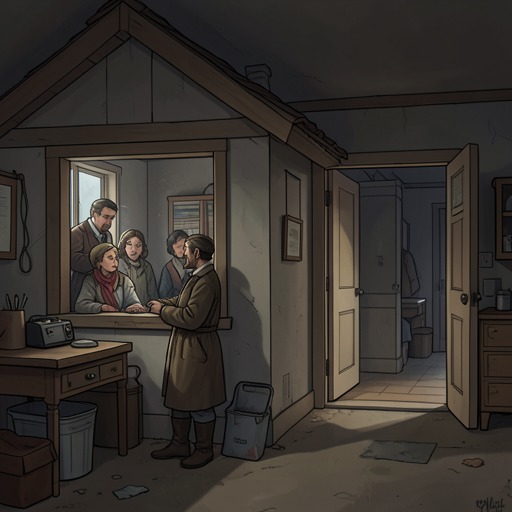
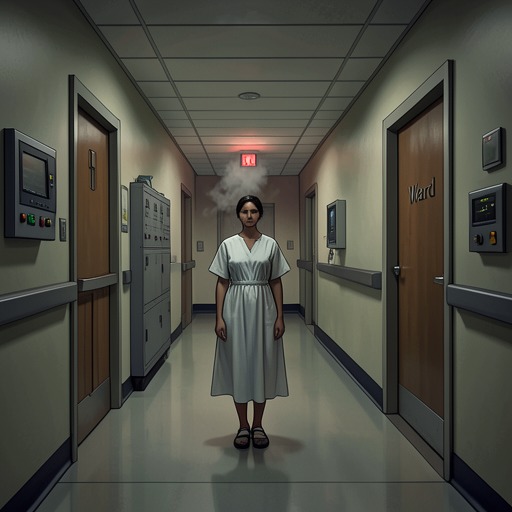
The ward’s threshold is made unmistakable. The glass door to the locked unit is shut; a large buzzer summons staff. A nurse brings the narrator into a common room where a television plays silently, a man in a formal dark-blue suit stares at it, three men play cards, and a woman repeatedly hops across the room carrying a tin can. The nurse reassures him that nobody there will hurt him and that the patients are no crazier than other people, then points him to a brown imitation-leather sofa. Her reassurance sits beside the practical fact of institutional control: the staff have the key.
Frieder is not free to leave the locked ward, and the narrator visits him every other day. Their time together includes homework and news from school, giving Frieder a link to ordinary life beyond the hospital. The days inside also follow a prescribed pattern: conversations, the distribution of medication, and occupational therapy, known as BT. The therapy room’s cheerful craft materials provide a bleakly precise image of the ward’s emotional atmosphere. Frieder points out a melted plastic disc, made by heating colored granules in a mold; unlike the narrator’s memory of the bright craft project from Catholic youth group, this one is entirely black. The routine offers activity, but it does not make the setting feel cheerful or erase the weight of Frieder’s condition.
Visits and the Boundary Between Patient and Visitor
For a long time, the narrator thinks of himself as a visitor, not a patient or inmate: he can enter and leave, and he hurries through the grounds as if the park were only a passage between the outside and Frieder’s ward. That distinction becomes less secure when Frieder is allowed out for the first time, in autumn, accompanied by the narrator and permitted only into the park. The narrator feels uneasy at being made responsible for accompanying him. He wonders whether the permission means Frieder is cured, then immediately qualifies the thought: Frieder is taking medication, but the narrator does not know what he might do or whether he would have to catch him if he ran.
Walking in the park with Frieder, rather than merely crossing it, changes how the narrator experiences the space. He imagines himself confined there too, having climbed a tree with a rope before a forester found him and talked him down. In that imagined version, he does not know how long he will remain in the hospital. For a moment, he feels no difference between himself and the patients. The thought does not mean that their situations are identical; it makes palpable how dependent the distinction is on permission, circumstance, and the ability to leave.
Frieder’s Departure and the Hospital’s Continuing Presence
The hospital is part of Frieder’s life even after his first outings begin. While he is still there, he tells the narrator that his doctor thinks it would be better if he no longer lived with his parents. His grandfather’s house is empty, and his parents will allow him to move in, provided he does not live alone. The proposed move offers a route out of the parental home without a return to solitary living. Schwarzes Holz is therefore a place of treatment and restriction, but also the setting from which a new domestic arrangement starts to become possible.
The later story prevents the hospital from serving as a simple before-and-after marker of recovery. Frieder explains that he had not wanted to kill himself so much as to stop living; later, he says that a person who wonders what life would be like without him believes that he matters to others. The narrator asks whether he should rescue Frieder in a sudden life-threatening situation, and Frieder answers, after thinking, that he may be rescued because he wants to choose for himself. These statements preserve a tension between suicidal thought and an attachment to choice; they do not supply a stable guarantee of safety. The narrator also remembers that when Frieder appears to announce something important, it is impossible to know whether he will say he has decided never to try again or that he has decided to die that day. In retrospect, the hospital’s locked doors and permissions stand against that uncertainty without resolving it.
Narrative Significance
Schwarzes Holz brings together care and control in concrete forms: a locked glass door, a buzzer, medication, scheduled activity, supervised access to the park. Its staff member’s reassurance that patients are no crazier than anyone else challenges the narrator’s inherited language of the asylum, while the key and ward boundaries show that reassurance does not abolish institutional power. The narrative lets both facts remain visible rather than reducing the hospital either to a refuge or to a prison.
The place also sharpens the book’s attention to the limits of observation. The narrator can visit, listen, accompany Frieder, and remember what he said, but he cannot reliably read the meaning of a smile, sadness, or sudden good mood. Nor does Frieder’s own distinction between not wanting to die and not wanting to live settle the question of what his thoughts will become. Schwarzes Holz gives that uncertainty a location and a daily shape: it is where freedom is restricted in the name of care, where an outing is a formal permission, and where even a visitor briefly discovers how fragile the boundary between inside and outside can feel.