Berlin
AuerhausBerlin is at once a place the narrator longs to reach and a city he later insists he dislikes. Its promise is initially concrete: living there, he believes, can keep him out of compulsory military service. But Berlin also gathers the book’s contrasts between escape and confinement, imagined possibility and difficult daily reality; a worn four-pfennig coin marked with the city’s mint becomes the narrator’s private talisman for both saving and arrival.
An imagined destination
Before he has ever visited, the narrator wants to move to Berlin as soon as he finishes the Abitur. He knows little about the city beyond the belief that residence there exempts a person from service in the Bundeswehr and the fact that the Wall somehow runs through it. Berlin’s significance precedes experience: it is a route out of a future shaped by conscription, rather than a home he already understands.
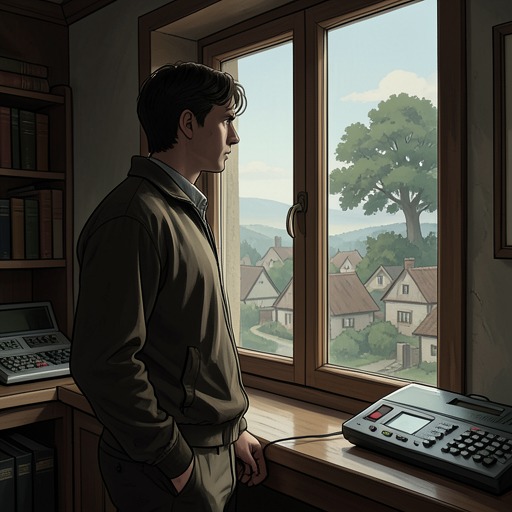
That imagined destination becomes briefly tangible when the narrator and Vera travel there by hitchhiking. They stay with an acquaintance of Vera’s brother, in a single large room so crowded with construction planks, shuttering boards, and barriers that the narrator cannot tell whether the intended project is a mezzanine or a kind of footbridge across the room. Vera sleeps in the room; the narrator sleeps in the kitchen. He accepts her explanation that there is no other way to arrange the space, wanting to believe it. The visit gives Berlin a cramped, improvised reality that sits uneasily beside its earlier promise of escape.
Movement through the city
Berlin’s everyday mobility appears effortless to the narrator. The U-Bahn arrives every few minutes, so there is no need to consult a timetable before leaving home: one can simply walk to a station and board. The narrator asks Vera whether they should ride without paying; she answers that they should hitchhike. The exchange sets the city’s regular infrastructure against the pair’s preference for informal movement, a small instance of the improvisational travel that shapes their relationship to places beyond home.
Berlin also belongs to a wider pattern of departures. The narrator and Vera repeatedly leave for several days, visiting her brother in Munich, Amsterdam, or Lake Constance, and forge their own school excuses by imitating their mothers’ signatures. Berlin is one destination in this restless circuit, but it carries a special weight: it is the place the narrator specifically imagines as his post-school escape from military service. The trips make departure a practiced act, while the city remains the destination invested with the greatest political and personal expectation.
The city as refuge and contradiction
The narrator’s later account overturns the clean logic of that expectation. On a snowy hillside, after drinking vodka, he says he would rather have been classified as disabled so he could refuse military service and perform civilian service without having to flee to Berlin. He admits that he does not really want to go there and describes its crowds, busy streets, and bad weather with disgust. The city that once seemed the necessary answer to conscription has become an unwanted alternative—yet his explanation of how to avoid service still turns on it.
Harry later makes the contradiction explicit through a dark joke: Berlin is both a prison and a psychiatric hospital, and so the narrator does not have to join the Bundeswehr. The line recasts the city’s exemption from military service as a resemblance to two institutions of confinement. Berlin can function as refuge from one system while being figured as another kind of enclosure; the joke does not erase the practical attraction of escaping conscription, but makes its cost and ambiguity visible.
Maps, memory, and arrival
A copper four-pfennig coin minted in Berlin in 1932 condenses the city’s associations into a small object. The narrator keeps this single coin from a collection, placing it in the small pocket of his jeans as a talisman. He connects it to saving money, recalling his uncle’s account that the denomination had been introduced to help housewives economize, and to Berlin itself: the A on the coin identifies the city where it was minted. Berlin is thus carried before it is securely inhabited, as memory and hope tucked into a pocket.
Eventually the narrator and Frieder set out for Berlin with a mattress and several boxes in the back of the borrowed Gluckgluck car. The narrator has hitchhiked there before but cannot find his way independently; Frieder knows even less of the route, so they need a map. They stop near the pedestrian zone and go into a bookshop, where the map selection runs from Germany and Europe to the world, alongside plans of Stuttgart, Ulm, and Berlin. Arrival is not presented as effortless fulfillment: even after earlier visits, the city must be located and navigated anew, with a road map and the practical help of others.
Harry’s later description makes that map itself an image of division. He says Berlin looks, on the map, like a thought bubble belonging to West Germany; when the narrator estimates West Berlin’s population at about two million, Harry calls them two million West German thoughts. The city is at once a physical place to reach and an idea attached to the divided country around it. The book’s changing Berlin—from distant loophole, to visited city, to destination approached with Frieder—keeps freedom unresolved: movement toward the city offers a way out, but never a simple escape from constraint.