Gymnasium Am Stadtrand
AuerhausGymnasium Am Stadtrand is the youngest gymnasium in the district town, a school for students from the surrounding villages whose plain, geographical name marks it off from institutions named for figures its pupils might aspire to become. It is where the narrator and Frieder share lessons, homework, and the routines of school; after Frieder’s suicide attempt, those routines continue on the surface while the teachers’ treatment of the two boys changes. The school becomes a revealing setting for the book’s account of stigma, institutional hierarchy, and the uneasy ways care can coexist with fear.
Identity and Place in the School System
The school is described as the youngest gymnasium in the district town and as the gymnasium for the villages. Its name, Gymnasium Am Stadtrand, points not to an admired historical figure or imagined future but to where its students come from. The contrast with the Schiller-Gymnasium and Albert-Einstein-Gymnasium is pointed: those names suggest what their students might become, while this school identifies its pupils by their origins. Its institutional position is reinforced by the narrator’s account of the Alb, where teachers who continued to abuse students might eventually be sent to a remote school far from parents who knew that beating pupils was forbidden. The school thus sits within a hierarchy that reaches beyond its own classrooms, and the narrator’s description makes its marginality both geographical and social.
Teachers and the School’s Reputation
The staff includes teachers whose presence reflects that hierarchy. Hoffmann had arrived only the year before. He had been transferred from the Schiller-Gymnasium after a rage in which he smashed a chair with a student still sitting on it. The narrator presents this episode as part of a broader pattern: when a teacher at one of the better gymnasiums struck or otherwise abused a pupil, the teacher might be transferred to Gymnasium Am Stadtrand on probation; if the behavior continued, the next posting would be in a more distant rural backwater. Hoffmann’s move therefore carries an institutional history into the school. The narrator says that the pupils had seen several “bastards” arrive and leave and were not especially good probation officers, a sardonic description of a school expected to absorb staff who had already failed elsewhere.
Hoffmann’s anger remains present in the students’ everyday talk. The narrator tells Frieder that Hoffmann berated Paul during a five-kilometer run because Paul could not keep up. Paul began to cry and stayed down on the inside lane; he could not stop crying and became rigid. Frieder answers with the image of an omega wolf lying behind a fence, ears flattened, its fur bitten and scabbed. He says the sight was interesting from outside the enclosure. The exchange links the school’s roughness to a wider pattern of watching suffering from a position of safety: the wolf can be observed, as can the boy who breaks down, while the person who sees is not necessarily able to intervene.
Frieder’s Absence and the Changed Classroom
When the narrator returns to class, he has missed what has happened. He says he has been ill, and Doktor Turnschuh, who normally responds to suspected truancy with an exasperated glance toward the ceiling, simply looks at him—an attention the narrator experiences as looking through him. Frieder is not there. The teacher begins the lesson without asking about the absence, and Frieder does not arrive. The classroom’s ordinary opening is therefore marked by what it does not say: the narrator has not yet understood why his friend is missing, while the teacher’s changed response hints that the absence belongs to a more serious situation than an ordinary skipped lesson.
The narrator eventually realizes that Frieder is probably at Schwarzes Holz, the psychiatric hospital. The realization is sharpened by the remembered threat familiar to local children: if someone went on behaving in a certain way, they would end up in Schwarzes Holz. The narrator’s mother buys butter biscuits and mandarins for him to take when he visits Frieder, making the hospital visit an immediate extension of the crisis that has entered the school’s social world. The school and the hospital are not the same institution, but the narrator’s return to class and his visits to Frieder establish a repeated movement between ordinary lessons and the locked ward.
Schoolwork, Routine, and Special Treatment
Frieder is not allowed to leave the locked ward, so the narrator visits him every two days. They do homework together, and the narrator reports what is happening at school. School continues to provide a shared subject and a structure for their friendship even when one of them can no longer attend: lessons and homework travel from the classroom to the hospital. The narrator’s account of Hoffmann’s outburst and Paul’s collapse is one such piece of school life carried across the boundary.
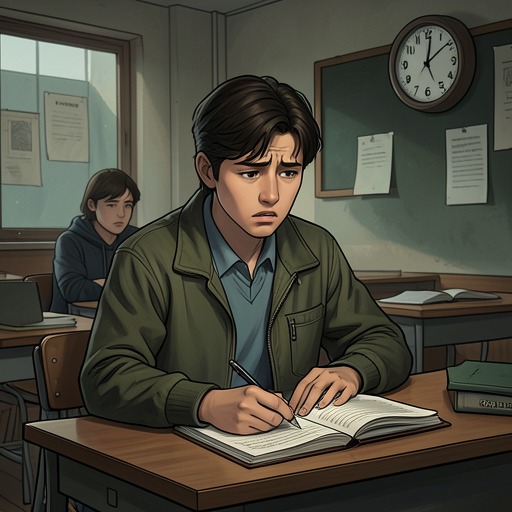
Later, the narrator describes the school’s familiar sequence as “Birth, school, work, death”: courses, breaks, and exams seem to run on the same mechanism as before. That appearance conceals a change in how teachers treat Frieder and the narrator. They are left alone to read what they choose openly on their desks: the narrator reads comics, while Frieder reads philosophers, psychologists, or suicide manuals. When either boy raises a hand, the teachers call on them immediately, as though whatever they have to say is urgent and must be heard without delay. The narrator cannot decide whether the staff now regard them as somehow enlightened or fear that Frieder might attempt suicide again if they are not kind to him. The altered classroom routine offers consideration, but the narrator’s uncertainty makes clear that this treatment is also shaped by the knowledge of Frieder’s crisis.
A School That Opens into the Wider Community
The school’s students and teachers belong to a broader village and district world rather than remaining within classroom walls. At the New Year gathering outside Auerhaus, the crowd includes the entire upper school from Gymnasium Am Stadtrand, alongside patients from Schwarzes Holz who have permission to leave and gay people from across a wide region. The school’s pupils appear within a shared celebration that crosses the boundaries separating students, psychiatric patients, and the local community. In this scene, the institution’s student body is part of a temporary gathering among people otherwise sorted into distinct social categories.
The school remains an ordinary place of lessons and examinations, but its episodes reveal how little ordinary routine can contain. A teacher’s history of violence shapes the atmosphere of the gymnasium; Frieder’s absence turns a missed school day into a sign of hospitalization; and, after his return to the shared orbit of school life, teachers offer him and the narrator both unusual freedom and watchful consideration. Gymnasium Am Stadtrand’s significance lies in that tension: it is a local institution that reproduces social and institutional hierarchies, yet its classrooms and students also form one part of the network of care and companionship surrounding Frieder.