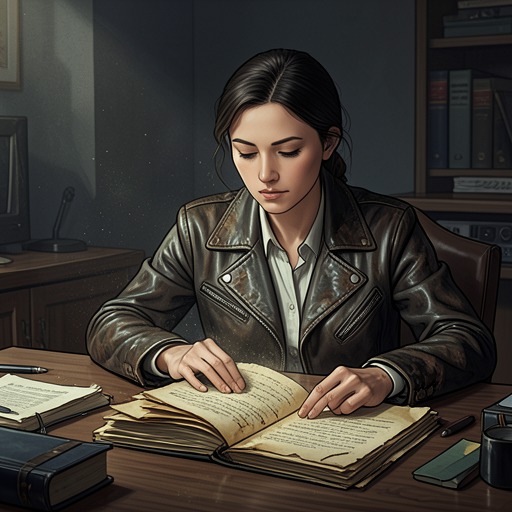
Braetsch-Duke Records Archive
BarkskinsThe Breitsprecher-Duke archives are the scattered records of a business and family history, preserved in storage rooms and gradually sorted into a company collection. Their significance lies not only in the corporate story Sophia hopes to tell: among the papers is evidence that complicates the accepted family genealogy, exposing a distinction between descent through Charles Duquet’s adopted sons and descent through his biological children. The archives thus make historical recovery a question of what gets preserved, interpreted, and pursued—and of whose claim to family inheritance counts.
Collection and Purpose
When Sophia sought a position that would keep her out of business deals, she proposed becoming Breitsprecher-Duke’s company historian. She wanted access to old journals and letters, copies of wires and telegraphs, and whatever other papers had survived being burned or discarded. The company had boxes of such material in storage, and her proposed collection acquired the name “the Breitsprecher-Duke archives.” Her employer welcomed the project partly because a history reaching back over two centuries might also supply favorable publicity for the business.
Sophia chose four dusty rooms that had once belonged to Lawyer Flense, with a view of the lake, for her archive and office. The rooms were to be cleared, cleaned, and repainted; the arrangement included an anteroom, a private office, and meeting rooms. Her son Robert helped plan the renovation, recommending that a partition be opened to create a larger office. Once Sophia was installed, she hired Debra Strong to sort the papers into rough time periods and place them in labeled folders. The physical transformation of the rooms gave the records an institutional home, but it could not make their contents immediately legible.
Reading a Fragmentary Record
The documents were difficult to interpret. Their handwriting was cramped, their spelling poor, and French passages obstructed Sophia’s progress. A possible promissory note signed with an X raised questions about whether Charles Duquet and Charles Duke were the same person, and about whether the mark belonged to Duquet or Dred-Peacock. Later letters signed by Charles Duke appeared to resolve some of that uncertainty, but Sophia did not understand much of the correspondence and set aside tedious lists of deals and accounts as immaterial.
From the material she did read, Sophia assembled a straightforward company origin story: Charles Duke was a poor French boy who left an oppressive farm life for North America, worked hard, acquired timberland, and opened a sawmill. The letters to his sons seemed to show a serious father who gave them instructions and advice, though they offered little insight into his character beyond that. Sophia also passed quickly over James Duke and described Lavinia as a respected businesswoman, without engaging with most of Lavinia’s technical notes on inventions, meetings, timber volumes, and shipments. The archive therefore records not just what survived, but how a historian’s interests and limitations determine which parts become the story.
Genealogy and the Heirs
A folder Debra labeled “Genealogy?” disrupted Sophia’s emerging account. Inside were torn, yellowed pages, including a letter from R. R. Tetrazinni about an investigation commissioned for Lavinia Duke. The letter said the inquiry had reached the point described in Tetrazinni’s report and that further work identifying and locating heirs would require Lavinia’s instructions. Sophia could not tell from the fragment who the heirs were or what they might inherit, and the report itself prompted her question: heirs to what?
The surviving report had set out a family history that Sophia’s company narrative had obscured. Charles Duquet had adopted Nicolaus and Jan from an Amsterdam orphanage, and Bernard from the streets of La Rochelle; he treated all three as sons and divided his goods equally among them. Lavinia descended from Nicolaus, so her family line was descended from an adopted son rather than from Charles’s biological children. After the adoptions, Charles’s wife Cornelia Roos had two biological children, Outger Duquet and Doortje Duquet. Doortje’s line ended with her unmarried son, Lennart Vogel. Outger’s daughter Beatrix Duquet remained in Maine when her father moved to Leiden; she married Kuntaw Sel, and their sons were Josime Sel and Francis-Outger Sel. Tetrazinni identified the grandchildren of those two sons as Charles Duquet’s living blood descendants, while noting that he had not yet established their names and addresses.
The report made succession depend on competing understandings of kinship. Tetrazinni acknowledged that the biological descendants would be rightful heirs if blood relationship alone determined the claim, but personally favored the descendants of the adopted sons, reasoning that their line had the stronger claim to the fortune. His report made the family archive a record of competing inheritance claims rather than a neutral repository of company origins. Its torn pages also show how easily a consequential disclosure could remain practically hidden among neglected papers.
Discovery and the Unfinished History
Sophia asked James Bardawulf to examine the report. He suggested it might be a fraudulent letter of the kind sometimes sent by people claiming to be heirs or distant relatives, and asked her to send it to him. Sophia preferred to show it to him in person and invited him to her office. At the point the episode ends, she has found evidence of unknown heirs but has not yet established their identities or inheritance, and James has not assessed the document.
The archive’s account remains unfinished in two senses. It contains the materials from which a company history can be built, but the papers are damaged, difficult to read, and selectively interpreted; and its genealogical discovery points beyond the familiar corporate family toward descendants whom Lavinia’s investigation had not yet identified by name or residence. Sophia’s work begins as an effort to turn company records into a celebratory history. The report instead opens a less comfortable history, in which adoption, blood descent, preservation, and the limits of documentary knowledge all shape who can be recognized as belonging to the family and entitled to its legacy.