Charley Breitsprecher’s notebooks
BarkskinsCharley Breitsprecher’s notebooks are both a sustained record of tropical tree life and a contested inheritance. Charley uses them to learn and describe forests he cannot reduce to a manageable catalogue; after his death, the notes pass to Conrad Breitsprecher and are used by Breitsprecher-Duke to exploit tropical forests. Their history turns on the distance between observing a forest and treating it as a store of commercial resources.
Making a Record
In Manaós, Charley struggles to learn Portuguese and begins with a project that quickly proves too ambitious: cataloguing the region’s tree species. There are simply too many kinds for him to identify them all. He shifts instead to recording what he can observe, writing down a tree’s general shape and, where possible, its epiphytes and strangler vines. His notebooks accumulate names for mahogany, Brazilian rosewood, teak, bloodwood, zebrawood, ipe, cambara, anigre, bubinga, cumaru, jatoba, lacewood, and makore, alongside hundreds of trees still unnamed to him. A successful week may yield only one newly identified species.
Charley buys imported notebooks with fine French paper at a Portuguese paper-goods shop, then uses them as field records. The pages hold more than a list of valuable woods: they preserve the limits of his knowledge as well as its growth. Senhor Davi Fagundes, a furniture maker who can identify some of the bark, flowers, and branches Charley collects, becomes an important source of help. Yet even Fagundes increasingly has to admit that he does not know a specimen. Charley’s records thus register both the work of learning and the vastness that resists complete naming.
Forest Knowledge and the Extractive Economy
The notebooks take shape in a landscape being rapidly reorganized around trade. At coastal stations in New Zealand, logging camps and trading posts handle flax, spars, and lumber, while warehouses, sawmills, shipyards, and chandlers draw European settlers. Companies move from one profitable site to another, leaving waste and burned forest behind; after cutting kahikatea, they turn to kauri. Against that extractive pattern, Charley’s notebooks are painstaking, particular records of many kinds of trees, including species that cannot be reduced to a single useful timber category.
The contrast is not simple: Charley himself is learning to name trees, but the knowledge he produces later becomes commercially useful. In Manaós, his work also brings him close to the human costs of the rubber economy. Following the paths of rubber tappers, whose lives are bound by debt, he comes to believe reports of lethal punishment for workers attempting to escape. The notebooks do not undo that system; they are part of a story in which forest knowledge can serve attention to ecological difference and, in other hands, the conversion of forests into resources.
Family Transmission
Charley sends his notebooks to his father, Dieter Breitsprecher, once a year. He receives no reply and wonders whether Dieter has abandoned him; the narrative explains that Dieter has withdrawn from everyone. The annual dispatch therefore carries an asymmetry: Charley continues to send his work across the distance, while the intended recipient does not answer.
For the next seven or eight years, Charley sends the notebooks instead to his young nephew Conrad, often including a letter and a sketch of a comic tropical insect. Conrad is the recipient of a family legacy he has not yet met in person: Charley’s notebooks and the seedling nursery business. At sixteen, Conrad falls ill and is advised to rest in a New Hampshire mountain sanatorium, but the notebooks’ inheritance is already taking effect through his curiosity about forests and his connection to an uncle he has never known.
The Final Notebook and Its Afterlife
Charley continues working despite increasingly severe malaria. He restricts himself to short excursions because an attack in the forest could leave him unable to return home. During a visit to Fagundes’s shop, ill and shaking, he presents a black twig with seven leaves for identification. Fagundes calls it leopardwood, noting its resemblance to lacewood. Charley collapses and dies a week later in Manaós of Plasmodium falciparum.
His last notebook contains a judgment on the human habit of valuing nature only when it offers a benefit. Charley argues that people treat forests, rivers, insects, and leaves as dispensable unless they can be made useful, and describes humanity as taking the role of an overlord that decides what may flourish or die. The final notebook also becomes a will: Charley asks that it be sent to Conrad and that his inherited fortune, together with Dieter’s seedling nursery, be held in trust for the boy until he is twenty-one.
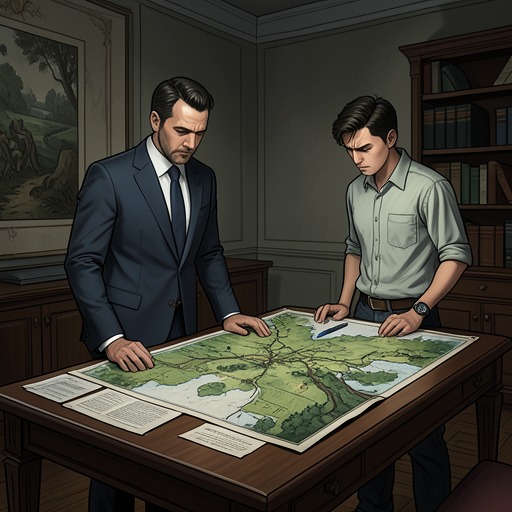
After Charley’s death, James Bardawulf reads the notebooks and finds useful information about tropical trees, then shows them to Andrew Harkiss. Conrad asks for them back, valuing their distinctive pages and the fact that the uncle he never met left them to him. But the company, now Breitsprecher-Duke, uses their information as it joins other businesses in the expansion into tropical raw materials. Charley’s notebooks, written to study a forest he found beyond the categories of his home, become instruments in the very exploitation his final words condemn.