Duquet’s house on Penobscot Bay
BarkskinsDuquet’s house on Penobscot Bay is at once a family possession, a disputed inheritance, and a surviving remnant of a forested landscape being transformed by logging and settlement. First tied to Charles Duquet’s ambitions for timber wealth, the great log house passes into the hands of Outger Duquet and his daughter Beatrix; over time, the woods around it disappear, and the house itself declines from an imposing family home into an isolated relic and an increasingly costly responsibility.
Timber Ambition and the House
Charles Duquet’s turn toward timber grew from his doubts about the fur trade. He had seen its profits depend on unstable conditions: beaver might become scarce, disease might diminish their numbers, and European warehouses could fill with pelts until buyers had no use for more. He wanted wealth that could endure and pass to his sons, and judged the forest to be the resource most likely to support it. In his view, timber could supply ships, houses, and fuel, while the forest’s apparent vastness and capacity to renew itself promised a business that could expand for generations.
That commercial vision gave the house on Penobscot Bay a place in a larger contest over land and resources. Charles asked the Trépagny brothers to remain partners when he eventually shifted from fur to timber, but they met the proposal without enthusiasm. The house later stood within acreage surrounded by uncut forest, while settlements and logging gradually altered the landscape around it. The difference between the timber imagined as an enduring source of family wealth and the forest as a living place becomes visible in the fate of the house and its woodlot.
Outger’s Home and the Inheritance Dispute
Outger’s return brought the house into the foreground as a family possession. He arrived with trunks and boxes, as well as a massive packing crate that required twelve sailors to move onto the ship’s deck. He told his relatives that he would not return to the Colonies or to the house on Penobscot Bay, but warned them not to expect to take the great table: he declared that the contents of the house belonged to his daughter, Beatrix Duquet. He explained that her mother was a Passamaquoddy woman who had helped him study Indigenous ways and beliefs, and that Beatrix had received her education from him. At the time of the letter, Beatrix was living in the house; Outger said he might visit her and that she might eventually join him in Leiden.
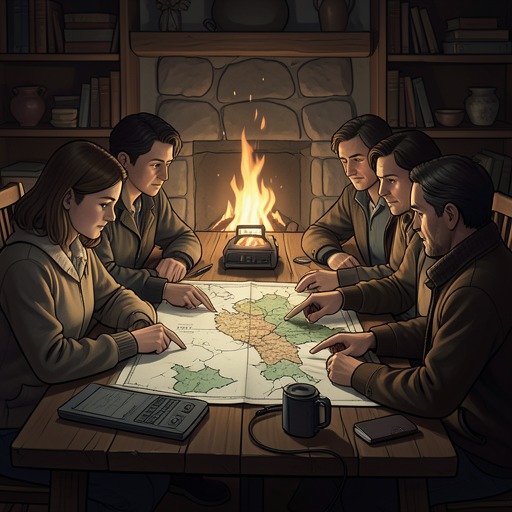
Outger’s letter turned the house into the focus of a dispute over ownership and kinship. Nicolaus rejected the claim, insisting that the property had always belonged to the company and that Outger had only been permitted to remain there to keep him from interfering with the business. He wanted to go at once and remove Beatrix. Jan and Nicolaus later made the journey to the house, ostensibly prompted by fear that another fire might destroy the great pine table. They found Beatrix there, a young woman who greeted them in English and invited them inside. While she prepared coffee, Jan ran his fingers over the table’s deep amber wood; he and Nicolaus then tried to persuade her that it should be removed for its protection and claimed that Charles had intended it for the company office. Their visit makes the table a tangible focus of the larger conflict: the company’s asserted claim confronts Outger’s explicit transfer of the house’s contents to his daughter.
A Home Shared Across Generations
The house remained a place of family refuge as well as property dispute. Tonny, carrying his children and bitter about the life available at the post, left with them to seek his father, Kuntaw. He knew that Kuntaw lived at Penobscot Bay, and found the house after travelling for weeks through mud and old snow, at times carrying the youngest child, Jinot. The arrival connects the house to a family trying to preserve ties of kinship amid hardship and cultural dislocation; it also places the home in the lives of Kuntaw and Beatrix, the people Tonny sought there.
The surrounding settlement changed as the years passed. Logging companies and settlers stripped the shores of the bay and moved up the Penobscot. Wheat and hay fields took the place of forest, and the stumps, turned on their edges, became barriers against settlers’ livestock. Houses lined the shore behind fences, while the old Charles Duquet house remained alone on its acreage, surrounded by forest that had not yet been cut. In that landscape it appeared as a relic of the wooden world: not simply an old building, but a surviving mark of a different relation between home, land, and trees.
Logging, Decline, and the Changing Value of the Property
The house’s isolation did not protect it from the economic changes around it. New, larger houses with painted clapboard sides appeared around the bay, while settlers derided the aging log building as “the wood wigwam.” Outger had left, and Beatrix remained. The house that had been their great possession increasingly stood apart from the standards of the new settlement, and its condition reflected the loss of the forested setting that had once made its acreage distinctive.
As the trees disappeared, the building’s deterioration became harder to ignore. After Beatrix sold the woodlot stumpage, the blackened, aging house stood exposed and decrepit. Its roof and sills needed repairs; when she fell ill, she sold the last large pines on the woodlot to pay for that work. Kuntaw did not attend to the house’s defects, regarding it simply as a large, immovable home. The sale of timber thus carried an immediate consequence for the dwelling: cutting the trees helped finance repairs, but also removed the remaining pines and left the house more visibly bare.
The House as Family Record and Forest Remnant
The house gathers together the book’s intertwined questions of ownership, inheritance, and environmental change. Outger’s declaration that its contents belonged to Beatrix conflicts with Nicolaus’s claim that the company owned the property; the visit over the great pine table turns those rival claims into a concrete encounter. Later, the home receives Tonny and his children, demonstrating its significance beyond the business interests that had originally contested it.
Its physical decline follows the gradual transformation of Penobscot Bay. Roads spread through the forest, fields and fenced settlements replaced wooded land, and logging advanced along the shore and upriver. The house survives amid that change, but survival does not mean permanence: the surrounding trees are stripped, the old structure becomes an object of derision, and Beatrix must sell the remaining pines to maintain it. The former family possession therefore stands as both an inherited home and an increasingly vulnerable remnant of the forest economy that helped give it value.