Achille’s family wikuom
BarkskinsAchille’s family wikuom is the home Achille returns to after a summer hunting journey only to find it destroyed and occupied by English settlers. The loss of the dwelling and the family members killed there marks a decisive rupture: Achille abandons hunting and Mi’kma’ki, declaring that he will go south to lumber and despoil English land in return. The wikuom thus stands both for a lived family home and for the violence by which settlement claims the land beneath it.
Home and Return
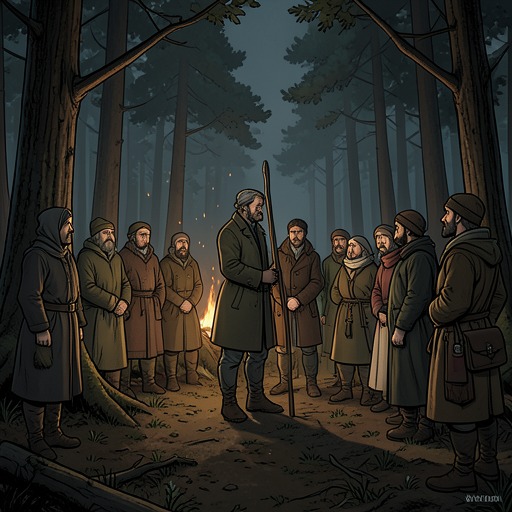
The wikuom is Achille’s home place, and the evidence identifies it as a family dwelling rather than an abstract territory: he returns carrying a moose quarter for a feast meant to mark the end of his hunting journey. As Achille and his companions approach, the familiar homecoming is overturned by the sound of chopping and unfamiliar voices. Two hundred English settlers are cutting trees and building log houses where the wikuom had stood, with thirty armed soldiers present. What should have been a return to family and celebration instead becomes a confrontation with a settlement already taking shape on the site.
The difference between the structures makes the dispossession visible. The settlers are building log houses, while the remains of Achille’s wikuom are still smoking on the ground. The new construction is not merely adjacent to the family home: it occupies its place. The scene makes the settlers’ expansion materially legible as the replacement of one home with another, backed by armed force.
Destruction and Flight
When Achille demands to know where his wife and children are, the soldiers point their guns at him. Settlers seize the moose meat, and one shoots Achille, who falls. Among the debris he recognizes a charred arm as belonging to his wife, Isobel. The evidence establishes that the English have killed her and the younger children, whose bones were incinerated in the burning wikuom. The house’s destruction and the family’s deaths are therefore inseparable: the home is the place where the loss is discovered and where the violence of settlement has already been carried out.
Kuntaw, Achille’s son, has also recognized his mother’s remains. He urges his father to get up and run, and he and Auguste help Achille escape while shots pass overhead. They reach Elphège’s wikuom, where Achille’s brother learns what happened. Achille refuses treatment for his wound and remains silent until evening. The surviving family members have escaped the immediate attack, but the return to their own home has become impossible.
Consequences for Achille
At Elphège’s wikuom, Achille names the loss plainly: the English have taken his wife and children, and there are hundreds of settlers with armed soldiers. He connects the event to what Sosep foretold. He then describes Mi’kma’ki as rich and beautiful, and recognizes that this richness is precisely why settlers will take it. The ruined family home gives that realization a concrete form: expansion is not a distant danger but a force that has destroyed his household while he was away.
Achille responds by rejecting the life he had lived there. He says he will hunt no more, that his life in Mi’kma’ki is finished, and that he will leave the land of his mother for Maine to do lumbering. He intends to despoil English land in return. The wikuom’s destruction thus precedes a change in both livelihood and allegiance: the hunter becomes a lumber worker, and his departure is framed as retaliation for the dispossession enacted at his home.
Narrative Significance
The wikuom’s destruction links the replacement of Indigenous homes with the transformation of forests into settler building material. At the site, settlers cut trees and construct log houses; elsewhere, Achille’s response is to enter lumbering as a deliberate act against the people who have taken his home. The novel’s wider account of forest commerce also follows timber toward distant markets, including a shipment of pine to Sydney, Australia. Read alongside that expanding trade, the destroyed wikuom belongs to a larger conflict over who may use the forest and who bears the cost when land is treated as a resource for settlement and profit.
The dwelling’s narrative force comes from the contrast between homecoming and erasure. Achille approaches expecting to mark his return with a feast; instead he finds settlers in the place of his home, his family gone, and the remnants of the wikuom still present. The loss changes what he believes he can continue to be: he leaves Mi’kma’ki and turns toward the very extractive labor that answers the settlers’ violence with further despoiling. The wikuom therefore remains significant not only as a destroyed structure, but as the point where family loss, land seizure, and the novel’s history of logging converge.