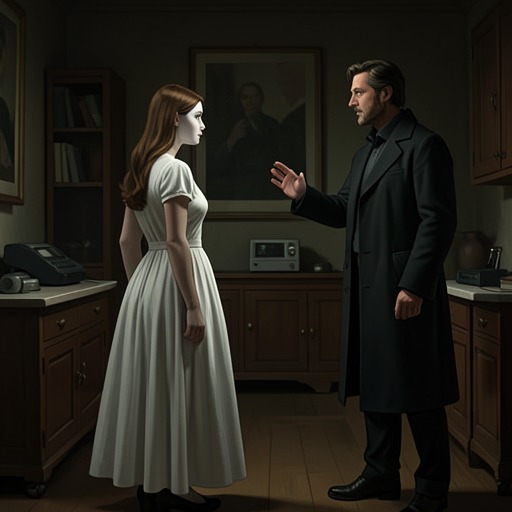
La fotografia “Miss Sogni d’Oro 1949”
BlondeLa fotografia “Miss Sogni d’Oro 1949” is an early nude image of Norma Jeane Baker, later known as Marilyn Monroe, whose circulation turns a financially desperate decision into a public scandal and a lucrative asset for others. Sold for fifty dollars without the negative or publication rights remaining in her hands, it returns years later in mass media, unsettling the boundary between the woman and the star she has become. Its history also records a transfer of value: the model receives a small payment, while photographers, publishers, and the machinery of celebrity profit from the image.
Making and Selling the Image
Before the photograph became famous, Norma Jeane worked long days at the Radio Plane Aircraft factory in Burbank and took promotional assignments through the Preene Agency. In 1945 she appeared as a pin-up in Stars and Stripes, pictured at work in a fitted coverall, and in her first week with the agency she promoted aluminum goods at a Los Angeles trade fair. The next week she represented paper products. These jobs placed her before customers as an attractive representative of merchandise, but the agency prohibited its models from meeting clients or accepting tips; breaking those rules could end the employment. The photograph belonged to a different, more consequential market, though the same conversion of appearance into paid work lay behind it.
Three years before the later scandal, Norma Jeane had politely refused Otto öse’s proposals for nude assignments. By the time she agreed to pose for Ace Hollywood Calendars, however, she had lost her studio accommodation, fallen behind on rent for a furnished room in West Hollywood, and had her second-hand car repossessed after missing two fifty-dollar payments. The studio had dropped her, and the Preene Agency was preparing to do the same. Otto had not called for months, waiting for her to contact him. In that precarious situation, the calendar session offered money she urgently needed. Norma Jeane received fifty dollars; Otto kept the negatives, and the shoot brought him nine hundred dollars. The unequal division of the proceeds was inseparable from the unequal control of the image.
The resulting photograph appeared in a 1950 Ace Hollywood Calendars publication called Bellezze per tutte le stagioni. The calendar presented twelve nude models as anonymous beauties for settings such as factories, garages, police stations, and military barracks. The image that would be recognized as Norma Jeane was therefore first distributed without her established star identity. Its later identification depended on a reporter examining the model’s face and discovering that a 1949 contract had been signed under the name Mona Monroe.
From Anonymous Model to Public Scandal
By the time the photograph resurfaced, Marilyn Monroe’s image was ubiquitous in newspapers, magazines, posters, and advertisements. An enlarged version of the old photograph appeared in the centerfold of Playboy’s first issue, prompting renewed media attention. Norma Jeane told reporters that she had never authorized its publication in Playboy or elsewhere, but could do nothing because neither the negative nor the rights belonged to her. The photograph thus circulated beside studio-made publicity while remaining outside her control: a past image, produced when she needed cash, was being repackaged as material for a star’s public story.
The rediscovery became a scandal when Hollywood Tatler placed the photograph on its front page beneath a headline asking whether the calendar model was Marilyn Monroe. The reporter had found the image in an old calendar and connected it to the 1949 contract. Variety, the Los Angeles Times, the Hollywood Reporter, and news agencies quickly took up the story. The published picture was partly obscured or covered, and the debate spread from gossip columns and radio discussions to editorials in more serious newspapers. Studio contracts prohibited actresses from nude photography and threatened suspension or termination for conduct judged contrary to Hollywood’s moral standards. The disclosure therefore placed Norma Jeane’s earlier work in direct tension with the studio’s effort to keep its contracted star persona publicly respectable.
The photograph did not look quite like the Marilyn Monroe promoted by the studio. The calendar model had honey-colored hair, little eye makeup, and no beauty mark on her cheek; she could seem like a younger sister to the polished blonde star. Yet that difference made the image more revealing, not less. It showed a version of Norma Jeane from before she had learned to perform the identity that the studio circulated, even as the publicity machine turned the contrast between the two images into another object of attention.
Reclaimed, Reprinted, and Reinterpreted
The photograph’s public meaning was not fixed by the scandal alone. Leviticus, a columnist known for caustic commentary and disclosures, addressed Miss Sogni d’Oro 1949 as a victim of society’s exploitation of female purity and praised the success of her film career. Norma Jeane was moved by his gallantry and sent him a copy of the very image at the center of the controversy, inscribed as a lasting friend from Mona and Marilyn Monroe. The gesture joined the old name and the public one on a single photograph, while making the image a personal token as well as a media commodity.
The studio had printed hundreds of copies of the photograph for just such contingencies. Norma Jeane accepted that it was still an image of her and challenged the people behind the calendar to sue her. That response did not give her back the negative or the original rights, but it complicates any account of her as simply powerless: she could not control the photograph’s circulation, yet she could decide how to face its exposure and could use copies the studio had prepared.
The Ex-Athlete later encountered another set of nude photographs when a seller offered negatives that he said Monroe’s husband would want to buy. Examining the material, he saw the young Norma Jeane as someone distinct from the more famous Marilyn: the earlier image suggested to him the woman he had loved before she became a star. He paid the seller, took the copies and negatives, and punched him after the man implied that buying them was the right thing to do. He intended to destroy the material. His intervention could not undo the photograph’s prior publication or restore its ownership to Norma Jeane, but it shifted control of this set of images away from a seller seeking to trade on her exposure.
Significance
The photograph’s history links an ordinary need for money to a lasting loss of control. Its initial sale secured Norma Jeane a small sum at a moment of financial difficulty; the photographer and later publishers held the material means to reproduce and circulate it, while the star whose body it depicted could not authorize its renewed publication. The disparity between her fifty-dollar payment and the much greater value others drew from the images makes the economics of her public exposure explicit.
At the same time, the image unsettles the distinction between an authentic private self and a manufactured star. The calendar model precedes the polished Marilyn Monroe, but later audiences encounter her only through the changing frames imposed by the photographer, the calendar, the studio, the press, and the people who possess copies. The photograph becomes both evidence of a past decision and a contested public object: one that can expose the structures behind celebrity, even as its continued circulation repeats them.