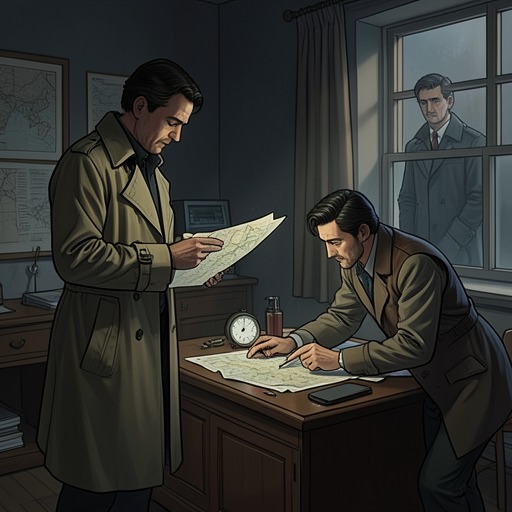
Milo's keys recovered from the Avoncliff waterway
BloodhoundsThe recovery of Milo Motion's keys from the Avoncliff waterway becomes a decisive test of the locked-room theory surrounding Sid Towers's death aboard the Mrs. Hudson. The keys do more than confirm where Milo had lost them: tested against the padlock on the boat, they overturn John Wigfull's account of a lock substitution and force Peter Diamond and Julie Hargreaves to reconsider what they thought they knew.
Investigative Context
Before the recovered keys resolve anything, suspicion has already attached itself to Rupert. Miss Chilmark names him as the person she suspects of killing Sid, while another speaker questions why Rupert would want to kill a man with whom he was not enemies. The exchange conveys how little that accusation settles: a suspected killer and an unresolved motive are not a solution to the practical puzzle of how the boat was locked.
Wigfull's explanation supplies that puzzle with an apparent mechanism. According to the theory Diamond later summarizes, Sid fitted a new padlock to the boat. The recovered keys matter because they can test this account against the actual lock, rather than leave the investigation dependent on a proposed sequence of events.
Recovery of the Keys
Diamond reveals the recovery to Julie at his desk. He opens a drawer and drops a rusty bunch of keys onto it with a metallic clunk. The divers, he explains, had contacted him after finishing the job. These are the keys Milo Motion dropped into the canal, and their return establishes that Milo had been telling the truth about where he lost them.
That confirmation is an important but limited result. It verifies the account of the lost keys; on its own, it does not explain Sid's death or establish who killed him. Diamond signals that the evidence has a further use when he takes a padlock from the same drawer. It is the lock that was on the door of the Mrs. Hudson on the evening Sid was found dead, so it allows him to compare Milo's recovered keys directly with the object at the centre of the locked-room question.
The Lock Test
Diamond selects a key from the recovered bunch and inserts it into the padlock. Rust falls onto the desk as he turns it, and the shackle springs open. Julie's hand goes to her mouth. The small, physical test replaces speculation with a result visible to both investigators: one of Milo's original keys opens the padlock associated with the boat on the evening Sid was found.
Julie asks whether these are Milo's original keys, and Diamond confirms that they are. That detail makes the comparison consequential. If the keys are original and they open the padlock, the lock cannot be treated as evidence that Sid replaced it in the manner Wigfull's theory required. The recovered bunch and the lock, brought together on the desk, expose the weakness in that explanation.
Revised Understanding
Diamond states the correction plainly: it was not a substitution, and the padlock must be the original one. The investigation, he says, has been working on a false assumption. Julie recognizes the immediate consequence for Wigfull's account of the locked room; Diamond agrees that the theory no longer works.
The discovery therefore revises the case without resolving every question. It confirms Milo's account of losing the keys and undermines the proposed replacement-lock mechanism, but the scene does not identify Sid's killer. Julie's next thought turns the reversal back on the investigators themselves: if Wigfull's explanation fails, they too may be left without a workable account. The recovered keys close one line of reasoning while reopening the central problem of how Sid was killed.