Penny Black reappears in The Hollow Man
BloodhoundsThe reappearance of the Penny Black during Milo Motion’s reading transforms a literary discussion into a public encounter with an apparently stolen object. Found inside his copy of The Hollow Man at the very chapter he is about to read, the stamp looks like an incriminating discovery and an oddly apt bookmark. The scene draws its force from that collision: a lecture about the classic locked-room mystery is interrupted by a real mystery of possession, suspicion, and evidence.
The reading and its setting
At a meeting of the Bloodhounds, Polly Wycherley asks Milo to begin after the group has heard enough from Rupert. Milo launches into an account of the sealed-room crime, in which no one but the victim is found when the locked door is opened. He invokes John Dickson Carr as a master of the form and turns to the challenge that the classic detective novel is unrealistic. When challenged, he argues that locked-room murders have occurred outside fiction as well, then returns to his prepared subject.
Milo introduces chapter seventeen, The Locked-Room Lecture, and describes the ideal setting Carr evokes: after dinner, beside a table lamp, with empty wine bottles, coffee, and snow beyond the windows. Their actual setting is St Michael’s Church Crypt, which Milo accepts as an imperfect but suitable alternative. The contrast gives the reading a deliberately theatrical air. He has brought a book and an argument to a gathering; the gathering is about to become the scene of a puzzle that neither his lecture nor the group’s literary expectations can contain.
The envelope and the stamp
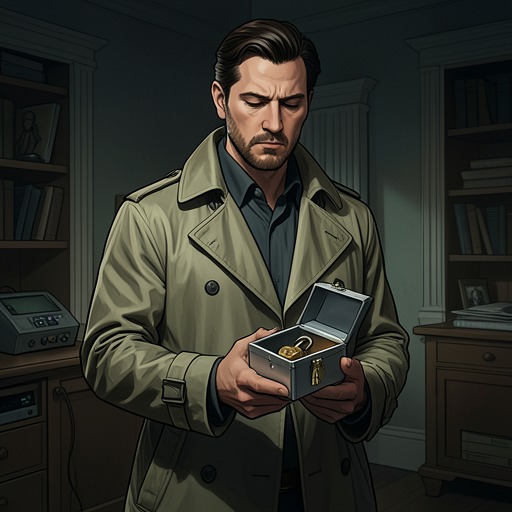
Before reading, Milo checks the contents page and turns to the chapter. Then he notices something between the pages that he does not remember using as a bookmark. The object is an old yellow envelope, its address written in fine, faded copperplate. A single stamp sits in the upper-right corner: Queen Victoria’s head against a black background, with ONE PENNY printed along the bottom. A cancellation mark reads PAID, and beneath and to the right the postmark is unusually clear: BATH, MY 2.
The envelope’s details make the discovery concrete before its significance is settled. It is not merely a reference in Milo’s speech or an illustration brought out for the meeting; it is a physical object lodged in the volume he is holding. Rupert leans across Jessica to inspect it and identifies it as the missing Penny Black. His response turns the find into an accusation by implication: he salutes Milo as though the book’s owner has become Bath’s most wanted man. The stamp is thus present in the room, but its presence does not establish who put it there or how it came to be inside the book.
Suspicion and the group’s response
Milo immediately denies stealing the stamp and insists that he is no thief. Rupert, however, treats the discovery as an ingenious feat and urges him to say no more, close the book, and let the group behave as if nothing has happened. The exchange sets two readings against each other: the apparent triumph of a clever criminal, and Milo’s plain denial that he committed the crime. The familiar conventions of detective fiction make Rupert’s interpretation tempting, but they do not make it proof.
Polly rejects the suggestion that the group should conceal the find. She says she is willing to believe Milo, urges him to report it so the police can catch the real thief, and offers the members as witnesses to his account. Miss Chilmark agrees. Their response gives Milo a practical way out of the immediate spectacle: rather than attempt to explain the stamp’s unexplained arrival, he can hand it over and allow an investigation. He nods and accepts that he should do so as soon as possible.
From apparent bookmark to evidence
Milo does not close the book before carefully placing the precious envelope between its pages. He remarks on the coincidence that it was waiting there, like a bookmark, in the very chapter he intended to read. The placement creates a pointed parallel with the lecture: the book proposes a locked-room problem, while the stamp’s appearance poses a question about the object’s route into Milo’s possession. Yet the scene supplies no answer to that question. Its force lies in the discrepancy between the striking location and the unresolved circumstances.
Milo prefers to go alone when Polly asks whether anyone should accompany him. The group’s support remains available, but he chooses to carry the envelope to the police himself. Afterwards, Shirley-Ann Miller tells Bert about the dramatic discovery. Bert’s suggestion that the police may come asking questions unsettles her; she imagines officers in their living room and worries that her collection of crime fiction, along with the Stanley Gibbons Junior Stamp Album she has kept since childhood, might attract suspicion. The episode therefore outlasts the crypt scene: the recovered stamp becomes not only an object to report but a cause of anxious anticipation. Its emergence inside the book has made the boundary between the Bloodhounds’ fictional puzzles and the consequences of a real investigation unexpectedly thin.