The first Penny Black riddle
BloodhoundsThe first Penny Black riddle is a public clue whose apparent reference to an art gallery conceals its real target: the stolen Penny Black stamp. Broadcast to a regional audience and circulated beyond radio, it invites collective decoding while helping turn attention toward the wrong Victoria. Peter Diamond eventually recognizes that the riddle and the Turner inquiry are linked by misdirection, not by the apparent subject of the painting.
Origins and public circulation
The riddle enters the action through a BBC Radio Bristol broadcast. Peter Diamond turns on the radio after asking what had been said about Claverton; the item is already under way, and the presenter is asking listeners to make sense of a message received early that morning. He describes several possible forms—a Valentine message, a code, a crossword clue, or a riddle—and says that other radio stations and the local press received the same communication. The message is therefore not a private puzzle: its distribution is part of its effect, inviting the whole region to speculate while making the sender and purpose seem unknown.
The presenter promises to repeat it before the sports news and tells listeners to have something ready to write with. Its compact form makes it easy to pass on and inspect: it begins with the initials “J.M.W.T.” and continues, “Surrounded by security. / Victoria, you challenge me, / I shall shortly come to thee.” The broadcast supplies the words but not a key. The names, initials, and language of approach leave the audience with several possible associations and no immediate way to distinguish the relevant one.
Diamond takes up the clue
Diamond asks for the message to be repeated, then writes it in the margin of the Guardian, taking a pen from the table. The newspaper has been placed ready for Stephanie Diamond’s daily attempt at the quick crossword, an ordinary domestic puzzle setting that makes the new challenge feel at first like another diversion. Stephanie points out the tension in Diamond’s interest: he is always telling her that puzzles are a waste of time. His attention, however, is not merely recreational. He records the wording and carries the riddle forward into the investigation.
The clue’s language gives no explicit object or location. “Surrounded by security” suggests protection, while “Victoria” can be read as the name of a place; “I shall shortly come to thee” makes the message sound like a threat or a promise of arrival. Those possibilities matter because the investigation has also involved the Victoria Gallery and Turner's watercolor of Bath Abbey. The riddle does not identify the gallery in its text, but its references make that interpretation available—and therefore useful as a diversion.
The false lead and its correction
John Wigfull initially separates the Turner inquiry from the loss of the stamp. He is prepared to say that the police prevented a possible crime in the Victoria Gallery, but insists that the painting has nothing to do with the missing item. Diamond warns that the press may connect the matters and that Wigfull will face questions. Wigfull remains uninterested in the proposed link, treating the Turner as an independent issue rather than as a clue to the riddle’s purpose.
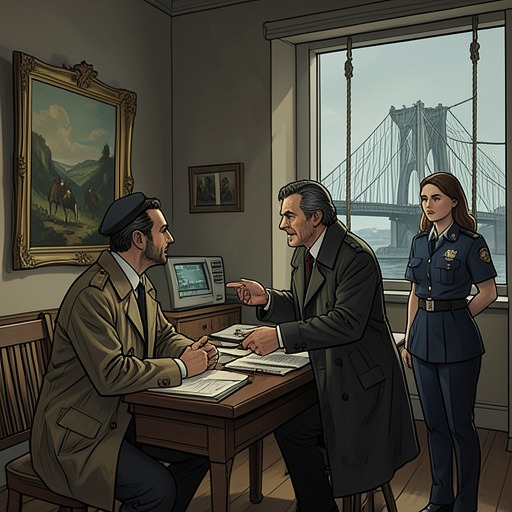
Diamond later confronts him with the verse and explains the misdirection: “Victoria” refers not to the name of the gallery but to the Penny Black, which bears Queen Victoria’s head. He identifies the Turner as a distraction and tells Wigfull that the police were set up. The change in interpretation is immediate. Wigfull first stares without understanding; after Diamond’s explanation, he recognizes how the line about Victoria could have been read differently and wonders why he did not see it. Diamond reassures him that anyone could have become absorbed in one line of inquiry.
Function in the investigation
The riddle works on two levels. As a broadcast puzzle, it turns an unexplained message into a public invitation to solve it; as an investigative device, it encourages attention to the Victoria Gallery and the Turner while concealing the stamp’s relevance. Its circulation through radio and the press broadens the audience for the puzzle, but the decisive interpretive shift occurs when Diamond connects the clue to the image of Queen Victoria on the stolen Penny Black stamp.
The correction also alters the meaning of the Turner inquiry. What Wigfull regards as a separate matter—a possible crime prevented at the gallery—becomes, in Diamond’s account, part of a deliberate setup. The riddle’s importance is thus not that it immediately names its object, but that its wording supports a plausible wrong reading before the investigation supplies the missing association. Its answer redirects the case from a gallery and a painting to the stamp, while exposing how easily a line of inquiry can become a distraction when one interpretation is accepted too soon.