Abel Jackson
BluebackAbel Jackson is a child of Longboat Bay whose life is formed by the sea: first through his mother’s example and his friendship with Blueback, later through scientific work and a return to the coast. His story turns on a choice between leaving for the wider world and staying in the place he has always wanted to call home; that choice links his family’s history of taking from the sea to a future devoted to its protection.
Identity and Background
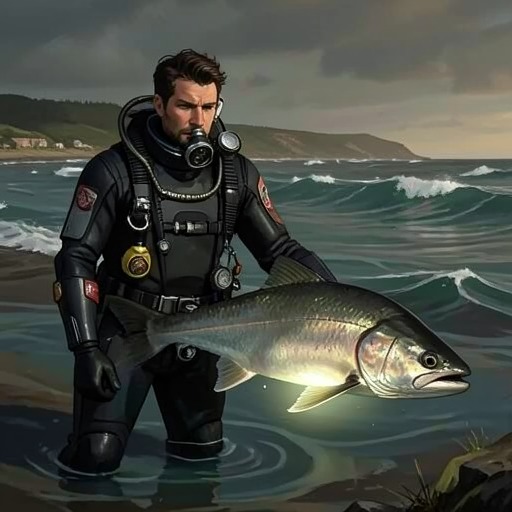
Abel has lived at Longboat Bay for as long as he can remember. At ten, he already feels most at home underwater. His mother says he was a diver before he was born, having floated in the ocean inside her for nine months. He follows her into the water and learns from her everything he knows, on land and below it. She is a strong, relaxed swimmer, and he watches her work in a patchy wetsuit as she gathers shellfish from seams in the granite.
The sea is not a backdrop to Abel’s childhood but the place where his ordinary life happens. He and his mother make repeated dives, surfacing for breath before returning to the bottom. They take only a couple of shellfish from each clump, leaving the rest to breed and grow. Around their work, reef fish dart through the stirred sediment. The routine teaches Abel both practical skill and a way of inhabiting the bay that depends on attention, restraint, and familiarity with its living rhythms.
His home life is largely self-sufficient. The Jackson family has lived at Longboat Bay for more than a century, on land acquired in the era of whaling, with national park surrounding their property. Behind the orchard lies a small family cemetery. A cross marks the grave of Abel’s father, though no body was buried beneath it. Abel and his mother fish and grow fruit and vegetables, keep ducks and chickens, and raise goats for milk. There is no mains electricity or running water, and the household relies on a generator and rainwater. Abel sometimes feels lonely, but he likes being with his mother. Watching kangaroos gather in the orchard, he imagines having a large, lively family of his own when he grows up.
Boyhood and Blueback
Abel’s first encounter with Blueback begins in fear. On a deep dive, almost out of breath, he feels a rush behind him and turns to see a huge blue shadow bearing down. The fish seizes his hand; the shellfish Abel is holding tears free, and pain shoots up his arm as a broad tail blurs across him. Abel reaches the surface trembling, with a small scratch and the conviction that he had nearly died. His mother recognizes the fish’s intelligence and treats the encounter as a rare privilege as well as a danger.
The moment changes the meaning of the bay for Abel. He is already planning to return to Robbers Head before he and his mother have finished preparing the day’s catch. As he carries the meat to the freezer shed, he names the fish Blueback: its color is unlike anything he has seen in either sky or sea, and the name feels right to him. Naming does not make the fish tame or fully knowable, but it gives Abel a way to recognize the particular presence that has entered his life.
On later dives, Blueback approaches as Abel and his mother reach the bottom. Abel touches him under the chin and feels the immense fish brush past. Their contact remains risky: Blueback is strong enough to crush Abel against the reef or drag him toward the dark drop-off. Yet the fish begins to hover near the divers, and Abel learns to hold out a hand to the blunt snout as Blueback pushes him backward through the water. Their silent play becomes familiar, while retaining the force and uncertainty of an encounter between a boy and a wild animal. Abel returns home with his head buzzing.
Blueback also becomes a presence Abel carries away from the coast. During his years inland, he dreams of the fish emerging from a blurred darkness, its eye turning like a moon. In one dream, Blueback leads him down a cold, pale-blue rock shaft past drowned sailors, children, and young men. Abel finds Mad Macka beside his father’s body. His father is still only thirty-two, the age at which Abel’s memory and imagination hold him. Abel reaches toward him, but Blueback keeps him out of reach and swims upward, carrying the view of his father away into warmer water. Abel wakes crying, with nobody in the dormitory to tell.
Leaving the Bay and Learning the Sea
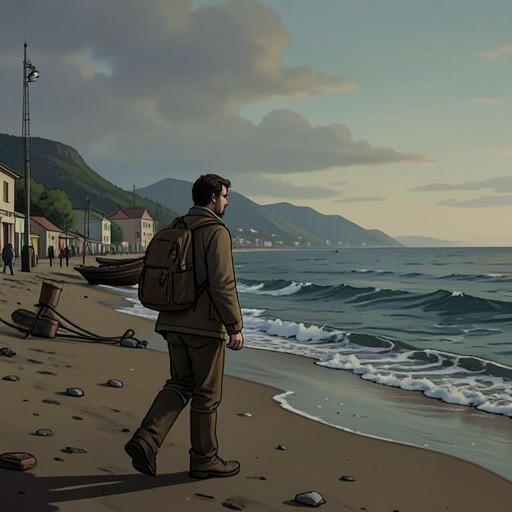
Away from Longboat Bay, Abel feels hemmed in by a flat inland town surrounded by wheat fields where trees have been cleared. School, the hostel, and even the dormitory keep him among other people; the noise and closeness make him miss the solitude of home. He works hard and makes friends, but time seems to pass more slowly than it did at the bay. Letters from his mother, along with coral, shells, a dried seahorse, and a starfish, give him material reminders of home. He listens to a turban shell, knowing it does not truly contain the sound of the sea, and uses it to imagine the ocean again.
When Abel goes to university, he is trying to understand a sea that has begun to seem puzzling and troubled. His mother sees the move as slightly mad: he has spent half his life underwater, his best friend is a fish, and now he is leaving Longboat Bay to study the sea. In the city, he approaches marine life through computer models, books, specimens, photographs, and films, and he joins field trips to unfamiliar islands, boats, and beaches. The methods give him new ways to investigate, but not mastery. Even when he returns home between semesters, watches whales and dolphins, and works beside his mother, he remains no closer to knowing what fish think.
Abel’s scientific life takes him far from home with Stella. They travel for work to coral atolls, polluted estuaries, unfamiliar countries, and other oceans. During one such journey he watches news of an oil tanker that has broken apart off Longboat Bay. The slick burns and is dispersed by foul weather before it reaches shore, but Abel understands how close the coast has come to disaster. He calls his mother; she cries at hearing his voice and calls the incident a warning. The episode brings the vulnerability of his home into sharp focus even while he is physically far away.
Family History and the Choice to Return
Abel’s connection to the bay includes a history that is not only intimate but inherited. While fishing with his mother, he learns that the Jacksons came as whalers: lookouts watched for whales from the ridge, and crews rowed out in longboats to harpoon them. His mother says she once felt bad about the family’s part in the hunt, though it belonged to an earlier time, and reflects that the sea has also taken its share from them. Abel thinks of the crosses behind the orchard. The exchange holds family loss and environmental harm together without resolving either into a simple account of guilt or compensation.
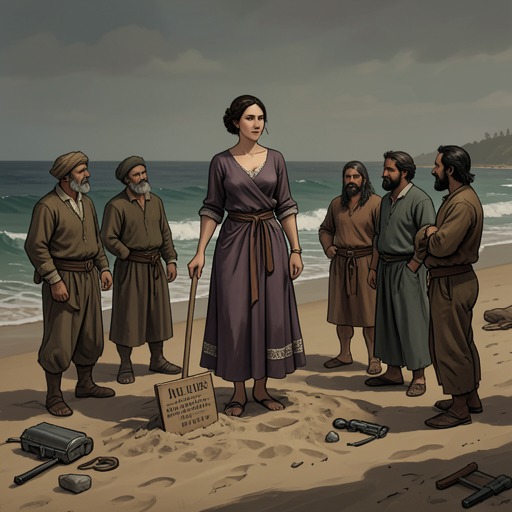
The family’s history becomes physically visible after a violent storm. The storm exposes thousands of whale bones buried along Longboat Bay, remains that had lain under the sand for a century or more. Abel’s mother recognizes them as the legacy of the whaling and sealing that brought the Jacksons to the coast and helped pay for their land. With only her and Abel left of the generations who lived there, she sees that their inherited relationship to the sea must change: it is time to help the sea live and protect the bay for the future. Abel is away when she begins her campaign, writing hundreds of letters to politicians, business leaders, and scientists. Her persistence eventually brings the news that Longboat Bay has been declared a marine sanctuary, with its life protected by law.
The declaration does not end Abel’s attachment to the coast or his mother’s need for him. As Dora Jackson grows older, the orchard and household become harder to maintain, while changing weather and ecological disruptions accumulate around her. Abel and Stella are often away, occupied by work. When Abel returns, he recognizes what he has wanted all along: although life at the bay is hard, it is the life he wants. He tells Stella he wants to stay, and she tells the Foundation they are quitting. He brings his mother home to a freshly painted house, with repaired sheds and newly planted gardens, and they nurse her on a bed on the shady verandah. When officials come to mark the marine reserve, his mother helps identify the politicians who had once wanted to build hotels there and watches the sanctuary’s boundary buoys go into the water. It stretches out to Robbers Head.
Change, Ending, and Significance
Abel’s return is a decision to make a life in the place he had once been forced to leave, not a withdrawal from knowledge or the wider world. He and Stella go back to being scientists, and visitors from around the world come to see them. They continue to watch, listen, and read, while accepting that scientific work has not yielded the sea’s final secret. Abel suspects that his mother, his father, and Mad Macka each understood parts of it; his own understanding, if it comes, will take time. For now, he lets the sea be itself.
The sanctuary makes the consequence of his mother’s campaign visible in the bay. Fish gather and breed there, adding to stocks beyond its boundaries; seagrass, coral, and sponges thrive; shellfish grow in abundance; dolphins and sharks return, and sea lions appear again at Robbers Head after a century away. People dive into the flourishing water and see what the ocean can be when it is allowed to sustain its own life. Abel’s work and homecoming place him within this change, though the protection begins with his mother’s insistence that the family’s inherited use of the coast must become care for it.
After his mother dies, Abel makes a new cross for the family cemetery behind the orchard. He does not regret staying. He lives the boyhood life he had wanted, and the bay’s renewed vitality gives that choice a communal consequence beyond his own happiness. The final image, three divers descending off Robbers Head on Little Dora’s third birthday, recalls the child who once imagined a crowded family of his own. It also returns the story to the water: Abel’s life continues not through possession of the sea’s secrets, but through belonging to a place, passing on attention to it, and allowing it to remain alive.