Costello
BluebackCostello is an abalone diver whose harvesting at Longboat Bay exposes the destructive reach of commercial exploitation. He remains unseen by Abel Jackson, but his presence is legible in the overloaded catch, the Fisheries patrol’s intervention, and a red buoy bearing his name. Through these traces, Costello becomes both a concrete antagonist in the conflict over the reef and a force behind Abel’s growing recognition of human cruelty toward animals.
Identity and Introduction
Dora Jackson identifies Costello as the abalone diver working the coast and describes him as a hard case. Abel already expects him to arrive, and his mother knows that he is right. Costello is therefore introduced not through a face-to-face encounter but through anticipation: his boat’s approach is familiar enough to be expected, while his reputation marks him as someone to reckon with.
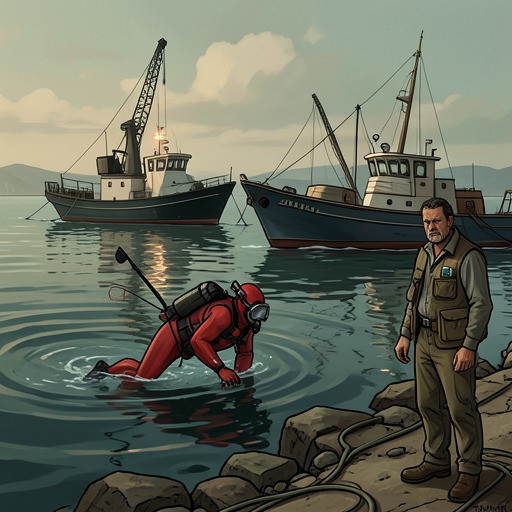
The narrative gives him no private history, stated motive, or direct speech. Instead, it defines him through his actions and their visible consequences. His red jet boat moves along the coast with dive flags streaming; from the house, Abel watches the diver bring up successive large bags of abalone and a string of fish attached to a red buoy. Costello’s character is built from the contrast between the scale of his extraction and the life of the bay being extracted.
Harvesting at Robbers Head
As Costello’s boat works farther along the bay, Abel calculates that it will reach Robbers Head by lunchtime. Looking through binoculars, he sees enough to conclude that the reef is being stripped and tells Dora that the situation is wrong. Her silence leaves his judgment unanswered, but Abel soon acts on it: he takes a boat out with her to approach Costello’s anchored vessel.
The scene aboard the boat makes the scale and nature of the harvesting unmistakable. Its deck is covered with the day’s catch, including large numbers of fish, many undersized. Abel recognizes blue morwong, trevally, sweep, boarfish, harlequins, breaksea cod, groper, jewfish, and samsons. Crates behind the steering console hold abalone and illegal crayfish. The range of species and the presence of undersized fish make this more than a dispute over one prized animal: Costello’s operation is taking a broad and indiscriminate toll on the reef.
Abel proposes returning the abalone to the water in the hope that some might survive. Dora warns him not to board Costello’s vessel, because he could be badly hurt. Costello himself is not shown confronting them; the danger Dora identifies belongs to the situation around his boat, where Abel’s wish to intervene meets the risk of taking matters into his own hands.
Enforcement and Absence
After Abel and Dora return ashore, they wait for trouble. They occasionally glimpse binoculars, but Costello and his offsider resume work, and the compressor starts again. The operation continues despite Abel’s protest: abalone keep coming up, although no speared fish appear, and Blueback stays hidden, recovering from a sore head and out of reach of the divers.
At four o’clock, a Fisheries patrol boat arrives at Longboat Bay. Three officers board Costello’s vessel; half an hour later, the abalone boat leaves Robbers Head under tow. The patrol’s horn carries across the water and into the forest as the boat is taken out to sea. Costello’s fines cost him his licence and put him out of business. The intervention supplies a practical consequence for his harvesting, though it comes after Abel and Dora have waited while the work continued.
Abel is disappointed that he has never met Costello, imagining that meeting a real-life villain would be thrilling. A couple of weeks later, he knows enough about him to no longer want that encounter. The shift is important: Costello’s significance does not depend on a dramatic personal confrontation. Abel has already seen what the man’s operation does, and the consequences of that knowledge are more consequential than the excitement of meeting its operator.
The Buoy and Costello’s Significance
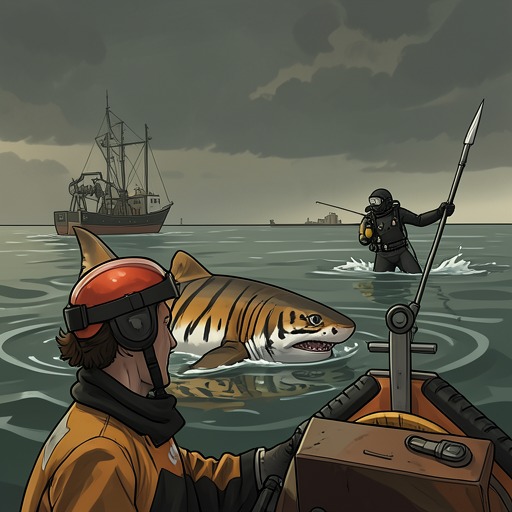
A later encounter gives Costello’s name a new and more disturbing context. Abel watches a tiger shark weakened by a hook and a chain towing a red buoy. The shark cannot dive without being dragged back toward the surface, and Abel recognizes that he cannot free it in time. After it dies, the tide leaves it on the beach; Abel turns over the buoy and sees COSTELLO stencilled on its side. The name links Costello to equipment involved in the shark’s suffering, though the narrative does not show who hooked it or establish exactly how the buoy came to be attached.
Abel takes the shark back out to sea, replaces the buoy with lead weights, and cuts it free. His response contrasts with Costello’s extractive presence: the diver’s name remains on the apparatus, while Abel acts to remove that burden from the animal. At the start of the new year, Abel returns to school feeling older and different. He has learned that nature is not the most cruel force around him; the story identifies greedy human beings as capable of greater cruelty. Costello embodies that lesson not through a personal confession or encounter, but through the repeated evidence of what bears his name and what his work leaves behind.