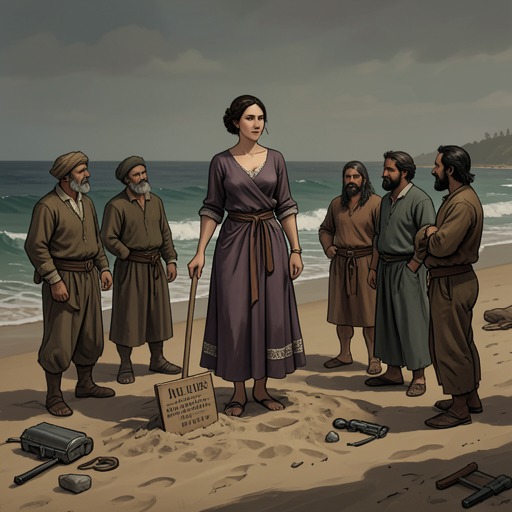
Dora Jackson
BluebackDora Jackson is a diver, mother, and determined advocate for Longboat Bay whose life gives the novel’s conservation story its local roots. She first teaches Abel Jackson the sea through shared work and close attention; later, when changing conditions and destructive fishing threaten the bay, she turns that knowledge into a sustained campaign for protection. Her decisive achievement is helping secure the bay as a marine sanctuary, so that the family’s long history of taking from the sea can give way to helping it live.
Identity and Life at Longboat Bay
Dora’s knowledge is practical and bodily: she dives alongside Abel, gathering abalone from seams in the granite with a screwdriver. She and Abel work by breath and depth, taking a couple from each clump and leaving the rest to breed and grow. The scene presents her not as a visitor to an underwater world but as an experienced worker within it, attentive to both the harvest and what must remain. Abel has learned what he knows on land and under the sea from her, and he watches her move through the water with the ease of someone at home there.
Longboat Bay is more than Dora’s residence. She explains to Abel that inland towns and cities are unbearable to her, while the bay keeps her close to everything: their memories, Abel’s father, and the place itself. She misses Abel when he is away, but says she is not lonely; the place is a kind of friend. Her attachment is therefore not simply nostalgia for a former home. The bay gathers personal memory, family history, and the conditions of her daily life into one enduring relationship.
Motherhood and the Sea’s Inheritance
Dora’s influence on Abel continues across distance. When he is sent inland, she writes to him and mails natural objects, including coral, shells, a dried seahorse, and a starfish. At school, Abel turns a turban shell from his bedside locker in his hands and listens to it, using the object to summon the ocean in a place where he feels hemmed in. Her gifts cannot return him to the coast, but they keep the bay present in his life and preserve a connection to the world she taught him to read.
Her care also takes the form of protection. As boats arrive in Longboat Bay, Dora tells each skipper that a large blue fish lives off Robbers Head and should be left alone. Fishing people respect her and take notice. When she tells Mad Macka, he assures her that the fish is safe with him; the warning helps keep Blueback from being harassed. Dora does not keep the fish’s existence entirely secret. Instead, she makes its protection a matter of shared responsibility, even as Abel worries that greater notoriety could attract someone eager to kill it for attention.
From Warning to Campaign
Dora’s concern grows as the bay faces mounting pressure. Visitors arrive in increasing numbers, including groups of people spearfishing, and she worries about the effects on the place. A month after an oil tanker breaks apart off the coast, Abel watches news of the slick and its eventual dispersal from far away. No oil reaches shore, but Dora calls the near-disaster a warning. The episode belongs to a wider pattern she has been watching: increasingly fierce and erratic weather, a season without salmon, a leopard seal far from its usual range, and five dead dolphins caught in the cliffs at Robbers Head. Meanwhile, age and arthritis make it harder for her to manage the orchard, animals, and machinery alone.
A severe storm tears at the coast and damages Dora’s property. Afterward, she finds thousands of whale bones newly exposed along the bay, remains that had lain beneath the sand for a century or more. The discovery unsettles her because it makes the hidden history of the place suddenly visible. The bones belonged to the Jackson family’s whaling past: whaling and sealing brought their ancestors there, and blubber oil, baleen, seal fur, and fish helped pay for the land. With generations of the family gone and only Dora and Abel remaining, she sees that their inheritance cannot simply mean continuing to live from the sea. She resolves that it is time to help the sea live and to protect the bay permanently.
Securing the Sanctuary
That night Dora begins writing letters, continuing through the next day and producing hundreds over the months that follow. She sends them to politicians, business leaders, and scientists. Although they initially ignore her, she persists, while photographs of Blueback reach newspaper editors. The fish’s image becomes part of her effort to make the bay’s value visible beyond the coast. Her campaign is patient rather than sudden: she keeps writing back and forth until she outlasts the people who dismiss her.
The result first reaches Abel and Stella by fax while they are working far from home. The message says Longboat Bay has been declared a sanctuary, with the life that grows and swims there protected by law. When Abel returns with Stella, Dora is recovering at home. They have repaired and painted the house, fixed the sheds, planted gardens, and made her a special bed on the shady verandah. With a walking frame, she stands when officials come to declare the bay a marine reserve. She recognizes among them politicians who had once been businessmen seeking to build hotels there, and watches with satisfaction as marker buoys establish the sanctuary’s boundary out to Robbers Head. The protected area is, at last, a safe place; Dora still wants other havens along the coast, but is content with what they have achieved.
Later Years and Legacy
Dora regains the ability to walk, though she does not go far without help. Some days she takes a chair down to the jetty; when strong enough, she climbs to the peppermint tree to be alone with her memories. She, Abel, and Stella share ordinary work—mending nets, bottling fruit, and smoking fish—while Abel and Stella supervise the bay, study abalone breeding, and take visitors to see Blueback. Her life after the campaign remains bound to the coast, but its terms have changed: the bay is no longer only a place of work and family memory, but a protected habitat they actively watch over.
Dora dies in her sleep the day after a final visit to the shallows, where a large blue shadow swims around her and Abel. Abel makes a new cross for the small graveyard behind the orchard. The bay’s subsequent flourishing gives her work a visible consequence: fish return to breed in the sanctuary and contribute to stocks beyond it; seagrass, coral, and sponges thrive; abalone multiply; dolphins and sharks come in; and sea lions return to Robbers Head after a century away. Abel and Stella continue their scientific work, but do not claim to discover the sea’s secrets. Dora’s legacy is instead a protected place and a way of living with it: knowledge grounded in attention, carried across generations, and put to work so the sea can remain itself.