“I was a radio repairman”
Bluebeard“I was a radio repairman” is the final message an unnamed brain surgeon manages to write after losing the ability to speak. Circe Berman turns this brief, enigmatic statement into a theory of people as receivers of signals: a way of imagining sudden changes in conduct and personality without assuming that the mind is always their origin. The metaphor travels from a failing hand to a tapped skull, then outward to the dead and the persistently static-filled mind of Paul Slazinger.
The surgeon’s last message
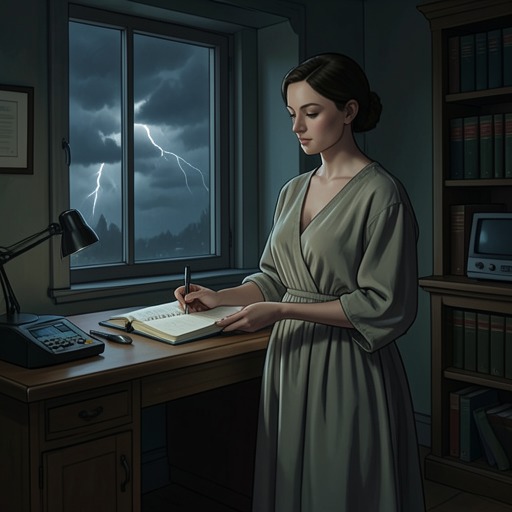
At the end of the surgeon’s life, his brain no longer permits him to talk. He can still make short scrawled messages with his left hand, although he is normally right-handed; the left hand is the only part of him that retains even a little function. Circe identifies “I was a radio repairman” as his ultimate communiqué. Its force comes partly from the circumstances of its delivery: a professional associated with the brain, reduced to writing with a damaged body, leaves behind a statement whose meaning cannot be securely diagnosed.
Circe offers two possibilities rather than settling the sentence’s meaning. The surgeon’s damaged brain may have taken the words literally, or he may have concluded that the brains he operated on were essentially receivers for signals coming from elsewhere. The first explanation makes the message an effect of injury; the second makes it a compressed account of a theory about consciousness. The scene preserves the gap between them. What the surgeon meant is not confirmed, but his last words become the starting point for Circe’s interpretation.
Circe’s receiver theory
To make the idea tangible, Circe compares a radio’s music with the orchestra that is not inside the box. As she explains this distinction, she comes over and raps Rabo Karabekian on the head with her knuckles as though his skull were a radio. The gesture turns an abstract proposition into a small demonstration: the receiver may produce or transmit what is heard without containing the source. The analogy makes the mind’s relation to thought imaginable as reception rather than authorship.
Circe connects the theory to Rabo’s father and Terry Kitchen. When either began doing things he had never done before and changed personality as well, she suggests, each may have started receiving signals from a different station, one with different ideas about what to say and do. Her phrasing is explicitly speculative. The image does not establish what caused either man’s change; it offers Rabo a model in which an unfamiliar impulse can seem to arrive from outside the self. Sudden transformation becomes a change of station, not proof of a settled account of human identity.
The metaphor travels
Rabo later tries Circe’s theory out on Paul Slazinger, who plays with its implications. He imagines Green River Cemetery as full of busted radios, while the transmitters to which they had once been tuned continue to broadcast. The extension gives death a peculiar asymmetry: the receivers are broken, but the signals go on. It is Paul’s speculative image, not confirmation that the dead remain connected to identifiable transmitters.
Paul also describes his own mind as receiving only static, along with what sounds like weather reports in a foreign language he has never heard. His comparison makes the receiver metaphor less an explanation than a vocabulary for estrangement: signals may be imagined as arriving, but they need not be intelligible. He recalls that toward the end of his marriage to Barbira Mencken, the actress, she seemed to be wearing headphones and listening to the 1812 Overture in stereo. In his account, the change coincided with her becoming a real actress rather than merely another pretty girl liked by everyone onstage. She was no longer “Barbara” to him, but “Bar-beer-ah!” The altered name, like the imagined headphones, registers a transformation Paul can describe without explaining its cause.
Meaning and limits
The expression gathers these episodes without resolving them. A surgeon’s last scrawl can be read as the literal statement of a damaged brain or as a theory about where thought comes from; Circe applies the theory to radical changes in behavior, and Paul extends it to death, mental static, and acting. Each use opens a different possibility, while the evidence stops short of proving that minds actually receive signals from an external source.
That unresolved status is central to the image’s work in the novel. The radio makes a familiar experience—the sudden arrival of a thought or an unfamiliar version of oneself—strange enough to reconsider. At the same time, the metaphor does not erase the individual scenes that give it weight: a left hand still able to write, Circe’s knuckles against Rabo’s skull, Paul’s busted radios in the cemetery, and the foreign weather reports in his head. “I was a radio repairman” persists not as a key that unlocks those scenes, but as a compact phrase through which the characters test how much of a person’s voice, conduct, or identity can be called their own.