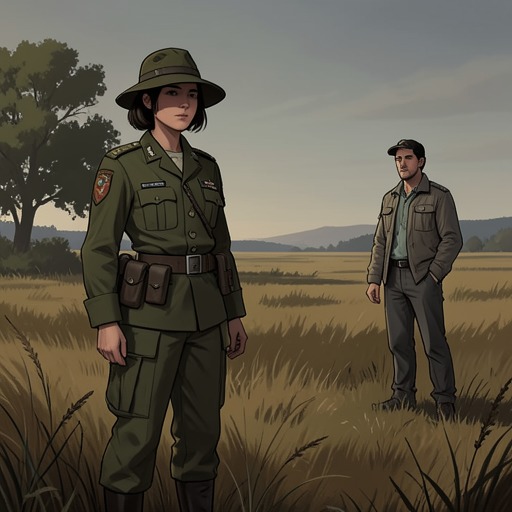
“One war to a customer”
Bluebeard“One war to a customer” is Rabo Karabekian’s wry shorthand for the way war reaches different people and generations in turn. Spoken after he recounts that his neighbor Big John served in the Korean War and Big John’s only son was killed in Vietnam, the phrase makes each man’s distinct war sound like an allotted, individual burden—without suggesting that the burden ends with him.
The Phrase in Context
Rabo encounters Big John Karpinski along the boundary north of his potato barn. A native potato farmer, Big John lives amid land that has passed through three generations of his family; its value has risen sharply as houses with ocean views have been built on former fields. Rabo compares this attachment to ancestral ground to an Armenian sense of sacred homeland, linking the neighbor’s local history to Rabo’s own immigrant background without making their histories identical.
Big John is a large man, usually in bib overalls, and a wounded veteran. He is younger than Rabo and Paul Slazinger, so his war was not theirs: he served in the Korean War, while Rabo and Paul are veterans of World War II. Rabo gives the difference a compact verbal form: “One war to a customer.”
A Family History of War
The phrase’s immediate setting is a sequence of losses across generations. Big John’s only son, Little John, was killed by a land mine in the Vietnam War. The line therefore does more than distinguish one veteran’s service from another’s. It places a father’s service and a son’s death in successive wars, making the family’s experience a concentrated instance of war’s recurrence.
Rabo’s own account widens that pattern. He was not born one-eyed: near the end of World War II, while commanding a platoon of Army Engineers in Luxembourg, he was wounded and captured. His unit consisted of civilian artists assigned to camouflage work, but at the time of his capture they were fighting as ordinary infantry. He remembers little of the moment of injury itself; his recollection turns instead on seeing a white German tank and soldiers crossing a snow-covered meadow. After being taken unconscious and kept under morphine, he awoke in a German military hospital in a church across the border. His wound healed quickly, and he was sent to a prisoner camp.
After the war, the United States paid for cosmetic surgery at Fort Benjamin Harrison outside Indianapolis where Rabo had lost his eye. He describes his response not as bitterness but as blankness, and connects it to the emotional condition he had recognized in Fred Jones. He says that neither of them had anything to come home to. The phrase about one war per customer thus sits beside an experience that did not conclude neatly with military service: Rabo returned with an injury, a sense of disconnection, and a life whose losses continued beyond the battlefield.
Veterans and the Aftermath
Rabo’s later life makes the distinction between a war and its aftermath especially consequential. After his first wife, Dorothy, and their two sons left him in 1956, he gave up on himself as a painter and spent eight years as a hermit. He identifies loneliness as something he had endured before, including as a boy and during the Great Depression in New York City. His story does not establish that military service alone caused his family estrangement or retreat, but it sets those later difficulties within a life shaped by wartime injury and separation.
Paul Slazinger is Rabo’s close friend and fellow wounded World War II veteran. Though he is said to sleep in a house next door, he comes over almost every day. Their shared veteran status offers a point of connection, while Big John’s Korean War service and his son’s death in Vietnam extend the phrase beyond Rabo and Paul’s own generation. “One war to a customer” is at once a joke about each person receiving a separate war and a sober recognition that no family or generation is thereby exempt from another’s.