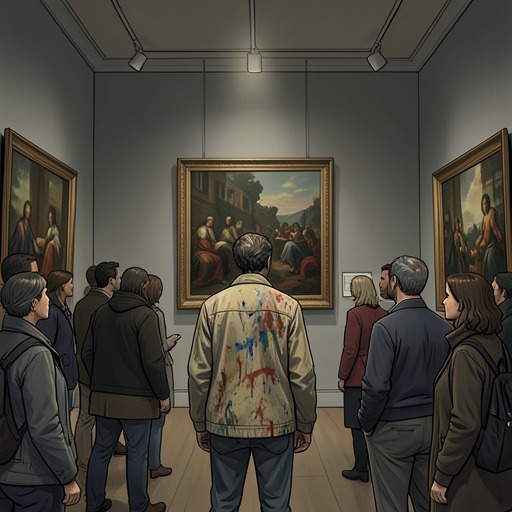
Rabo’s will stipulates that the barn remain sealed
BluebeardRabo’s will stipulates that the barn remain sealed. The provision made the potato barn’s contents inaccessible until after his burial, converting a private artistic refuge into a secret whose opening was deferred beyond his lifetime. It is both a practical instruction and a narrative lock: the work inside could be approached only after the artist himself was gone.
The Barn and Its Contents
The barn contained eight primed, stretched canvases, each eight feet square, arranged side by side to form a continuous surface sixty-four feet long. Supported from behind by two-by-fours, they stood like a fence down the middle of the building. These were the panels from Windsor Blue Number Seventeen, the painting that had once adorned the lobby of the GEFFCo headquarters on Park Avenue before its celebrated status gave way to disgrace.
The panels had returned to Rabo three months before Edith’s death. They were discovered in a locked chamber on the lowest of the three basement floors beneath the Matsumoto Building, formerly the GEFFCo Building. An insurance inspector searching underground for fire hazards recognized the canvases by shreds of Sateen Dura-Luxe still clinging to them. Behind a locked steel door, they had remained hidden from people who had no idea what lay beyond it. Their recovery brought the discarded work back into Rabo’s possession, but not into public view.
The Rule in the Will
After spending six months working in the barn with its sliding doors closed, Rabo installed five additional locks and hasps and snapped them shut. He then had a lawyer draw up a new will, which directed that the barn not be unlocked until after his burial. Secrecy was thus reinforced twice: first by the visible hardware on the doors, then by a legal condition that postponed access even after the work had been completed.
The will also left his property to his two sons on the condition that they do something in memory of their Armenian ancestors. The barn clause therefore sits within a larger set of instructions connecting inheritance to family obligation, while imposing its own separate restriction on when the studio could be opened. Rabo later says that his sons did well despite the horrors of their childhood and had taken the surname of their stepfather; the account does not specify the precise action the will required of them.
Secrecy and Delayed Disclosure
Rabo had already hinted at the potato barn’s secret in the manuscript, yet he asks whether Circe will read those clues and guess the rest, then answers that she will not. The will gives that withheld knowledge a concrete counterpart: the barn is not merely difficult to enter, but explicitly to remain closed until after his death. The reader is told about the provision before the canvases are fully described, so the rule helps sustain the suspense surrounding what the barn contains.
The clause also reverses the usual relation between an artwork and its audience. The canvases’ earlier public history had carried them from prominence to disgrace; after their recovery, Rabo placed them behind doors that neither visitors nor heirs could open at will. Their eventual availability is governed not by recognition, curiosity, or ownership alone, but by a condition tied to the end of his life. The will therefore protects the secret while ensuring that concealment cannot be permanent.