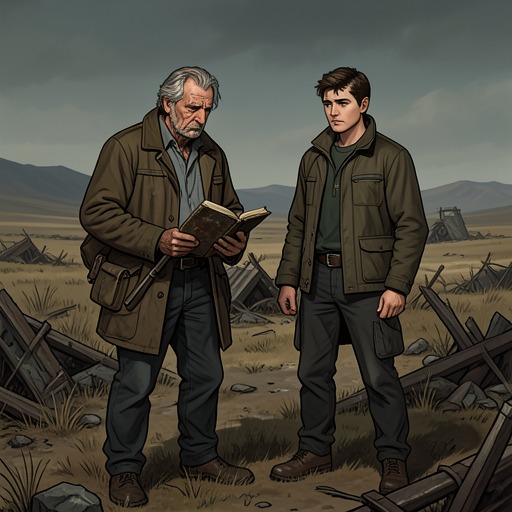
Candide–Pangloss relationship
CandideThe Candide–Pangloss relationship is at once a teacher–pupil bond and a continuing test of optimism against experience. Pangloss gives Candide the language with which to explain the world; when that world repeatedly contradicts the explanation, Candide still risks money, safety, and judgment to help his former master. Their final exchanges preserve their affection but distinguish Pangloss’s insistence on theory from Candide’s practical conclusion that life requires work.
Identity and Instruction
Pangloss is the preceptor in the household of the Baron of Thunder-ten-Tronckh in Westphalia, and Candide receives his lessons with the faith and receptivity of youth. The tutor’s elaborate title, professor of metaphysico-theologico-cosmolo-nigology, parodies the authority of a system that claims to explain everything. Pangloss teaches that every effect has a cause and that the existing world must be the best possible arrangement. His examples make the reasoning concrete: noses are for spectacles, legs for stockings, stones for castles, and pigs for eating. Because each thing is said to serve its purpose, even the Baron’s castle and household become evidence for the doctrine.
Candide does not initially treat this philosophy as a proposition to examine. He believes Pangloss and ranks hearing him as the fourth of his imagined degrees of happiness: after being born into the Baron’s family, possessing Cunegonde’s love, and seeing her every day. This placing of the tutor among Candide’s sources of happiness gives the instruction an intimate force. Pangloss is not merely a dispenser of abstract claims; he is a trusted presence within the young man’s sheltered world. Candide’s admiration also shows how the doctrine takes hold: the pupil accepts the master’s comprehensive explanation before experience gives him grounds to test it.
Doctrine Meets Experience
The relationship changes when Candide, expelled from the castle, encounters Pangloss again as a gravely ill beggar. The contrast is immediate: the philosopher who had explained the order of the world now appears in a condition that Candide finds shocking. Moved more by compassion than horror, Candide gives him the two florins he had received from James the Anabaptist. Pangloss recognizes him, and Candide’s first response combines recoil with concern. He asks what misfortune has brought his teacher so low and what has become of the people and home associated with their former life.
Pangloss recounts the destruction of the castle and the deaths of its household, including Cunegonde, the Baron, the Baroness, and the Baron’s son. Candide faints, then, on recovering, asks after the cause, effect, and sufficient reason for Pangloss’s miserable condition. The question carries the vocabulary of Pangloss’s own teaching into circumstances in which it can no longer remain safely abstract. Pangloss attributes his illness to love, and Candide compares the disastrous consequence with the brief kiss and kicks that had marked his own attachment to Cunegonde. The old explanatory language remains between them, but its comic logic is sharpened by what each has endured.
When Pangloss says he cannot afford treatment, Candide acts on his behalf. He pleads with James, whose generosity brings Pangloss into his home and pays for his cure. Pangloss survives but loses an eye and an ear; James then employs him as a bookkeeper. After two months, James takes Pangloss and Candide aboard his ship for Lisbon. The episode reverses the original direction of instruction: Candide, once the pupil who accepted Pangloss’s account of the world, now supplies the decisive care that allows the teacher to continue living. His response is not an argument against Pangloss but a concrete act of loyalty.
Reunion and the Persistence of Belief
Much later, Candide encounters Pangloss again in a Turkish galley, where both Pangloss and the Baron are enslaved at the oar. Candide embraces Pangloss repeatedly and asks how he could have survived the hanging Candide had witnessed. Pangloss explains that he was meant to be burned, but heavy rain prevented the fire from being lit; the authorities hanged him instead. A surgeon bought his body and began an incision while Pangloss was still alive. His scream frightened the surgeon and the surgeon’s wife, whose flight brought a barber to sew Pangloss’s wounds. After recovering, Pangloss passed through service with a knight of Malta and a Venetian merchant before a separate incident in Constantinople led to his sentence to the galleys.
The account makes the reunion more than a return to their earlier roles. Candide asks directly whether Pangloss continued to believe that everything happens for the best after being hanged, dissected, whipped, and forced to row. Pangloss answers that he remains of his first opinion, invoking his commitment to philosophy and to Leibnitz, as well as the pre-established harmony, plenum, and materia subtilis. The contrast is exact: Candide’s question gathers a sequence of bodily ordeals; Pangloss answers with the same theoretical confidence that preceded them. Candide’s affectionate address does not conceal the intellectual distance between them.
Counsel and the Final Difference
Pangloss remains part of Candide’s circle even after that difference has become visible. When Candide consults Pangloss, Martin, and the faithful Cacambo about the Baron’s renewed opposition to his marriage to Cunegonde, each offers a distinct course. Pangloss draws up a legal memorandum arguing that the Baron has no authority over his sister and that she may marry Candide with her left hand. His role as adviser thus continues, but his expertise is now placed alongside Martin’s proposal to throw the Baron into the sea and Cacambo’s plan to return him to the galley captain. The group chooses the latter course, punishing the Baron’s pride and removing the obstacle without accepting Pangloss’s argument as the practical solution.
At the close, Pangloss still supplies an interpretation, this time connecting human labor to the Garden of Eden. Candide answers that they must cultivate their garden, and Martin urges them to work without disputing as the only way to make life tolerable. Pangloss’s reply supports the value of labor, but it does not undo the difference established by the novel: he reaches action by fitting it into a philosophical rationale, while Candide’s conclusion turns from disputation toward the work itself. Their relationship therefore ends neither in a simple break nor in the pupil’s return to unquestioning belief. Pangloss remains teacher, companion, and adviser; Candide remains attached to him, yet no longer treats his explanations as sufficient. In the concise, comic movement of Voltaire’s tale, their bond gives philosophical optimism a human history: first received as instruction, then confronted with suffering, and finally set beside a modest practice of shared work.