Candide–Cunégonde relationship
CandideThe Candide–Cunégonde relationship turns an adolescent attraction into a test of what love can mean after repeated separation, violence, and disillusionment. Their first kiss sets Candide’s travels in motion, but their eventual marriage does not restore the innocence of that beginning: it is secured through a promise and defiance of aristocratic pride, then exposed to the ordinary irritations of shared life. The story makes their union both a plot-long object of pursuit and an ironic contrast to the happiness Candide once imagined it would provide.
Identity and First Encounter
Candide and Cunegonde first meet within the enclosed social world of the Castle of Thunder-ten-Tronckh. Candide is an inexperienced young man who believes the lessons of Pangloss, the family’s philosophical authority; he ranks being born to the Baron of Thunder-ten-Tronckh as the greatest happiness, and being near Cunegonde just below it. He finds her extremely beautiful but lacks the courage to tell her. His affection is therefore real but initially unspoken, shaped by the same sheltered confidence in the castle and its established order that informs his youthful understanding of happiness.
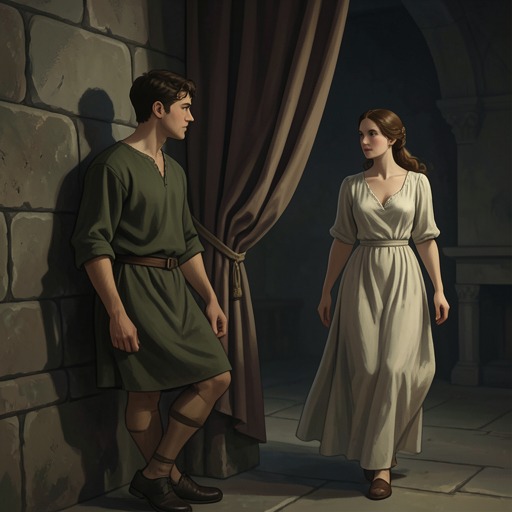
Cunegonde’s interest develops after she witnesses Pangloss conducting an experiment with her mother’s chambermaid. She interprets what she sees through the language of causes and effects, imagines herself as a sufficient reason for Candide, and returns to the castle pensive and stirred by the possibility of intimacy. Their mutual attraction then moves from speculation to physical contact. After blushing and faltering greetings, they meet behind a screen; Cunegonde drops her handkerchief, Candide picks it up, and their innocent exchange of hands becomes a kiss. Their trembling and wandering hands make the encounter a bodily reversal of Candide’s earlier inability to speak.
That brief closeness brings immediate punishment. The Baron of Thunder-ten-Tronckh sees the couple and drives Candide from the castle with kicks; the Baroness of Thunder-ten-Tronckh boxes Cunegonde on the ears after she regains consciousness. The lovers’ first encounter thus establishes the conflict between private desire and family rank, while abruptly separating them before their relationship can become a settled courtship. The contrast is pointed: a kiss that Candide experiences as the beginning of happiness becomes the cause of his expulsion.
Separation and Recognition
Their reunion in Portugal gives the relationship a different emotional weight. Candide has been told that Cunegonde was killed, and, on seeing a veiled woman whose jewels and bearing suggest a different life, he approaches without certainty. When the veil is lifted, recognition overwhelms both of them: Candide falls at her feet, Cunegonde collapses onto a sofa, and the Old Woman uses a smelling bottle to revive them. Their speech returns in broken questions, answers, sighs, tears, and cries. The scene makes recognition itself an event: the attraction begun at the castle survives not as an uninterrupted romance but as the shock of finding someone believed lost.
Cunegonde’s survival does not mean that the violence Candide heard about was imaginary. She confirms that she was violated and disembowelled, while explaining that neither assault nor injury necessarily proves fatal. She also tells him that her brother was killed. Candide’s astonishment at finding her alive is therefore bound up with the confirmation of what she has endured. Before telling her own history, she asks to hear his account, beginning with their innocent kiss and the kicks he received for it. Candide recounts the events since their separation; Cunegonde weeps when she hears of the deaths of the Anabaptist and Pangloss. Their reunion renews intimacy through an exchange of histories, but those histories consist of loss as well as longing.
Promise, Rank, and Marriage
Candide’s intention to marry Cunegonde remains explicit even after their paths diverge again. When he and her brother meet in Paraguay, the brother embraces Candide and calls him his saviour, imagining that they may enter a town as conquerors and recover Cunegonde. Candide answers that marrying her is all he wants and that he continues to hope for it. The brother’s response converts the old conflict into an argument about lineage: he objects that his sister has seventy-two quarterings and treats Candide’s proposal as insolence. Candide’s love is expressed as a continuing objective; the brother measures the proposed marriage by inherited rank.
At the final reunion, the discrepancy between remembered and present appearances makes the relationship harder to idealize. Candide finds Cunegonde’s face and body altered by age and hardship: her eyes are bloodshot, her neck withered, her cheeks wrinkled, and her arms rough and red. He recoils three paces in horror before advancing out of politeness. Yet Cunegonde embraces him and her brother, and Candide ransoms her and the Old Woman. She does not know that she has become ugly because nobody has told her. When she reminds Candide of his promise in a tone that leaves him unable to refuse, the remembered romance becomes a claim upon his word.
Her brother again resists the marriage, insisting that she should marry only a baron of the empire and invoking the scandal that, in his view, would prevent her children from entering the church in Germany. Cunegonde throws herself at his feet and bathes them with tears, but he remains inflexible. He declares that Candide may kill him again but may not marry his sister while he is alive. Candide’s decision is consequently shaped by more than desire: he has little wish to marry Cunegonde deep down, yet the brother’s impertinence determines him to proceed, while Cunegonde’s insistence makes him feel bound by his promise.
Marriage and the Limits of the Romance
The group’s proposed ways of dealing with Cunegonde’s brother expose how the marriage is finally secured. Pangloss prepares an argument that the brother has no right to control his sister and that, under imperial law, she may marry Candide with her left hand. Martin proposes throwing him into the sea; Cacambo recommends returning him to the galley captain and arranging his delivery to the head of the order in Rome. The advice is accepted, the Old Woman approves, and the plan is carried out for a little money without telling Cunegonde. The episode punishes the brother’s pride and removes his obstruction, but it does not present the marriage as a spontaneous return to youthful bliss.
After many disasters, Candide does marry Cunegonde, and the companions settle on a small farm. The marriage brings no simple reward: Candide has been cheated by Jews and retains only the farm; Cunegonde grows uglier and more peevish and difficult to bear. Their life together is part of a household in which the Old Woman is infirm and fretful, Cacambo is worn out by garden work and selling vegetables in Constantinople, Pangloss despairs of not shining in a German university, and Martin endures his circumstances because he expects to fare badly elsewhere. The reunion and wedding therefore resolve the lovers’ long separation without fulfilling Candide’s early equation of Cunegonde with happiness.
The relationship’s ending shifts attention from romantic expectation to the conditions of daily life. The companions’ disputes continue, but so do idleness and dissatisfaction; the Old Woman asks whether their past sufferings were worse than staying with nothing to do. Against that background, Candide’s insistence that they must cultivate their garden offers no retrospective guarantee that his marriage is happy. It marks a practical answer to the exhausting cycle of promises, separations, and philosophical argument. Cunegonde and Candide do end together, but the story makes the endurance of ordinary work, rather than the recovery of their first kiss, the more consequential conclusion.