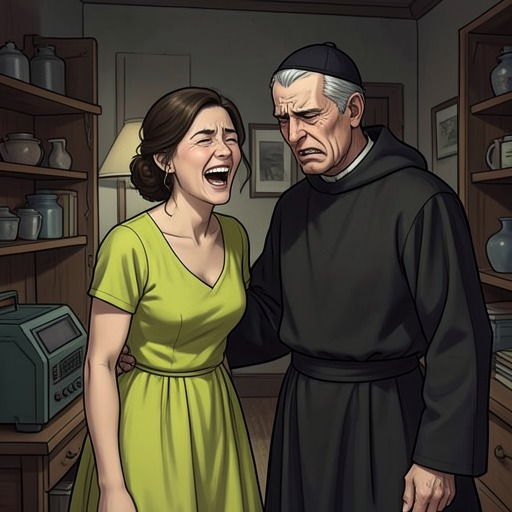
Pangloss–Paquette relationship
CandidePangloss and Paquette’s relationship links a private intimacy in the Baron’s household to illness, separation, and Paquette’s later account of hardship. First glimpsed by Cunegonde as one of Pangloss’s supposed lessons in natural philosophy, the relationship becomes part of the chain of events that shapes the young woman’s understanding of desire and precedes Candide’s expulsion. When Pangloss and Paquette reappear in separate episodes, their experiences also test his claim that every misfortune belongs to the best of all possible worlds.
The Affair in the Baron’s Household
Paquette is a chambermaid in the household of the Baron of Thunder-ten-Tronckh. One day, Cunegonde sees Pangloss with her in a small wood near the castle, where he presents their intimacy as a lesson in experimental natural philosophy. The scene is filtered through Cunegonde’s eager interpretation: interested in science, she attends to what she takes to be the lesson’s causes and effects, then imagines that she might be a sufficient reason for Candide, and he for her. The episode thus makes Pangloss and Paquette’s private relationship the occasion for Cunegonde’s first conscious speculation about her own attachment.
The connection is not presented as a formal courtship or marriage. It is a clandestine encounter within a household organized around rank and supervision, and the narrative’s account of it is comic in its use of philosophical language to frame private conduct. That comedy has a consequence beyond Pangloss and Paquette themselves. After Cunegonde and Candide meet behind a screen and kiss, the Baron discovers them and expels Candide; Cunegonde is punished by the Baroness of Thunder-ten-Tronckh. Paquette’s earlier intimacy with Pangloss is therefore the example that awakens Cunegonde’s desire, while the young couple’s attempt at intimacy brings the household’s authority down on them.
Illness and Pangloss’s Explanation
Pangloss later identifies love as the cause of his miserable condition. He recalls his relationship with Paquette and connects their intimacy with the illness from which he suffers. His explanation extends beyond the pair: he recounts a chain of transmission involving Paquette, a Grey Friar, and earlier partners, reaching back through a succession of people. The account turns a personal consequence into an elaborate genealogy, making the disease a subject for Pangloss’s characteristic reasoning as much as a source of suffering.
He argues that even this affliction must be necessary in the best of worlds, associating its historical spread with the arrival of chocolate and cochineal in Europe. The reasoning places the consequences of Pangloss and Paquette’s relationship inside his larger doctrine of sufficient cause: no misfortune can simply stand as evidence against the world’s order, because it can be assigned a place in a chain of causes and supposed benefits. Yet his own circumstances resist the neatness of that defense. He is ill, without money for treatment, and dependent on others for help.
Candide responds to Pangloss’s need by asking James the Anabaptist to take him in. James pays for his treatment; Pangloss survives, though he loses an eye and an ear, and later works as James’s bookkeeper. The intervention does not erase the consequences of the illness, but it changes Pangloss’s immediate circumstances from destitution to paid employment. His recovery is therefore practical and limited, secured not by the explanatory system he teaches but by another person’s charitable action.
Paquette’s Later Account
Paquette reappears in Venice, where Candide recognizes her in the company of a Theatine. She tells him that she remembers him and has heard of the disasters that befell the Baroness of Thunder-ten-Tronckh and Cunegonde. Candide recalls the condition in which he saw Pangloss and asks whether she had brought it about. Paquette confirms her connection to Pangloss’s illness, but her account gives her own history a wider frame than his account of their intimacy.
She says that she was innocent when Candide knew her and that a Grey Friar, her confessor, seduced her. After leaving the castle, she was treated by a surgeon and remained with him as his mistress out of gratitude. His wife’s hostility made her life miserable. When the surgeon’s treatment of his wife resulted in the wife’s death, he fled prosecution and Paquette was imprisoned. She was released by a judge on condition that she become the surgeon’s partner; later, another woman displaced her, leaving Paquette destitute and working as a prostitute in Venice.
This history does not establish that Paquette and Pangloss renew their relationship when she meets Candide again. Instead, the reunion makes their different positions visible: Pangloss’s account turns illness into an argument about universal necessity, while Paquette recounts a succession of constrained circumstances that cost her security and livelihood. Her story also complicates the comic chain of causes surrounding their affair. The relationship is one link in Pangloss’s philosophical genealogy, but Paquette’s remembered consequences are social and material, extending well beyond the moment of intimacy.
Narrative Significance
The relationship brings the book’s philosophical comedy into the private sphere. At the castle, a lesson in causes and effects is simultaneously an affair and the stimulus for Cunegonde’s imagined romance with Candide. Later, the same language of causation accompanies Pangloss’s illness and his attempt to explain it as necessary. The recurring pattern places intimate conduct, bodily misfortune, and abstract doctrine side by side without allowing Pangloss’s explanation to cancel the practical damage.
Paquette’s return in Venice broadens that contrast. Her story links the castle episode to the novel’s continuing sequence of reversals, but it also gives the relationship a consequence that Pangloss’s reasoning cannot fully contain: her repeated losses of protection and means of support. The two are not shown resolving their history together. Their narrative connection instead remains an example of how a brief private relationship can reappear as a long chain of consequences, interpreted very differently by the people caught in it.