Candide–Martin relationship
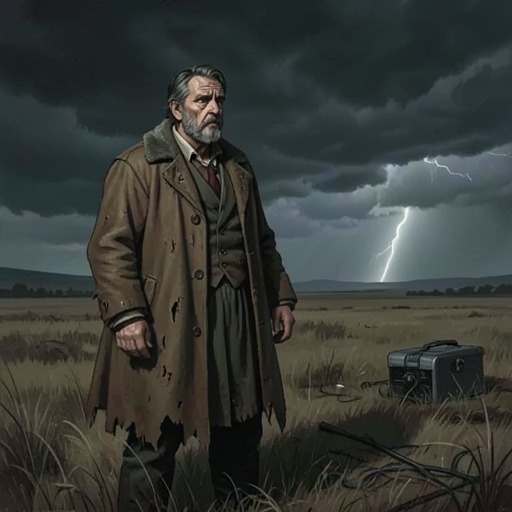
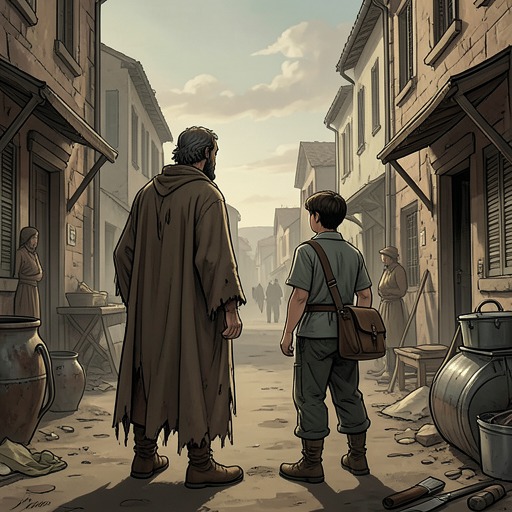
CandideThe Candide–Martin relationship turns philosophical disagreement into a durable form of companionship. As they travel together, Martin’s belief that the world is ruled by suffering repeatedly meets Candide’s hope of finding Cunegonde and his lingering tendency to trust Pangloss’s optimism. Neither man simply converts the other: they argue, observe fresh misfortune, and continue together. Their final shared commitment is not agreement about how the world works, but work that can make life more tolerable.
Meeting as fellow travelers
Martin joins Candide on the voyage from Surinam to Bordeaux. Both have seen and suffered much, and the subject of moral and natural evil supplies them with an ongoing topic of conversation. Their starting positions are unequal in one important respect: Candide still hopes to see Cunegonde, whereas Martin has nothing to hope for. Candide also has money and jewels, though he has lost one hundred large red sheep carrying treasure and remains troubled by the Dutch skipper’s knavery. When he thinks of what remains to him, and especially when he mentions Cunegonde, he finds himself leaning again toward Pangloss’s doctrine.
Candide asks Martin to explain his ideas about evil. Martin says that priests accused him of being a Socinian, but that he considers himself a Manichean and cannot think otherwise. His outlook is not presented as a detached theory: it is the conclusion he draws from looking at human relations and public life. He excepts Eldorado, but elsewhere sees cities wishing for the destruction of neighboring cities, the weak living in fear of the powerful, and organized soldiers earning their bread through predation and murder. Even places that appear peaceful and cultivate the arts, he argues, are burdened by envy, care, and uneasiness; private grief can be worse than public calamity. Candide answers that some things are good. Martin allows that this may be so, but says he does not know them.
Argument tested by events
The voyage supplies an immediate test of the men’s competing readings. They see two ships fighting at sea. One sinks the other, and a hundred men on the deck of the doomed vessel raise their hands and cry out before being swallowed by the water. Candide treats the sinking as punishment for the Dutch skipper, whom he identifies as a rogue. Martin objects that the passengers have also been destroyed: punishment of the skipper does not account for their deaths. The same scene thus offers Candide an apparent instance of moral consequence and Martin a further example of innocent suffering.
The ships continue on, and so does the conversation. Candide and Martin dispute for fifteen successive days without advancing beyond the positions from which they began. Yet argument is not their only bond: they exchange ideas and console one another. Candide caresses the sheep he has kept and connects their reunion with the possibility of finding Cunegonde again. Hope remains for him not as a settled explanation of every event, but as a personal expectation that keeps his journey pointed toward her.
Different readings of Europe
As they near France, their contrast also shapes their plans. Martin recounts his unhappy experience in Paris: he was robbed at the fair of St. Germain, mistaken for a robber and imprisoned for eight days, then worked as a corrector of the press to earn enough to return to Holland on foot. He describes the city as a confused multitude in which people seek pleasure and few find it. Candide, by contrast, has little curiosity about France. After spending a month in Eldorado, he wants to see no place on earth except wherever he might find Cunegonde; he proposes that they travel through France on the way to Italy and wait for her in Venice. Martin agrees to accompany him, noting that he has no money and Candide does.
In Venice, the difference sharpens. When an officer orders them seized and taken to prison as suspected foreigners, Candide compares their treatment unfavorably with the hospitality of Eldorado. Martin says that he is more Manichean than ever. Later, as Candide waits for Cunegonde and sinks into melancholy, Martin advises him not to expect the missing Cacambo to find and return her. He argues that there is little virtue or happiness on earth, perhaps except in Eldorado, where almost no one can gain admittance. Candide resists that outlook when he sees a young Theatine friar with a girl and suggests that the pair may be happy. The exchange shows that his hope is not simply a doctrine repeated in conversation: he keeps searching for counterexamples, while Martin remains reluctant to accept them.
From disputation to shared work
The conclusion changes the terms of their companionship without resolving their metaphysical dispute. After Candide decides that he and Cunegonde will marry, the Baron’s impertinence helps determine him to proceed. The group consults Pangloss, Martin, and Cacambo about the Baron, whose opposition to the marriage continues despite Candide’s having rescued him from the galleys. The final turn comes when the companions encounter a Turkish farmer whose life seems preferable to the exposed grandeur of the deposed kings. Candide says that they must cultivate their garden. Pangloss supplies a philosophical explanation for human labor, connecting it to the Garden of Eden; Martin instead urges them to work without disputing, as the only way to make life tolerable.
The small society follows Martin’s practical counsel. Each member works according to ability, and their plot of land produces plentiful crops. Martin’s proposal does not erase Candide’s history or Pangloss’s habit of explaining it. Pangloss still strings Candide’s expulsion, punishment by the Inquisition, journey through America, stabbing of the Baron, and loss of the sheep into a chain supposedly leading to their present meal. Candide answers that they should cultivate the garden. Against this retrospectively imposed sequence of causes, Martin’s emphasis on labor offers a limited, shared course of action: the companions can tend their own lives even when their arguments about the world remain unsettled.