Portuguese Inquisition
CandideThe Portuguese Inquisition is presented in Candide as a religious authority whose formal ceremonies and claims to public order repeatedly serve coercive ends. In Lisbon, its officials punish Candide and Pangloss after a university decree claims that an auto-da-fé can prevent earthquakes; the ceremony neither prevents disaster nor restrains the Grand Inquisitor from using his office in a private contest over Cunegonde. The institution’s narrative force lies in this collision between solemn procedure and arbitrary power.
Presence and Authority
The story introduces an official of the Portuguese Inquisition as a Familiar, a functionary who listens while Pangloss explains the earthquake as part of a world in which everything is necessarily for the best. The official challenges the reasoning through the doctrine of original sin: if everything is already best, he points out, the Fall and punishment would have no place in Pangloss’s account. The exchange makes religious authority part of the philosophical debate, but the official’s presence also anticipates a system in which theological disagreement carries practical consequences.
The Inquisition’s authority appears alongside other forms of rule and justification in the book. The University of Coimbra has decided that a public auto-da-fé, including the execution of people by fire, is an infallible way to stop the earth from shaking. The decree gives a catastrophic natural event a purportedly manageable religious remedy. Rather than investigate the cause of the earthquake, the authorities convert the aftermath into a reason for punishment.
The Lisbon Auto-da-fé
The proceedings target several people on different grounds. A Biscayan is seized for marrying his godmother; two Portuguese men are arrested for refusing bacon on their chicken; Pangloss is taken for speaking his mind; and Candide is taken for listening to him with apparent approval. The distinctions between their alleged offenses do not prevent them from being drawn into the same public ceremony. Their confinement, the preparations for the procession, and the assigned costumes make punishment a carefully staged institutional spectacle.
The sentences are not uniform. Candide is publicly whipped, the Biscayan and the two men who rejected bacon are executed, and Pangloss is hanged, although the narrative notes that hanging is not the customary penalty in this setting. The sequence exposes a gap between the appearance of ordered procedure and the unevenness of what is done to those accused. Most decisively, the earth suffers another violent convulsion on the very day of the ceremony. The outcome directly contradicts the university’s promise that the ritual would prevent further earthquakes, while Candide’s punishment turns that contradiction into a personal crisis of belief.
The Grand Inquisitor and Cunegonde
The Grand Inquisitor’s power is not confined to public prosecution. In Cunegonde’s account, he sees her at Mass, summons her to his palace, and argues that her status makes it beneath her rank to belong to Don Issachar. When Issachar refuses to surrender her, the Grand Inquisitor threatens him with an auto-da-fé. The threat helps force a bargain under which the two men divide access to Cunegonde by days of the week. She reports that this arrangement has lasted six months and that they have quarrelled even over which of them has a claim to Saturday night.
This account links institutional authority to private possession without making the arrangement an official sentence. The Grand Inquisitor uses the threat of a public religious punishment to press his claim against a rival, and his position gives that threat weight. The auto-da-fé thus recurs in two different roles: first as the declared remedy for Lisbon’s earthquakes, then as leverage in a personal struggle. In both, the language and machinery of religious authority are bound to interests that the ceremony’s solemnity does not resolve.
Collision, Death, and Pursuit
At the end of Cunegonde’s account, she explains that the Grand Inquisitor invited her to an auto-da-fé where people were executed. She recognizes Pangloss among those condemned and later sees Candide being whipped. Her account discloses that the punishment of Candide and Pangloss has brought the Lisbon proceedings into the private story of the people under the Grand Inquisitor’s control; she also concludes that Pangloss’s assurance that all is for the best has been profoundly misleading.
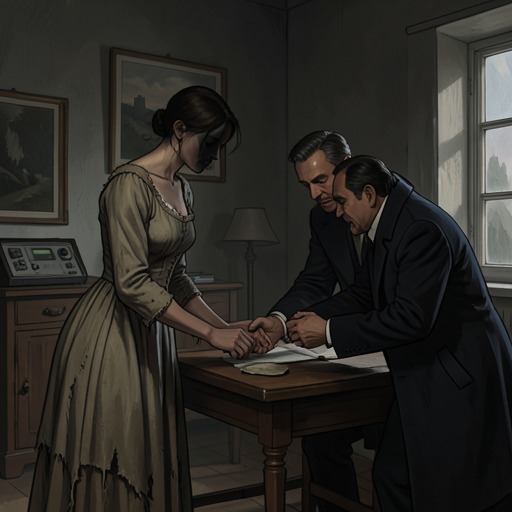
The Grand Inquisitor subsequently enters Cunegonde’s apartment shortly after midnight, on a night that, under the weekly bargain, belongs to him. He finds Candide there with a sword, the dead Don Issachar, Cunegonde, and the Old Woman. Candide reasons that the official may call for help, that Cunegonde may then be punished, and that the Grand Inquisitor was responsible for his whipping; he kills him before he can recover from his surprise. The killing is a sudden reversal: the officeholder who had wielded the threat of punishment becomes the target of Candide’s defensive violence.
The consequences extend beyond the room. Cunegonde fears that they will be excommunicated and that their lives are in danger, while the Old Woman urges an immediate escape to Cadiz. Later, a Grey Friar’s theft of Cunegonde’s jewels exposes the fugitives’ route: the jeweller recognizes the property as belonging to the Grand Inquisitor, and the Friar’s confession allows authorities to trace the fugitives to Cadiz and send a vessel after them. The Grand Inquisitor’s death therefore continues to shape the plot after his own part in it has ended.
Narrative Significance
The Portuguese Inquisition’s episodes test the idea that institutional order guarantees a rational or beneficial world. Its officials and ceremonies organize accusation, confinement, and punishment, yet the supposed earthquake remedy fails immediately, the penalties differ sharply among the accused, and the Grand Inquisitor applies his standing to a personal dispute. Voltaire’s satire does not need to deny that these actions have procedures; it makes their procedures visible and then sets their stated purposes against their consequences. The institution becomes one of the story’s clearest examples of authority offering a formal explanation for suffering while helping to produce further danger.