Society of Jesus
CandideThe Society of Jesus is presented in Candide as both a religious order and a governing power in Paraguay: its Fathers command territory, troops, and access to authority, while their political conduct contradicts the loyalties they profess in Europe. The organization’s reach is made concrete through its armed frontier, its unequal social arrangements, and the career of the Commandant, a German nobleman who becomes a priest and military officer. His fortunes also show how quickly the Order’s institutional power can give way to violence, capture, and forced labor.
Government and Political Position
Cacambo introduces the Society of Jesus as the ruling force in a Paraguayan territory more than three hundred leagues across and divided into thirty provinces. In his account, the Fathers possess everything while the people possess nothing; he calls this arrangement a masterpiece of reason and justice with a marked irony. His description makes the Order not simply a community of clergy but the center of a political system in which religious authority and material control are joined.
That system is also defined by its shifting relationship with European monarchies. Cacambo says the Fathers make war on the kings of Spain and Portugal in Paraguay while confessing those same kings in Europe. The contrast turns the Society’s religious language into a measure of its political adaptability: the Order’s conduct changes with its setting, and the difference is presented as an institutional contradiction rather than a private failing. Cacambo, who says he once served in the College of the Assumption, speaks as someone familiar with its government, though his praise of it is plainly entangled with the contradiction he describes.
The Provincial Frontier and Its Hierarchy
The organization’s authority becomes visible when Candide and Cacambo arrive at its first barrier. Cacambo tells the guards that a captain wishes to speak with the Commandant. The visitors are disarmed, their two Andalusian horses are taken, and they are brought between lines of musketeers. A sergeant explains that no Spaniard may speak or remain in the province for more than three hours without the Father Provincial’s presence. The rule makes entry a matter of controlled access, enforced by armed personnel and administered through a clear hierarchy.
Candide’s German identity changes the outcome. When Cacambo points out that his companion is German rather than Spanish and asks that they be given breakfast while they wait, the Commandant authorizes an audience on that basis. Candide is taken to the Commandant’s arbour, where green-and-gold marble, an aviary of rare birds, and breakfast served in gold vessels mark the officer’s privilege. Outside, Paraguayans eat maize from wooden dishes in the open fields. The contrast gives the Order’s political structure a material form: the commanding clergy enjoy a sheltered, ornate space while ordinary people receive a different and less comfortable provision.
The Commandant’s household is itself protected by armed order. The pair’s weapons and horses are eventually returned, and Cacambo watches the animals while they remain near the arbour, wary of a possible surprise. The scene joins hospitality to surveillance and privilege to military control. Access is granted, but only after the visitors have been disarmed, examined, and sorted according to the province’s political rules.
Recruitment and the Commandant’s Career
The Commandant is Cunegonde’s brother, believed to have been killed during the attack on his family’s home. He explains that he survived because a Jesuit recognized signs of life while the dead were being taken for burial. After recovering, he entered the Order’s life and was later sent to Rome. The Father-General sought young German Jesuits for service in Paraguay, where the rulers admitted as few Spanish Jesuits as possible and preferred members of other nationalities as more subordinate to their commands.
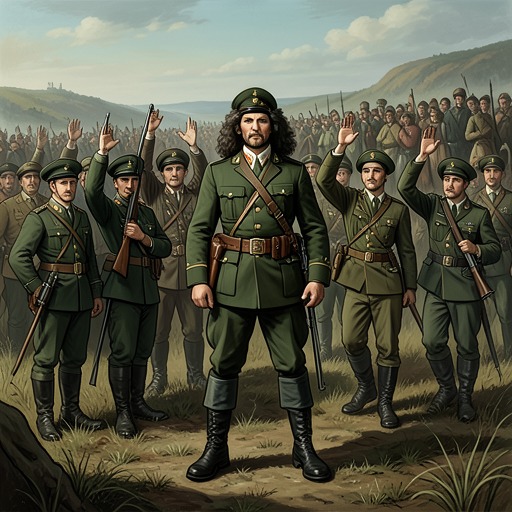
His advancement combines clerical and military rank. Sent to Paraguay with a Pole and a Tyrolese, he received a sub-deaconship and a lieutenancy; by the time Candide meets him, he is both colonel and priest. He expects to resist the Spanish king’s troops and presents the Order as prepared to answer them with military force and excommunication. The pairing of priestly office and command makes the organization’s dual character explicit: its representative speaks as a religious authority while preparing to lead soldiers in a political war.
The reunion also reveals how the Order has remade the family’s surviving son into one of its officers. Candide recognizes the Commandant as the brother thought lost in the massacre and tells him that Cunegonde is alive. The revelation briefly turns the Commandant’s public position into a family encounter, but it does not dissolve the institutional hierarchy or the rigid ideas of rank that shape what follows.
Conflict, Capture, and Return to Servitude
Candide’s claim that he intends to marry Cunegonde brings the Commandant’s aristocratic pride into direct conflict with his companion’s expectations. Candide argues that noble ancestry should not prevent the marriage and invokes Pangloss’s teaching that all men are equal. The Commandant rejects the proposal and strikes Candide; Candide responds by seriously wounding him. The encounter fractures the reunion and forces Candide and Cacambo to flee, wearing the Commandant’s clothes as they escape.
That disguise nearly costs them their lives. The Oreillons mistake Candide for a Jesuit and prepare to treat him as an enemy. Cacambo argues that the apparent uniform is not proof of membership: Candide has killed the Jesuit officer whose clothes he wears. The Oreillons send representatives to verify the claim at the barrier; after confirmation, they release the two travelers and treat them courteously. The episode makes the Order’s uniform a political sign with immediate consequences, while the Commandant’s position as an enemy officer determines how strangers interpret Candide’s identity.
Candide later learns that the Commandant survived. After a surgeon treated his wound, Spanish troops captured him and imprisoned him in Buenos Aires. He sought permission to return to Rome to the General of his Order, but was instead appointed chaplain to the French Ambassador at Constantinople. Within days, an encounter with a young Muslim led to his arrest under a local rule; a cadi sentenced him to the galleys. His account carries the organization’s representative from Paraguayan colonelcy through successive jurisdictions, showing how rapidly rank and religious office can fail to protect him when political and legal authorities change.
The Order’s Reach and the Satire of Authority
The Commandant’s story does not end with the restoration of his former authority. After he is reunited with Candide and the others, he still refuses to permit Candide to marry Cunegonde while he is alive. The group debates what to do with him: Pangloss prepares a legal argument against his control over his sister, Martin favors a harsher solution, and Cacambo proposes returning him to the galley captain, with the intention of sending him back to the General of the Order in Rome. The plan is carried out for money, and the party takes satisfaction in trapping a Jesuit and punishing the pride of a German baron.
The Society of Jesus thus appears through a sequence of institutions rather than through a single settled portrait: a provincial government, a guarded military frontier, a recruitment system favoring non-Spaniards, an officer who is also a priest, and a transnational hierarchy reaching from Paraguay to Rome. Its authority is formidable but conditional. The Commandant can command soldiers and exclude visitors, yet he is wounded by Candide, captured by Spanish troops, sentenced by a cadi, and finally returned to galley service through a transaction arranged by the travelers. In this compressed career, the organization’s claims to religious purpose coexist with territorial control, political war, and personal pride; the reversals expose how little any office guarantees security or moral consistency.