San Antonio
CherrySan Antonio is where the narrator’s Army medical training takes shape in both classroom and hospital, and where the routines of military instruction briefly give way to weekend drinking and homesickness. Fort Sam Houston and Brooke Army Medical Center make the city a threshold between recruit training and the narrator’s eventual assignment to an infantry company: a place where he learns medical procedure by studying death, treating patients, and discovering the weight of getting a basic task wrong.
Fort Sam Houston and Medical Training
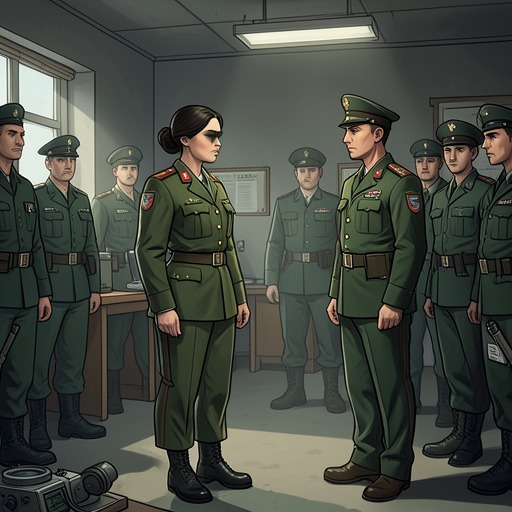
Recruits assigned to the medical services travel by bus to Fort Sam Houston in San Antonio. Their driver, a friendly Vietnam veteran, has a right hand contracted into a red, claw-like shape after exposure to white phosphorus. He encourages the recruits to drink and smoke during the journey. At Fort Sam Houston, newly arrived sergeants shout at them, but the recruits have grown used to the performance. They feign being impressed so the instructors will not notice that they are drunk and smell of cigarettes.
After several days in admissions, the recruits are joined by other groups and organized as Charlie Company. The training is scheduled to last fourteen weeks, with weekend leave expected after an initial period. Its institutional slogan is “Warrior Medic,” a title the recruits consider foolish even as the hierarchy insists on using it. The training begins with classroom instruction and emergency-medical manuals, following earlier recruit exercises that included digging graves, enduring cold in the woods, and being exposed to tear gas.
Instruction also confronts the recruits with graphic examples of death. In sessions called “faces of death,” they watch footage of a man breaking his neck in a car rollover, a motorcyclist disemboweled, and a woman who has been stabbed repeatedly. The lessons make death an explicit subject of training rather than an abstraction, while the recruits’ new title tries to join the roles of caregiver and combatant in a phrase they themselves find absurd.
Weekend Leave and the Artificial River
On a Friday evening, during the first weekend when the narrator has leave for the entire weekend, he walks beside San Antonio’s artificial river with Kovak. The narrator is there the weekend after Emily; he misses her, and the scene’s account of desire is bound up with physical distress rather than relief. The artificial waterway resembles the Pirates of the Caribbean attraction, except that its scenery consists of drunk people and chain restaurants instead of pirates and pirate ships. The contrast gives the leisure district a deliberately unromantic cast: this is a manufactured escape populated by the ordinary excesses of a night out.
Kovak, a twenty-three-year-old from Nevada and the son of a military family, has a history of using speedballs and has since enlisted in the Army. Because he is old enough to buy alcohol legally, he and the narrator begin drinking early in the afternoon. By the evening, the narrator has consumed a bottle of Seagram’s gin and is considering whether he should eat. The weekend’s freedom is therefore uneasy: the city offers a break from training, but the narrator’s longing for Emily and heavy drinking shape how he experiences it.
Brooke Army Medical Center
The recruits’ two-week practicum takes place at Brooke Army Medical Center, the Fort Sam Houston hospital that treats both military personnel and civilians. The narrator describes its floors as exceptionally clean and the hospital as handsome. Five young recruits are assigned to his floor and separated to make their rounds individually. They are expected to behave as though they know what they are doing, although the work immediately tests the gap between that expectation and their limited experience.
One patient has a broken leg from a motorcycle accident. When the narrator tries to take his blood pressure, he puts the cuff on backwards; it inflates like a life raft. The patient responds relatively well, but his wife considers the narrator an idiot. On the next round, the narrator gives a bed bath to a man stabbed in what appears to have been a conflict among homeless people. The patient smells strongly of infection, and the narrator’s care includes lifting and washing him.
A third patient, in his thirties, was struck by a car while crossing a street. The collision tore off his penis and left him with irreversible brain damage. His mother sits at his bedside, and the intensity of her grief affects the narrator profoundly. He is glad by then to understand how the blood-pressure monitor works: after the earlier mistake, the possibility of causing this family still more pain has become concrete. The practicum’s lessons are thus not only technical. Each patient makes the consequences of incompetence visible in a different way, from a humiliating error to the risk of compounding a family’s suffering.
A Training Ground, Not a Destination
San Antonio brings together the Army’s promises of training and service with the imperfect circumstances in which those promises are carried out. The recruits are taught through manuals, lectures, graphic footage, and direct contact with patients; they are also expected to perform confidence before they have mastered the work. The narrator’s hospital rounds turn that performance into a practical and ethical problem: he must learn procedures because other people are vulnerable to his mistakes.
The city is a temporary stage in the narrator’s military trajectory, not his eventual assignment. After Fort Sam Houston, he reaches Fort Hood, where he is initially placed in the medical section of a mixed battalion. Dissatisfied with that section and wanting to be with a company bound for combat, he asks to join one and is assigned to Echo Company. In retrospect, San Antonio’s hospital training stands at the point where medical service and the prospect of infantry life begin to converge.