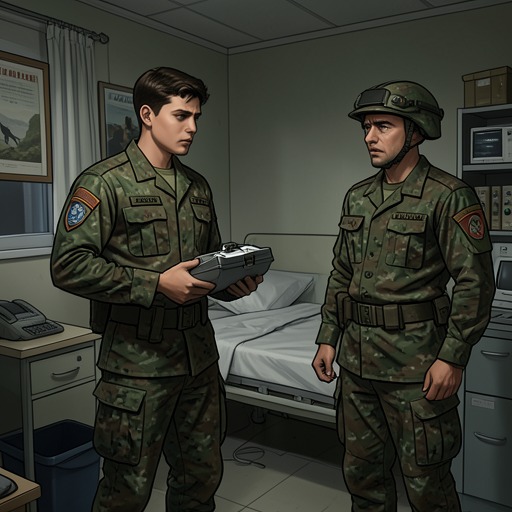
Brooke Army Medical Center
CherryBrooke Army Medical Center serves as both a training ground and a place where the limits of inexperienced care become painfully concrete. During the narrator’s two-week practicum, young Army medical trainees are sent to make rounds among soldiers and civilians; later, after an injury during field exercises, he returns to the same hospital as a patient. The shift makes the hospital a hinge between learning to care for others and discovering his own vulnerability.
Setting and Clinical Training
Located at Fort Sam Houston, Brooke Army Medical Center treats military personnel and civilians. The narrator remembers its clean floors and handsome appearance, a polished setting for a practicum in which five young recruits are separated and assigned individual rounds. They are expected to behave as though they know what they are doing, although the work quickly exposes how little confidence or experience they possess.
On an early round, the narrator attempts to take the blood pressure of a man with a broken leg from a motorcycle accident. He puts the cuff on backward, and it inflates awkwardly when he switches on the machine; the patient takes the mistake in stride, but his wife sees the narrator as an incompetent fool. The episode makes training less an orderly progression from instruction to mastery than an encounter with real patients whose needs exceed a recruit’s confidence.
Patients and the Limits of Training
The rounds brought the recruits into contact with injuries that could not be made abstract by their inexperience. A man stabbed in what the narrator calls a kind of conflict among homeless people smelled intensely infected; the narrator had to wash him in bed, including lifting his testicles to clean him. He frames this humiliating task as a good deed whose value would outlast worldly recognition, but the thought does not make the work less bodily or the patient less vulnerable.
Another patient, a man in his thirties with significant cognitive impairment, had been struck by a car while crossing a street. The collision had torn away his penis and left irreversible brain damage. His mother stayed at his bedside, and the intensity of her grief made it almost unbearable for the narrator to look at her. By then, he was relieved to have learned how to use the blood-pressure machine: he feared that another mistake might add to the family’s suffering. The episode turns a small technical skill into a moral responsibility, because the recruit’s uncertainty now has consequences for people already living with devastating loss.
At the end of a corridor, an isolation room held a young soldier burned in Iraq. No one was allowed inside because the burns left him extremely vulnerable to infection; the staff could only observe him through a porthole. The narrator calls the sight the culmination of a life, collapsing the distance between the patient described as a child and the soldier injured in war. The sealed room makes care visible as both attention and exclusion: the trainees can look, but infection control forbids them to approach.
The narrator finished the practicum without killing anyone and felt, he says, some pride in having managed that much. His darkly limited measure of success captures the distance between being assigned responsibility and feeling competent to bear it. At Brooke Army Medical Center, the novice’s first lessons are not only procedures, but the knowledge that a reversed cuff, a difficult bedside task, or the limits imposed by a sterile barrier occur in the presence of other people’s pain.
The Hospital as a Patient
After finishing the practicum, the narrator returned to Brooke Army Medical Center not as a trainee but as a patient. A military prank had left his testicles painfully swollen; he waited until the swelling was pronounced before reporting it. At the emergency department, an X-ray led a doctor to suspect an inguinal hernia. Surgery seemed unnecessary, as far as the doctor could tell, but the injury remained badly painful. The hospital’s earlier role as a place where he was expected to act competent gave way to the uncertainty of having his own body examined and assessed.
The condition worsened during field exercises. In a mock combat drill, the recruits carried rubber M16s and were supposed to jump from a truck at a ridge; when the narrator landed, he collapsed. At the aid station, medics found internal bleeding and testicles turned royal blue. Staff gathered to inspect and discuss the injury, and the company’s senior warrant officer also came to look before the narrator was taken back to the hospital. The episode echoes the earlier practicum’s exposure of patients to inexperienced observers, but now the narrator occupies the bed and is the body around which medical personnel confer.
At Brooke Army Medical Center, a clinician examined him without warning by inserting a finger into his rectum. Another explained that the bleeding had caused inflammation of the epididymis. Morphine eased the pain, and the narrator remembers the comfortable bed and a delicious vegetarian burger alongside the repeated examinations: a doctor arrived with a group of interns so they could observe and discuss his testicles. He left the hospital the next morning with penicillin, three days of Percocet, and instructions to remain in bed, yet returned to the field. The hospital could diagnose and treat the injury, but it could not keep the demands of training from drawing him back into danger.
From Hospital Training to Field Care
Later, while serving as a medic in the Republic of Iraq, the narrator encountered patients whose needs could not be met by the clean wards and controlled routines of a hospital practicum. On the final day of an operation, he treated an elderly man waiting outside a school that had been turned into a medical center. The man’s wrists bore deep cuts from handcuffs, and one hand was swollen and trembling. The narrator cleaned and dressed the wounds, then sought guidance from two senior sergeants sleeping in a military truck. The chief medic identified the swelling as cellulitis, but the answer to what could be done for the patient was that nothing could be done; the narrator was left without a useful explanation to give him. The scene carries the earlier training’s uncertainty into a setting where the limits are no longer merely a novice’s awkwardness: care is constrained by what the unit can offer.
A later shooting made those limits more intimate and consequential. The narrator was assigned to treat a young man wounded in the abdomen, packing the entry wound with gauze and covering it with plastic while searching unsuccessfully for an exit wound. In retrospect, he recognized that he should have used more gauze and positioned the patient on his wounded side; at the time, he was unsure what to do, and his talk of elevating the man’s feet served partly to fill that uncertainty. With the patient’s veins flattened, he could not establish an IV. A helicopter had been called, but it did not arrive before the wounded man began choking, stopped breathing, and lost his pulse. The narrator and Bautista performed CPR and ventilation, and the man began breathing again. The scene does not establish that the hospital caused or resolved the narrator’s later decisions; instead, it sharpens the contrast between supervised clinical practice and battlefield care, where incomplete knowledge, scarce resources, and immediate responsibility converge.