Fort Sam Houston
CherryFort Sam Houston, in San Antonio, Texas, marks the narrator’s transition from recruit to medical trainee. Its training program gives him practical instruction and hospital experience, but also exposes the distance between being assigned responsibility for care and knowing how to provide it.
Arrival and Medical Training
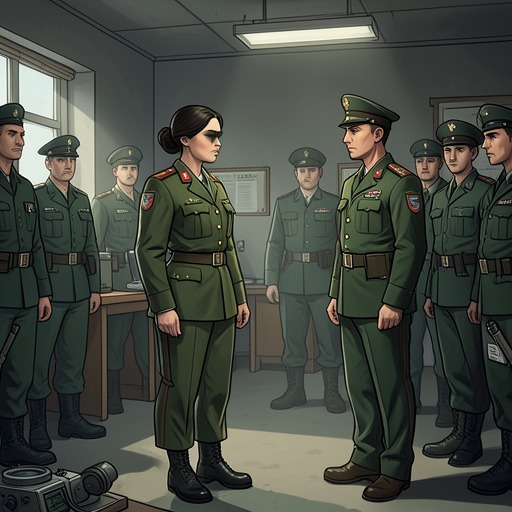
Those recruited for medical services traveled to Fort Sam Houston by bus. Their driver, a Vietnam veteran whose right hand had been badly burned by white phosphorus, encouraged them to drink and smoke during the ride. At Fort Sam, newly arrived recruiting sergeants shouted at the group, but the recruits had grown used to the performance: they pretended to be impressed so the sergeants would not notice that they were drunk on beer and smelled of cigarettes. They spent several days in admissions waiting for other groups to finish their classes. Once everyone had arrived, they were designated Company Charlie and taken to their new barracks. The training battalion’s imposed identity was Warrior Medic, a slogan the recruits thought ridiculous even as the hierarchy expected them to adopt it. The course was to last fourteen weeks, with weekend leave expected later in the program.
Instruction began in classrooms, a welcome change from earlier classes in which the recruits had dug graves, endured the cold in the woods, and been exposed to tear gas. They studied emergency medical manuals and attended lectures, interspersed with graphic films intended to familiarize them with death: a man breaking his neck in a rollover, a motorcyclist disemboweled, and a woman stabbed repeatedly. The contrast between the institutional label Warrior Medic and these unvarnished images made Fort Sam’s training both a professional preparation and an encounter with the violence its trainees would be expected to meet.
Hospital Rotation at Brooke Army Medical Center
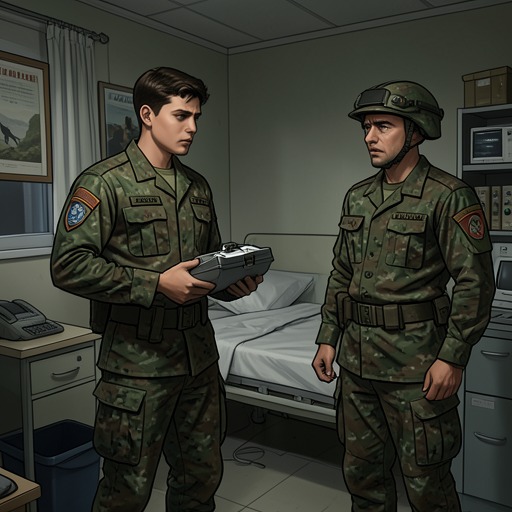
The two-week clinical rotation took place at Brooke Army Medical Center, the hospital at Fort Sam Houston, where civilians and service members received care. Its clean floors and polished appearance contrasted with the graphic death films used in training. Five young recruits were assigned to the narrator’s floor and sent on separate rounds, expected to behave as if they knew what they were doing while learning through contact with actual patients.
One patient had broken his leg in a motorcycle accident. The narrator tried to take his blood pressure but put the cuff on backward; when he switched on the machine, it inflated like a life raft. The patient took the mistake in stride, while his wife regarded the recruit as an idiot. On the same rounds, the narrator washed a man who had been stabbed in what he understood as a dispute among homeless people. The task required intimate bodily care, including lifting the patient’s testicles, and he framed the unpleasant work as a store of spiritual merit that no thief could take away.
Another patient, a man in his thirties with cognitive impairment, had been struck by a car while crossing a street. The collision had torn off his penis and left permanent brain damage. His mother sat beside him in grief so intense that looking at her felt like staring at the sun. By then the narrator had learned to use the blood-pressure monitor; he was relieved not to make another mistake that might add to the family’s suffering. The scene makes clinical competence matter not as abstract proficiency but as a small restraint on the harm a novice might cause.
At the end of a corridor, a porthole offered a view into an isolation room occupied by a young soldier burned in Iraq. Infection risk made entry forbidden, so the recruit could only watch through the window. The rotation thus brought him close to military injury while keeping him physically outside the most vulnerable patient’s room. He finished without killing anyone and believed he had reason to feel proud: at Fort Sam, the medical trainee’s duty was real, but so were the limits of what he knew and was permitted to do.
The Limits of Medical Authority Beyond the Base
The later field episodes test the medical role first learned at Fort Sam Houston under conditions the hospital rotation could not reproduce. On the final day of Operation Radiant Honor, the narrator treated an older Iraqi man whose wrists bore deep marks he attributed to handcuffs. He cleaned the wounds with saline and applied Bacitracin and gauze, but a swollen, violently trembling hand left him unsure what was wrong. He woke two senior medical personnel accompanying the clinic; the chief medic identified cellulitis, then said there was nothing to be done and advised him to tell the patient to go die. The exchange places the trainee’s uncertainty beside a harsher limit: even when he recognizes a possible danger and seeks guidance, the authority above him may offer no care to pass on.
In another combat episode, the narrator had to treat a wounded man while gunfire and evacuation demands shaped the scene. He packed gauze into the apparent entry wound and taped a plastic dressing over it, but found no exit wound and later judged that he should have used more gauze and positioned the man on his injured side. A helicopter had been called, with the injury identified as requiring emergency surgery, but it did not arrive before the wounded man began choking on vomit, lost consciousness, and stopped breathing. The narrator used a ventilation bag while another soldier performed chest compressions; the man soon regained consciousness and breathed on his own. The episode gives the hospital trainee’s earlier errors a sharper consequence: in the field, uncertainty is not merely embarrassing, and the narrator’s retrospective account distinguishes what he did from what he believes he should have done.
From Medical Training to Combat Assignment
The Fort Sam Houston training course did not leave the narrator in a hospital role. Afterward, the 4th Infantry Division assigned him to a mixed battalion at Fort Hood, where its medical section initially placed him in the command-and-logistics company. He disliked the section’s older personnel and unfamiliar jargon, and asked instead to join a company expected to enter combat. The request transferred him to Echo Company and into the infantry.
That onward movement defines Fort Sam Houston’s place in his military trajectory: it supplied medical instruction, but not a sheltered professional destination. The narrator had learned the work through classroom lessons and hospital rounds; his next assignment would require him to carry that role into a combat unit.