Fort Leonard Wood
CherryFort Leonard Wood, Missouri, is where the narrator’s entry into the Army takes physical and institutional form. Its recruit-training world is marked by compulsory haircuts, injections, issued equipment, shouted instruction, and the discipline of learning to function among strangers; the graduation ceremony offers a brief family interlude, but not an escape from the system that has reshaped the recruits.
Setting and Arrival
The narrator’s account places Fort Leonard Wood at the start of his basic training. Before arriving, he had pursued enlistment as a 91W medical specialist and learned during testing that color blindness would not disqualify him from that role. His parents regarded his Army plans as foolish, while he rejected the prospect of settling into their newly purchased house. The training post thus follows a deliberate break with civilian life, though the account does not specify the date of his arrival there.
At Fort Leonard Wood, the transition begins with a haircut imposed by civilian barbers. The workers use vacuum clippers that suck the scalp toward the blades, and the narrator describes recruits being cut and mocked when they complain. The haircut is not simply a change of appearance: it is a humiliating, physical introduction to a process in which recruits have little control over their bodies or how they are treated.
Processing and the Recruit Camp
After the haircuts, the recruits receive numerous injections and collect Army clothing, boots, helmets, and other equipment. They carry their papers from place to place for signatures, a procedural rhythm that makes incorporation into the Army tangible. The remaining instruction takes place in an auditorium, where they learn basic marching commands and the Army song. Even meals become part of the collective performance: the recruits act as though the food is terrible, although the narrator says it is not especially bad.
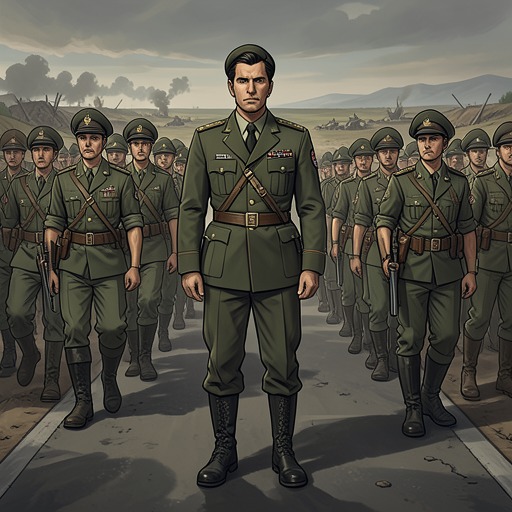
The recruits are initially divided into two groups, B1 and B2, whose hostility toward one another lasts three days. Random assignment to three platoons in Alpha Company dissolves those divisions; with everyone’s head shaved, it is difficult to recognize who had belonged to which group. They are loaded into cattle trucks and driven up a slope to the recruit-training camp, where the shouting and abuse intensify. The account presents the movement from temporary group identities to a shared company as both administrative sorting and forced collective life.
Training, Discipline, and Contradictions
The training culture relies on aggressive insults and theatrical threats. Drill sergeants claim they might lose control and break a recruit’s neck, invoking post-traumatic stress as part of the performance of danger. The narrator contrasts that act with an actual incident in which a sergeant chokes a recruit unconscious, while emphasizing that the sergeant had never served in combat. The post’s authority is therefore depicted as something performed through intimidation, yet capable of becoming physical violence.
Stories about Iraq add another layer to the recruits’ preparation. Recruiters who had served there tell them that children may approach American soldiers with grenades and that soldiers may have to kill them first. One truck driver claims to have run over children with his vehicle and presents this as the reason he is mentally unstable. The narrator calls the recruiters liars, making the training environment a place where frightening claims about war circulate alongside the institution’s own staged threats.
The narrator generally keeps to himself, but cannot avoid being drawn into the regimen. When he asks to exchange a Country Captain Chicken combat ration for a vegetarian meal, instructor Cordero erupts at him for refusing meat. In another lesson, recruits practice unarmed fighting and chokeholds in pairs. Matched with Kovak, the narrator chokes him, then feels guilty and lets Kovak choke him in the next round; the exercise leaves him troubled by having harmed his training partner. The training’s physical skills and its demands for obedience are thus accompanied by moments of personal discomfort that the institutional routine does not resolve.
Graduation and Significance
The narrator’s parents travel to Fort Leonard Wood for the formal ceremony. Recruits march across an auditorium stage and perform cadences; after a Toby Keith song, they are released for the day until 9 p.m. His parents take him to a Chili’s, where he orders a vegetarian burger, and his mother remarks that it must be the first one he has eaten in some time. The small meal preserves a trace of his civilian preferences within a day organized by Army ceremony and schedule.
Fort Leonard Wood is consequently more than a backdrop for enlistment. In the narrator’s account, it is the setting where bureaucratic processing, bodily discipline, group formation, violence, and military storytelling converge. The graduation ceremony marks completion of this stage, while the harsh and often contradictory practices that precede it show the costs of the transformation the ceremony celebrates.