Byron's Search for the Woman from Marco Polo's Past
ChowringheeByron’s search for a woman from Marco Polo’s past succeeds only when the narrator recognizes her in the worn rooms of his former workplace: Elizabeth, remembered by the women there under that name, is Lisa, the singer Susan Munro had replaced. The discovery turns a faltering private investigation into a route back to Marco Polo, joining the narrator’s obscure earlier life on Chhatawala Lane to the crisis unfolding at the Hotel Shahjahan.
A Search with Little Hope
Byron presents himself as a detective in name more than in practice. People come to him after other avenues have failed, hoping he can solve what remains; the police regard him with either suspicion or pity and offer no help. He admits that he had little confidence that he could do anything for Marco Polo. This qualification makes the eventual success less a triumph of professional method than the convergence of a source’s clue with the narrator’s personal knowledge.
One of Byron’s sources had led him to a woman who had once sung in a restaurant. The trail pointed to a dark, unhealthy corner of Chhatawala Lane. On the previous night, Byron and Marco Polo had gone there together, hoping to see her. A guest was in the woman’s room, however, and they waited outside for what felt like an age, expecting the guest to leave. He did not, and the search stalled at the threshold.
When Byron recounts the address, the narrator recognizes it as the building that also housed Magpil & Clerk, the company where he had worked before joining the hotel. The same location therefore carries two kinds of history: to Byron, it is a lead in Marco Polo’s case; to the narrator, it is a former workplace and a community whose residents he knew at close quarters. His recognition gives the investigation a human connection that Byron’s source alone could not supply.
The Narrator’s Former Workplace
The narrator had known the women in the building as colleagues in the practical business of making and selling wastepaper baskets. They counted the baskets and tied them into bundles; in the afternoons they painted them on low benches, wearing worn blouses and sandals, then set them in the sun to dry. Rain meant bringing the baskets in. Their work earned them a few coins, and they had also helped Mr. M. G. Pillai through difficult periods. The narrator remembers that they treated him kindly too, even offering water when he was thirsty.
That remembered familiarity makes the narrator useful to Byron in a way the detective himself is not. Byron asks whether he knows any of the women and urges him to make inquiries, confident they will recognize him. He wants to go at once, but the narrator knows the timing matters: before eleven, the women would still be asleep, since for them even ten o’clock could feel like midnight. When the two return later that day, the women gather around the narrator enthusiastically. His clean clothes make plain that his life has changed since he worked there, while the old connection remains strong enough for them to receive him warmly.
The women’s circumstances also expose the bodily cost of earning a living. One explains that they depend on their bodies just as the narrator depends on his health, and that both kinds of livelihood require keeping in good condition. Their work and their precariousness are not abstract background to the search: they shape who is present, when the narrator can reach them, and what shared memories can unlock the clue.
From Elizabeth to Lisa
The narrator first asks whether anyone knows Susan Munro, recalling that she used to sing on Park Street. The women reject the suggestion that a singer from Park Street would have ended up in their building. The mismatch between the name and the place nearly conceals the answer. A reminder about Elizabeth changes the direction of the conversation: she had once kept count of the baskets, and the other women used her towel to dry them when afternoon rain made them wet. The narrator suddenly remembers her and asks where she is.
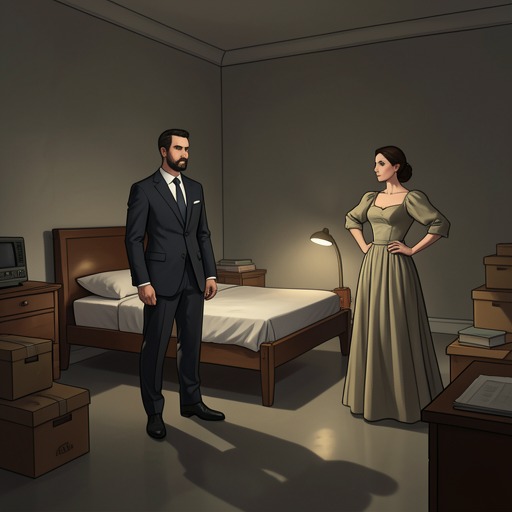
Elizabeth is ill and in bed, behind a closed door. The women point the narrator toward her room; he knocks, enters at her invitation, and finds it dirty and greatly changed from how it had been. Though weak, she recognizes him immediately and tries to sit up, then gestures for him to take a stool. Her familiarity with him confirms that this is not a stranger found by chance but someone from the shared workday he has just recalled.
She explains that she cannot walk. A fall broke her leg long ago, but she could not afford a doctor; the bone worsened, and she is now living with the consequences. She cannot stand and must hold the wall to reach the bathroom, sometimes unable even to manage that. Barbara and Pamela have obtained a bedpan for her. These details make the passage from the remembered basket worker to the bedridden woman painfully concrete: the search uncovers not merely a name but the material decline that has overtaken someone once embedded in the narrator’s working life.
Then the narrator understands that Elizabeth is Lisa, the singer Susan had replaced. He had known her fairly well when he worked at Magpil, without realizing that she was the woman whose past had disturbed Marco Polo’s life. Lisa begins humming a refrain that once moved Calcutta’s pleasure-seekers. The old performance survives in the room, but now her damaged leg prevents her from standing; the contrast links her former public identity as a singer to her present dependence and isolation.
The Clue Returns to the Hotel
The narrator considers telling Lisa everything he knows and asking whether she remembers the night at the Shahjahan with a foreigner called Marco Polo, but holds back. He leaves although he wants to stay and examine the rediscovered chapter of his own life more closely. Byron is waiting alone in the street, and the investigation’s immediate purpose draws the narrator away from Lisa’s room before he can test what she remembers.
Byron greets the discovery as a stroke of providence. The narrator’s work at the Shahjahan and his earlier employment on Chhatawala Lane have brought him, by an unlikely route, to the woman Byron had been seeking. Byron rushes them into a taxi and insists on going directly to the Hotel Shahjahan. There he practically forces open the manager’s office door and soon emerges dragging Marco Polo with him. The search ends not with a narrated conversation between Marco Polo and Lisa, but with Byron recovering Marco from the hotel and the two men leaving together.
At the reception desk, William Ghosh is covering his shift and appears to be having a difficult spell. The narrator offers to help if William has a problem. The brief exchange returns the scene from Byron’s dramatic breakthrough to the hotel’s ordinary working life, where other people’s troubles continue at the counter. The episode’s decisive discovery has depended on precisely such overlooked connections: the narrator’s former coworkers, the baskets and towel that revive a memory, and an address shared by a failed company and a hidden past.